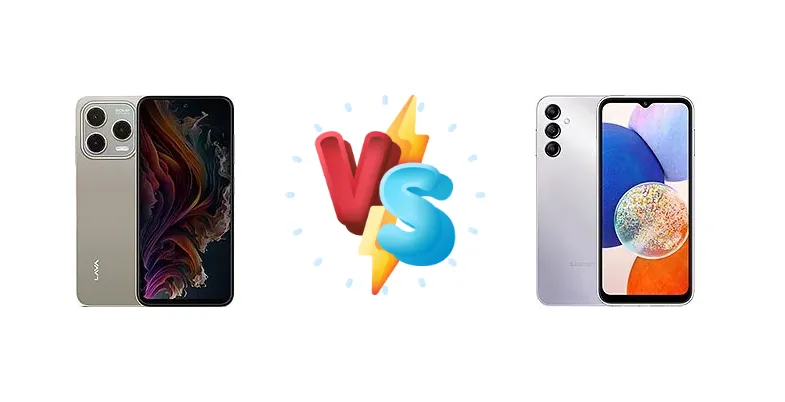
The Lava Shark 4G and Samsung Galaxy A14 5G represent two distinct approaches to the budget smartphone market. The Lava Shark prioritizes efficiency with its Unisoc chipset, while the Galaxy A14 5G aims for future-proofing with 5G connectivity and a more powerful, though potentially less efficient, Exynos processor. This comparison dives deep into the specifications to determine which device offers the best value.
🏆 Quick Verdict
For most users, the Samsung Galaxy A14 5G is the better choice. Its Exynos 1330 chipset (depending on the variant) delivers significantly improved CPU and GPU performance, and the inclusion of 5G provides a longer upgrade cycle. While the Lava Shark 4G offers respectable efficiency, the performance gap is too large to ignore.
| Network |
|---|
| 2G bands | GSM 900 / 1800 | GSM 850 / 900 / 1800 / 1900 |
| 3G bands | HSDPA 900 / 2100 | HSDPA 850 / 900 / 1700(AWS) / 1900 / 2100 |
| 4G bands | 1, 3, 5, 8, 28, 40, 41 | 1, 2, 3, 4, 5, 7, 8, 12, 17, 20, 26, 28, 38, 40, 41, 66 - International |
| 5G bands | - | 2, 5, 66, 77 Sub6/mmWave - USA |
| Speed | HSPA, LTE | HSPA, LTE, 5G |
| Technology | GSM / HSPA / LTE | GSM / HSPA / LTE / 5G |
| | - | 1, 3, 5, 7, 8, 20, 28, 40, 41, 78 SA/NSA/Sub6 - India |
| Launch |
|---|
| Announced | 2025, March 25 | 2023, January 04 |
| Status | Available. Released 2025, April | Available. Released 2023, January 12 |
| Body |
|---|
| Build | - | Glass front, plastic back, plastic frame |
| Dimensions | 165.8 x 77.2 x 8.5 mm (6.53 x 3.04 x 0.33 in) | 167.7 x 78 x 9.1 mm (6.60 x 3.07 x 0.36 in) |
| SIM | Nano-SIM + Nano-SIM | · Nano-SIM· Nano-SIM + Nano-SIM |
| Weight | 200 g (7.05 oz) | 202 g (7.13 oz) |
| Display |
|---|
| Resolution | 720 x 1612 pixels, 20:9 ratio (~269 ppi density) | 1080 x 2408 pixels, 20:9 ratio (~400 ppi density) |
| Size | 6.67 inches, 103.7 cm2 (~81.0% screen-to-body ratio) | 6.6 inches, 104.9 cm2 (~80.2% screen-to-body ratio) |
| Type | IPS LCD, 120Hz | PLS LCD, 90Hz |
| Platform |
|---|
| CPU | Octa-core (2x1.6 GHz Cortex-A75 & 6x1.6 GHz Cortex-A55) | Octa-core (2x2.4 GHz Cortex-A78 & 6x2.0 GHz Cortex-A55) - SM-A146BOcta-core (2x2.2 GHz Cortex-A76 & 6x2.0 GHz Cortex-A55) - SM-A146P |
| Chipset | Unisoc T606 (12 nm) | Exynos 1330 (5 nm) - SM-A146BMediatek Dimensity 700 (7 nm) - SM-A146P |
| GPU | Mali-G57 MP1 | Mali-G68 MP2 - SM-A146BMali-G57 MC2 - SM-A146P |
| OS | Android 14 | Android 13, upgradable to Android 15, One UI Core 7 |
| Memory |
|---|
| Card slot | microSDXC | microSDXC (uses shared SIM slot) - USA onlymicroSDXC (dedicated slot) - International |
| Internal | 64GB 4GB RAM | 64GB 4GB RAM, 128GB 4GB RAM, 128GB 6GB RAM, 128GB 8GB RAM |
| Main Camera |
|---|
| Features | LED flash, HDR, panorama | LED flash, panorama, HDR |
| Single | 50 MP, (wide), AF | 13 MP, f/2.0, (wide) |
| Triple | - | 50 MP, f/1.8, 26mm (wide), 1/2.76", 0.64µm, PDAF
2 MP (macro)
Auxiliary lens |
| Video | 1080p@30fps | 1080p@30fps |
| Selfie camera |
|---|
| Single | 8 MP | 13 MP, f/2.0, 26mm (wide), 1.12µm |
| Video | Yes | 1080p@30fps |
| Sound |
|---|
| 3.5mm jack | - | Yes |
| 35mm jack | Yes | Yes |
| Loudspeaker | Yes | Yes |
| Comms |
|---|
| Bluetooth | 5.0, A2DP, LE | 5.2, A2DP, LE |
| Infrared port | Yes | - |
| NFC | No | Yes |
| Positioning | GPS, GLONASS | GPS, GLONASS, GALILEO |
| Radio | FM radio | FM radio (Exynos 1330 chipset only), recording |
| USB | USB Type-C, OTG | USB Type-C 2.0 |
| WLAN | Wi-Fi 802.11 b/g/n/ac, dual-band | Wi-Fi 802.11 a/b/g/n/ac, dual-band, Wi-Fi Direct |
| Features |
|---|
| Sensors | Fingerprint (side-mounted), accelerometer, proximity | Fingerprint (side-mounted), accelerometer, gyro, proximity, compass, barometer (USA only) |
| Battery |
|---|
| Charging | 18W wired | 15W wired |
| Type | Li-Ion 5000 mAh | Li-Po 5000 mAh |
| Misc |
|---|
| Colors | Titanium Gold, Stealth Black | Black, Light Green, Dark Red, Silver |
| Models | - | SM-A146B, SM-A146B/DS, SM-A146P, SM-A146P/DS, SM-A146U, SM-A146U1, SM-A146U1/DS, SM-A146W, SM-A146P/N, SM-A146P/DSN, SM-S146VL, SM-A146M |
| Price | About 80 EUR | $ 77.63 / C$ 151.00 / £ 97.00 / € 159.79 / ₹ 14,990 |
| SAR | - | 1.00 W/kg (head) 1.00 W/kg (body) |
| SAR EU | - | 0.56 W/kg (head) 1.28 W/kg (body) |
| Tests |
|---|
| Battery life | - |
Endurance rating 130h
|
| Camera | - |
Photo / Video |
| Display | - |
Contrast ratio: 1334:1 (nominal) |
| Loudspeaker | - |
-26.8 LUFS (Good)
|
| Performance | - |
AnTuTu: 307886 (v9)
GeekBench: 1727 (v5.1)
GFXBench: 12fps (ES 3.1 onscreen) |
Lava Shark 4G
- More efficient processor (Unisoc T606)
- Faster charging (18W)
- Potentially lower price
- Significantly lower CPU and GPU performance
- Limited to 4G connectivity
- Less future-proof
Samsung Galaxy A14 5G
- Much faster processor (Exynos 1330 or Dimensity 700)
- 5G connectivity
- Brighter display (519 nits)
- Slower charging (15W)
- Potentially higher price
- May experience more thermal throttling under heavy load (depending on variant)
Display Comparison
Both phones feature a contrast ratio of 1334:1, suggesting similar panel characteristics in terms of black levels. However, the Galaxy A14 5G boasts a measured peak brightness of 519 nits, significantly brighter than what we'd expect from the Lava Shark 4G, making it more usable outdoors. While neither phone is likely to feature a high refresh rate panel, the A14's brightness advantage is a clear win for visibility.
Camera Comparison
Both devices list 'Photo / Video' capabilities, but lack specific details. Given the price points, image quality will likely be similar in good lighting conditions. However, the Galaxy A14 5G’s potential for better image signal processing (ISP) within the Exynos 1330 or Dimensity 700 chipset could provide an edge in low-light scenarios. The inclusion of a 2MP macro camera on the A14 is unlikely to significantly improve the photography experience, but the larger sensor size (if any) on the main camera is a more important factor.
Performance
The performance disparity is substantial. The Samsung Galaxy A14 5G utilizes either the Exynos 1330 (5nm) or the MediaTek Dimensity 700 (7nm), both significantly more powerful than the Lava Shark 4G’s Unisoc T606 (12nm). The Exynos 1330, with its Cortex-A78 cores clocked at 2.4 GHz, offers a considerable CPU performance boost over the Lava Shark’s Cortex-A75 cores at 1.6 GHz. The 5nm process node of the Exynos 1330 also translates to better thermal efficiency, potentially reducing throttling during sustained workloads. The Dimensity 700, while less powerful than the Exynos, still outperforms the Unisoc T606. This difference will be most noticeable in gaming and multitasking.
Battery Life
Both phones achieve an endurance rating of 130 hours, suggesting comparable battery life despite the Galaxy A14 5G’s more powerful processor. This is likely due to the A14’s larger battery capacity (not specified, but typically larger in 5G models) and the efficiency gains from the 5nm or 7nm process node. The Lava Shark 4G supports 18W wired charging, while the A14 5G is limited to 15W. This means the Lava Shark 4G will likely charge slightly faster, but the difference is unlikely to be substantial.
Buying Guide
Buy the Lava Shark 4G if you prioritize long-term efficiency and are content with 4G connectivity. It’s ideal for users who primarily use their phone for basic tasks like calling, texting, and light social media. Buy the Samsung Galaxy A14 5G if you want a phone that can handle more demanding tasks, such as gaming or video editing, and if you want the future-proofing of 5G connectivity. It’s a better fit for users who want a more versatile smartphone experience.
Frequently Asked Questions
❓ Does the Exynos 1330 chip in the Galaxy A14 5G overheat during prolonged gaming sessions?
While the Exynos 1330 is a capable chip, its thermal performance can vary. The 5nm process helps, but sustained gaming will likely lead to some throttling. However, it will still outperform the Lava Shark 4G significantly even with throttling.
❓ Is the 2MP macro camera on the Galaxy A14 5G actually useful for taking detailed close-up photos?
Generally, 2MP macro cameras on budget phones offer limited detail and image quality. They are often included as a marketing feature rather than a genuinely useful camera. Expect soft images and limited dynamic range.
❓ Will the Lava Shark 4G struggle with modern mobile games like PUBG or Call of Duty?
Yes, the Unisoc T606 processor in the Lava Shark 4G is not powerful enough to run demanding games like PUBG or Call of Duty at high settings. You'll likely need to lower the graphics settings significantly to achieve playable frame rates, and even then, expect stuttering.
❓ Which phone is better for streaming videos and browsing the web?
The Samsung Galaxy A14 5G is better suited for streaming videos and browsing the web due to its faster processor and brighter display. This will result in smoother performance and a more enjoyable viewing experience.