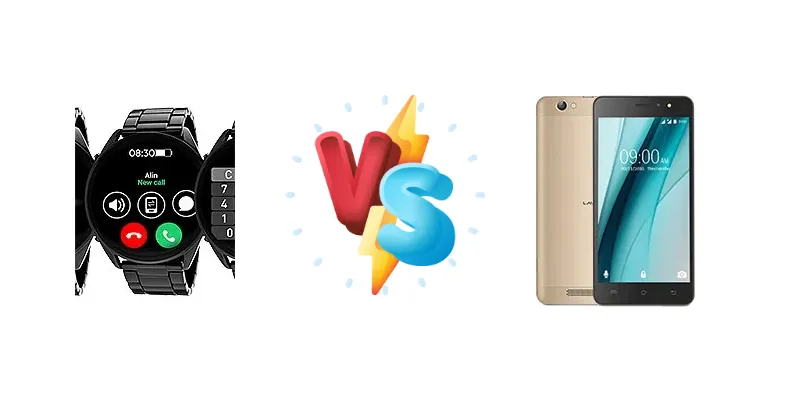
Lava's product lineup presents a curious comparison with the Prowatch ZN and X28 Plus. One is a dedicated wearable focused on activity tracking and notifications, while the other is a fully-fledged, albeit entry-level, smartphone. This isn't an apples-to-apples comparison, but understanding their distinct roles is crucial for potential buyers.
🏆 Quick Verdict
For the average user seeking a smartphone, the Lava X28 Plus is the clear choice due to its processing capabilities. However, if you're specifically looking for a budget-friendly smartwatch for basic fitness tracking and notifications, the Prowatch ZN fills that niche, despite lacking detailed specifications.
| Network |
|---|
| 2G bands | N/A | GSM 900 / 1800 - SIM 1 & SIM 2 |
| 3G bands | N/A | HSDPA 900 / 2100 |
| 4G bands | N/A | 3, 5, 40 |
| EDGE | No | - |
| GPRS | No | - |
| Speed | - | HSPA, LTE |
| Technology | No cellular connectivity | GSM / HSPA / LTE |
| Launch |
|---|
| Announced | 2024, April 23 | 2017, February. Released 2017, February |
| Status | Available. Released 2024, April 26 | Discontinued |
| Body |
|---|
| Build | Glass front (Gorilla Glass 3), zinc alloy frame | - |
| Dimensions | - | 155 x 78 x 9 mm (6.10 x 3.07 x 0.35 in) |
| SIM | No | Dual SIM |
| Weight | - | 175 g (6.17 oz) |
| Display |
|---|
| Protection | Corning Gorilla Glass 3 | - |
| Resolution | 466 x 466 pixels (~326 ppi density) | 720 x 1280 pixels, 16:9 ratio (~267 ppi density) |
| Size | 1.43 inches | 5.5 inches, 83.4 cm2 (~69.0% screen-to-body ratio) |
| Type | AMOLED, 600 nits | IPS LCD |
| Platform |
|---|
| CPU | - | Quad-core 1.3 GHz |
| OS | Proprietary OS | Android 6.0 (Marshmallow) |
| Memory |
|---|
| Card slot | No | microSDHC |
| Internal | Unspecified | 8GB 1GB RAM |
| Main Camera |
|---|
| Features | - | LED flash, panorama |
| Single | - | 8 MP, AF |
| Video | - | 1080p@30fps |
| Selfie camera |
|---|
| Features | - | LED flash |
| Single | - | 5 MP |
| Sound |
|---|
| 3.5mm jack | - | Yes |
| 35mm jack | No | Yes |
| Loudspeaker | Yes | Yes |
| Comms |
|---|
| Bluetooth | 5.2, A2DP, LE | 4.0, A2DP |
| NFC | No | No |
| Positioning | No | GPS |
| Radio | No | FM radio |
| USB | No | microUSB 2.0 |
| WLAN | No | Wi-Fi 802.11 b/g/n |
| Features |
|---|
| Sensors | Accelerometer, heart rate, SpO2 | Accelerometer, proximity |
| Battery |
|---|
| Type | Li-Ion 350 mAh | Li-Ion 2600 mAh, removable |
| Misc |
|---|
| Colors | Black, Tarnish | Black/Gold |
| Price | About 50 EUR | - |
Lava Prowatch ZN
- Dedicated wearable form factor
- Focus on activity tracking
- Potential for long battery life (smartwatch optimized)
- Limited functionality compared to a smartphone
- Lack of detailed specifications
- No app ecosystem
Lava X28 Plus
- Quad-core 1.3 GHz processor enables app usage
- Smartphone functionality (calls, texts, web browsing)
- Camera for image capture
- Lower processing power compared to flagship smartphones
- Unknown display quality
- Battery life dependent on usage
Display Comparison
The Lava Prowatch ZN, being a smartwatch, will feature a smaller display optimized for glanceable information, likely utilizing a TFT LCD or similar technology. Given the lack of specifications, we can assume it prioritizes power efficiency over resolution. The Lava X28 Plus, as a smartphone, will have a larger display, though its panel type and resolution are unknown. The X28 Plus's display is geared towards media consumption and app usage, while the Prowatch ZN's is for quick data presentation.
Camera Comparison
The Lava X28 Plus, being a smartphone, will include a camera system, though the sensor details are unavailable. It's reasonable to expect a primary camera for basic photography. The Prowatch ZN, as a smartwatch, does not have a camera. The X28 Plus offers image capture capabilities, while the Prowatch ZN focuses on health and activity monitoring.
Performance
The Lava X28 Plus boasts a Quad-core 1.3 GHz CPU, providing a baseline level of processing power for everyday tasks like calling, texting, and light app usage. The Prowatch ZN's processor is not specified, but it will be significantly less powerful, designed solely for handling sensor data and displaying notifications. The X28 Plus's CPU allows for multitasking, while the Prowatch ZN is limited to its core functions. The X28 Plus's chipset will likely be paired with a modest amount of RAM, sufficient for its intended use case.
Battery Life
The Lava Prowatch ZN will have a smaller battery capacity optimized for all-day wear, likely charged via a proprietary cable. The Lava X28 Plus will have a larger battery capacity to support its smartphone functions, and charging wattage is unknown. The X28 Plus's battery life will depend on usage patterns, while the Prowatch ZN's is geared towards lasting a full day with typical smartwatch use.
Buying Guide
Buy the Lava Prowatch ZN if you need a dedicated wearable device for basic activity tracking, notifications, and timekeeping, and prioritize a form factor designed for wrist-worn use. Buy the Lava X28 Plus if you prefer a traditional smartphone experience with the ability to run apps, browse the web, and make calls, and require a device with processing power for these tasks.
Frequently Asked Questions
❓ What kind of health tracking features does the Lava Prowatch ZN offer?
While specific details are unavailable, the Prowatch ZN, as a smartwatch, likely tracks steps, distance, calories burned, and potentially heart rate. It's designed for basic fitness monitoring and providing activity insights.
❓ Can the Lava X28 Plus handle popular social media apps like Facebook and Instagram?
The Lava X28 Plus's Quad-core 1.3 GHz processor should be capable of running lighter versions of social media apps, but performance may be limited. Expect slower loading times and potential lag compared to higher-end smartphones.
❓ Is the Lava X28 Plus a dual-SIM phone?
This information is not available in the provided context. However, many entry-level smartphones in this price range do offer dual-SIM support, so it's a possibility worth investigating before purchase.