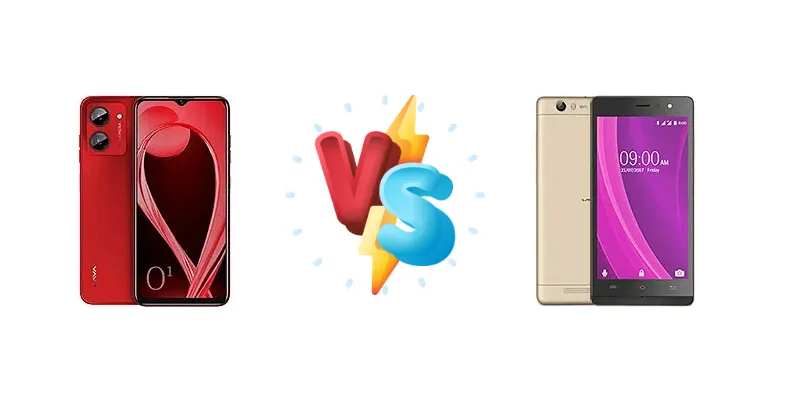
Lava is targeting the entry-level smartphone market with the O1 and A97 2GB+. While both aim to provide affordable connectivity, they differ significantly in their internal hardware. This comparison dissects those differences, focusing on how the chipset choices impact real-world performance and user experience, particularly for those seeking a first smartphone or a reliable secondary device.
🏆 Quick Verdict
For most users, the Lava O1 is the superior choice. Its Unisoc T606 chipset offers a substantial performance advantage over the A97 2GB+'s Spreadtrum SC9832, enabling smoother multitasking and a more responsive user interface. While both phones are budget-focused, the O1 provides a better long-term experience.
| Network |
|---|
| 2G bands | GSM 900 / 1800 | GSM 900 / 1800 - SIM 1 & SIM 2 |
| 3G bands | HSDPA 900 / 2100 | HSDPA 900 / 2100 |
| 4G bands | 1, 3, 5, 8, 40, 41 | 3, 5, 40 |
| Speed | HSPA, LTE | HSPA 42.2/11.5 Mbps, LTE Cat4 150/50 Mbps |
| Technology | GSM / HSPA / LTE | GSM / HSPA / LTE |
| Launch |
|---|
| Announced | 2023, July 04 | 2017, June. Released 2017, June |
| Status | Available. Released 2023, July 07 | Discontinued |
| Body |
|---|
| Build | Glass front, plastic frame, plastic back | - |
| Dimensions | 163.7 x 75.3 x 9.3 mm (6.44 x 2.96 x 0.37 in) | 145 x 72 x 9.2 mm (5.71 x 2.83 x 0.36 in) |
| SIM | Nano-SIM + Nano-SIM | Dual SIM (Micro-SIM, dual stand-by) |
| Weight | 199.5 g (7.05 oz) | 160 g (5.64 oz) |
| Display |
|---|
| Resolution | 720 x 1600 pixels, 20:9 ratio (~267 ppi density) | 480 x 854 pixels, 16:9 ratio (~196 ppi density) |
| Size | 6.56 inches, 103.9 cm2 (~84.3% screen-to-body ratio) | 5.0 inches, 68.9 cm2 (~66.0% screen-to-body ratio) |
| Type | IPS LCD, 90Hz | IPS LCD |
| Platform |
|---|
| CPU | Octa-core (2x1.6 GHz Cortex-A75 & 6x1.6 GHz Cortex-A55) | Quad-core 1.3 GHz |
| Chipset | Unisoc T606 (12 nm) | Spreadtrum SC9832 |
| GPU | Mali-G57 MP1 | Mali-400 |
| OS | Android 13 | Android 7.0 (Nougat) |
| Memory |
|---|
| Card slot | microSDXC (uses shared SIM slot) | microSDHC |
| Internal | 64GB 4GB RAM | 16GB 2GB RAM |
| Main Camera |
|---|
| Features | LED flash, HDR, panorama | LED flash, HDR, panorama |
| Single | 13 MP | 8 MP, AF |
| Video | Yes | 720p@30fps |
| Selfie camera |
|---|
| Features | - | LED flash |
| Single | 5 MP | 5 MP |
| Video | Yes | - |
| Sound |
|---|
| 35mm jack | Yes | Yes |
| Loudspeaker | Yes | Yes |
| Comms |
|---|
| Bluetooth | 5.0, A2DP, LE | 4.0, A2DP |
| NFC | No | No |
| Positioning | GPS, GLONASS | GPS |
| Radio | FM radio | Stereo FM radio with RDS; recording |
| USB | USB Type-C 2.0, OTG | microUSB 2.0 |
| WLAN | Wi-Fi 802.11 b/g/n/ac | Wi-Fi 802.11 b/g/n |
| Features |
|---|
| Sensors | Fingerprint (side-mounted), accelerometer, proximity | Accelerometer, proximity |
| Battery |
|---|
| Charging | 18W wired | - |
| Type | Li-Po 5000 mAh | Li-Ion 2350 mAh, removable |
| Misc |
|---|
| Colors | Prism Blue, Lively Lavender, Luxe Red | Gold, Silver, Blue |
| Price | - | About 7700 INR |
Lava O1
- Significantly faster processor for smoother performance
- 18W fast charging for quicker top-ups
- More capable GPU for light gaming and video playback
- Likely higher price point than the A97 2GB+
- May still lack advanced features found in higher-end phones
Lava A97 2GB+
- Extremely affordable price point
- Functional for basic communication tasks
- Simple and easy-to-use interface
- Slow processor struggles with multitasking
- Limited performance for modern apps and games
- Likely slower charging speeds
Display Comparison
Neither Lava provides detailed display specifications. However, given the price points, both likely utilize LCD panels. The key difference lies in the processing power available to drive the display. The O1’s Unisoc T606 has a more powerful GPU, potentially leading to smoother animations and faster app loading times on the display, even if the panel itself is similar. Bezels are expected to be substantial on both devices, reflecting their budget nature.
Camera Comparison
Both phones likely feature basic camera setups. Without detailed sensor information, it’s difficult to make precise comparisons. However, the O1’s more powerful ISP (Image Signal Processor) within the Unisoc T606 chipset will likely result in better image processing, even with similar sensors. Expect limited low-light performance on both devices. Any 2MP macro or depth sensors present on either phone should be considered marketing features rather than significant photographic assets.
Performance
The performance gap is the most significant differentiator. The Lava O1’s Unisoc T606 is an octa-core processor featuring two Cortex-A75 cores clocked at 1.6 GHz and six Cortex-A55 cores, also at 1.6 GHz. This architecture provides a substantial boost over the Lava A97 2GB+'s quad-core Spreadtrum SC9832 clocked at 1.3 GHz. The Cortex-A75 cores in the O1 offer significantly higher single-core performance, crucial for responsive app launches and general UI fluidity. The A97 2GB+ will struggle with multitasking and demanding applications. The O1’s GPU will also handle graphics-intensive tasks far more effectively.
Battery Life
Battery capacity isn't specified for either device. However, the Lava O1’s 18W wired charging is a clear advantage over the A97 2GB+, which likely supports slower charging speeds. The more efficient Unisoc T606 chipset in the O1 may also contribute to slightly better battery life, even with a similar capacity battery, due to reduced power consumption during typical usage. The 18W charging will significantly reduce downtime for the O1.
Buying Guide
Buy the Lava O1 if you need a phone capable of handling more than basic tasks like calls and messaging. It's suitable for light social media use, web browsing, and occasional gaming. Buy the Lava A97 2GB+ if your primary needs are extremely basic – voice calls, SMS, and perhaps WhatsApp – and you prioritize absolute affordability above all else. It's a functional device for those with minimal smartphone requirements.
Frequently Asked Questions
❓ Will the Lava A97 2GB+ struggle with popular apps like Facebook or WhatsApp?
Yes, the Spreadtrum SC9832 processor in the A97 2GB+ is quite limited. While it can run these apps, you may experience significant lag, slow loading times, and occasional crashes, especially with multiple apps open simultaneously. The 2GB of RAM further exacerbates this issue.
❓ Is the Lava O1 a good choice for playing mobile games?
The Lava O1 is suitable for *light* gaming. The Unisoc T606 chipset and its GPU can handle less demanding titles at lower settings. However, don't expect to play graphically intensive games like PUBG Mobile or Genshin Impact smoothly. Frame rates will likely be low, and you may need to reduce graphics settings significantly.
❓ How much faster is the Lava O1 compared to the A97 2GB+ in everyday tasks?
The Lava O1 is noticeably faster in almost all everyday tasks. App launch times will be quicker, multitasking will be smoother, and the overall user interface will feel more responsive. The difference is primarily due to the O1’s octa-core processor and more modern CPU architecture.
❓ Does the Lava O1 support software updates?
Lava's update track record is limited. While the O1 launched with Android Go Edition, long-term software support is uncertain. Expect limited security patches and potentially no major Android version upgrades. This is a common limitation in the ultra-budget segment.