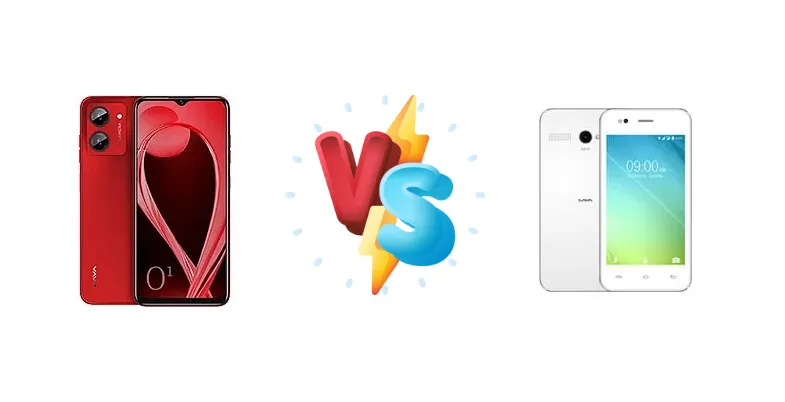
Lava is targeting the entry-level smartphone market with the O1 and A50. While both aim to provide affordable connectivity, they diverge significantly in their internal hardware. This comparison dissects the core differences, focusing on the impact of the O1’s Unisoc T606 chipset versus the A50’s quad-core processor, to determine which device offers the best user experience.
🏆 Quick Verdict
For most users, the Lava O1 is the superior choice. Its Unisoc T606 chipset, featuring an octa-core CPU, provides a substantial performance advantage over the A50’s quad-core processor, making it better suited for multitasking and demanding applications. The 18W charging is also a welcome addition.
| Network |
|---|
| 2G bands | GSM 900 / 1800 | GSM 900 / 1800 - SIM 1 & SIM 2 |
| 3G bands | HSDPA 900 / 2100 | HSDPA 900 / 2100 |
| 4G bands | 1, 3, 5, 8, 40, 41 | - |
| Speed | HSPA, LTE | HSPA |
| Technology | GSM / HSPA / LTE | GSM / HSPA |
| Launch |
|---|
| Announced | 2023, July 04 | 2016, November. Released 2016, November |
| Status | Available. Released 2023, July 07 | Discontinued |
| Body |
|---|
| Build | Glass front, plastic frame, plastic back | - |
| Dimensions | 163.7 x 75.3 x 9.3 mm (6.44 x 2.96 x 0.37 in) | 123 x 63.4 x 9.7 mm (4.84 x 2.50 x 0.38 in) |
| SIM | Nano-SIM + Nano-SIM | Dual SIM |
| Weight | 199.5 g (7.05 oz) | - |
| Display |
|---|
| Resolution | 720 x 1600 pixels, 20:9 ratio (~267 ppi density) | 480 x 800 pixels, 5:3 ratio (~233 ppi density) |
| Size | 6.56 inches, 103.9 cm2 (~84.3% screen-to-body ratio) | 4.0 inches, 45.5 cm2 (~58.4% screen-to-body ratio) |
| Type | IPS LCD, 90Hz | TFT |
| Platform |
|---|
| CPU | Octa-core (2x1.6 GHz Cortex-A75 & 6x1.6 GHz Cortex-A55) | Quad-core 1.2 GHz |
| Chipset | Unisoc T606 (12 nm) | - |
| GPU | Mali-G57 MP1 | - |
| OS | Android 13 | Android 6.0 (Marshmallow) |
| Memory |
|---|
| Card slot | microSDXC (uses shared SIM slot) | microSDHC |
| Internal | 64GB 4GB RAM | 8GB 512MB RAM |
| Main Camera |
|---|
| Features | LED flash, HDR, panorama | LED flash, panorama |
| Single | 13 MP | 5 MP |
| Video | Yes | Yes |
| Selfie camera |
|---|
| Single | 5 MP | VGA |
| Video | Yes | - |
| Sound |
|---|
| 3.5mm jack | - | Yes |
| 35mm jack | Yes | Yes |
| Loudspeaker | Yes | Yes |
| Comms |
|---|
| Bluetooth | 5.0, A2DP, LE | 2.1, EDR |
| NFC | No | No |
| Positioning | GPS, GLONASS | GPS |
| Radio | FM radio | FM radio |
| USB | USB Type-C 2.0, OTG | microUSB 2.0 |
| WLAN | Wi-Fi 802.11 b/g/n/ac | Wi-Fi 802.11 b/g/n |
| Features |
|---|
| Sensors | Fingerprint (side-mounted), accelerometer, proximity | Accelerometer |
| Battery |
|---|
| Charging | 18W wired | - |
| Stand-by | - | Up to 388 h |
| Talk time | - | Up to 9 h |
| Type | Li-Po 5000 mAh | Li-Ion 1550 mAh, removable |
| Misc |
|---|
| Colors | Prism Blue, Lively Lavender, Luxe Red | Black + Silver |
Lava O1
- Significantly faster processor with octa-core architecture
- 18W fast charging support
- More efficient chipset potentially leading to better battery life
- Display specifications are unknown
- Camera details are unavailable
Lava A50
- Likely the more affordable option
- Sufficient for basic smartphone tasks
- Simple and straightforward user experience
- Quad-core processor will struggle with multitasking
- Slow application launch times
- Charging speed is unknown and likely slow
Display Comparison
Display specifications are not provided for either device. However, given their price points, it's reasonable to assume both utilize LCD panels with 720p+ resolutions. The absence of details like refresh rate or peak brightness suggests neither phone will excel in display quality. The user experience will likely be similar in terms of visual fidelity, but the O1’s processing power could contribute to smoother animations.
Camera Comparison
Camera details are absent for both devices. Given the market segment, we can expect basic camera setups. The absence of information prevents a meaningful comparison. It’s likely both phones feature a primary camera and potentially a secondary depth or macro sensor, but image quality will heavily depend on software processing and sensor size – details currently unavailable.
Performance
The core difference lies in the chipset. The Lava O1’s Unisoc T606 (12nm) is an octa-core processor with a heterogeneous architecture – 2x 1.6 GHz Cortex-A75 cores for performance and 6x 1.6 GHz Cortex-A55 cores for efficiency. This contrasts sharply with the Lava A50’s quad-core 1.2 GHz processor. The T606’s architecture allows for significantly better multitasking and application launch speeds. The A75 cores provide a noticeable boost in single-core performance, crucial for responsive UI interactions. The 12nm process node of the T606, while not cutting-edge, is more efficient than what is typically found in similarly priced quad-core processors, potentially leading to better battery life under load.
Battery Life
The Lava O1 features 18W wired charging, a significant advantage over the A50, where charging speed is unspecified. While battery capacity isn’t mentioned for either device, the more efficient Unisoc T606 in the O1 could translate to comparable or even better battery life despite potentially having a similar capacity to the A50. The 18W charging will also reduce the time needed to replenish the battery, offering a more convenient user experience.
Buying Guide
Buy the Lava O1 if you prioritize responsiveness and the ability to run multiple apps simultaneously, or if you occasionally engage in light gaming. The O1’s more powerful processor will provide a smoother, more enjoyable experience. Buy the Lava A50 if your smartphone usage is limited to basic tasks like calls, texts, and light social media browsing, and you are seeking the absolute lowest possible price point.
Frequently Asked Questions
❓ Will the Lava O1 be able to handle popular games like PUBG Mobile?
While the Unisoc T606 isn't a gaming powerhouse, it should be capable of running PUBG Mobile at lower settings. Expect frame rate drops during intense action, but it will provide a playable experience, unlike the Lava A50 which will likely struggle significantly.
❓ Is the Lava O1 a good choice for someone who uses a lot of apps simultaneously?
Yes, the Lava O1’s octa-core processor and likely sufficient RAM (spec not provided, but typical for this segment) will handle multitasking much better than the Lava A50. You’ll experience fewer app reloads and a smoother overall experience when switching between applications.
❓ How long will it take to fully charge the Lava O1 with the 18W charger?
Without knowing the battery capacity, it’s difficult to provide an exact time. However, 18W charging should fully charge the device in approximately 2-3 hours, depending on the battery size. This is considerably faster than the charging speed of the Lava A50.