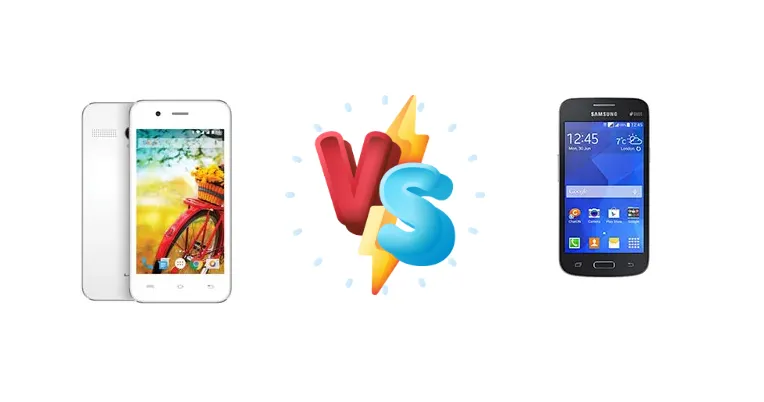
The Lava Iris Atom and Samsung Galaxy Star 2 Plus represent the extreme end of the smartphone market, catering to users prioritizing affordability above all else. Both devices aim to provide essential smartphone functionality without breaking the bank, but they achieve this with different hardware approaches. This comparison dissects their specifications to determine which offers the better value proposition for first-time smartphone buyers or those seeking a reliable secondary device.
🏆 Quick Verdict
For the average user seeking a slightly more responsive experience, the Lava Iris Atom emerges as the better choice. Its quad-core 1.3 GHz processor offers a modest performance advantage over the Samsung Galaxy Star 2 Plus’s 1.2 GHz Cortex-A7, making everyday tasks feel a bit smoother. However, both phones are limited by their entry-level specifications.
| Network |
|---|
| 2G bands | GSM 900 / 1800 - SIM 1 & SIM 2 | GSM 850 / 900 / 1800 / 1900 - SIM 1 & SIM 2 (dual-SIM model only) |
| 3G bands | HSDPA 2100 | - |
| EDGE | - | Yes |
| GPRS | - | Yes |
| Speed | HSPA | - |
| Technology | GSM / HSPA | GSM |
| Launch |
|---|
| Announced | 2015, December. Released 2015, December | 2014, July. Released 2014, August |
| Status | Discontinued | Discontinued |
| Body |
|---|
| Dimensions | 125.5 x 63.2 x 9.7 mm (4.94 x 2.49 x 0.38 in) | 129.7 x 65.9 x 9.4 mm (5.11 x 2.59 x 0.37 in) |
| SIM | Dual SIM | Single SIM (Micro-SIM) or Dual SIM (Micro-SIM, dual stand-by) |
| Weight | 110 g (3.88 oz) | 129 g (4.55 oz) |
| Display |
|---|
| Resolution | 480 x 800 pixels, 5:3 ratio (~233 ppi density) | 480 x 800 pixels, 5:3 ratio (~217 ppi density) |
| Size | 4.0 inches, 45.5 cm2 (~57.4% screen-to-body ratio) | 4.3 inches, 52.6 cm2 (~61.6% screen-to-body ratio) |
| Type | TFT, 256K colors | TFT |
| Platform |
|---|
| CPU | Quad-core 1.3 GHz | 1.2 GHz Cortex-A7 |
| OS | Android 5.1 (Lollipop) | Android 4.4.2 (KitKat) |
| Memory |
|---|
| Card slot | microSDHC | microSDHC (dedicated slot) |
| Internal | 8GB 512MB RAM | 4GB 512MB RAM |
| Main Camera |
|---|
| Features | LED flash, HDR, panorama | LED flash |
| Single | 5 MP | 3.15 MP |
| Video | Yes | 320p |
| Selfie camera |
|---|
| Single | VGA | - |
| | - | No |
| Sound |
|---|
| 3.5mm jack | Yes | Yes |
| 35mm jack | Yes | Yes |
| Loudspeaker | Yes | Yes |
| Comms |
|---|
| Bluetooth | 2.1, EDR | 4.0, A2DP |
| NFC | No | No |
| Positioning | GPS | No |
| Radio | FM radio | FM radio |
| USB | microUSB 2.0 | microUSB 2.0 |
| WLAN | Wi-Fi 802.11 b/g/n | Wi-Fi 802.11 b/g/n, Wi-Fi Direct, hotspot |
| Features |
|---|
| Sensors | Accelerometer | Accelerometer |
| Battery |
|---|
| Music play | - | Up to 32 h |
| Stand-by | Up to 150 h (3G) | - |
| Talk time | Up to 12 h 30 min (3G) | Up to 17 h |
| Type | Li-Ion 1550 mAh, removable | Li-Ion 1800 mAh, removable |
| Misc |
|---|
| Colors | Black, White | Black, White |
| Models | - | SM-G350E, SM-G350 |
| Price | - | About 90 EUR |
| SAR | - | 0.75 W/kg (head) 1.12 W/kg (body) |
| SAR EU | - | 0.48 W/kg (head) 0.49 W/kg (body) |
Lava Iris Atom
- Potentially faster processor for smoother multitasking.
- Quad-core CPU offers more headroom for basic apps.
- Likely the more affordable option.
- Brand recognition is lower than Samsung.
- Limited software support and updates expected.
Samsung Galaxy Star 2 Plus
- Established brand reputation for reliability.
- Potentially more refined software experience.
- Wider availability of accessories.
- Slower processor compared to the Lava Iris Atom.
- Older Cortex-A7 architecture limits performance.
- May be slightly more expensive.
Display Comparison
Neither Lava nor Samsung provide display specifications beyond the device dimensions. Given the price point, both likely utilize TN panels with limited viewing angles and color accuracy. The absence of detailed display information suggests neither phone is geared towards media consumption. Expect basic readability under normal lighting conditions, but poor performance outdoors. The resolution is likely 480x800, standard for this segment.
Camera Comparison
Camera details are sparse for both devices. It’s safe to assume both feature basic rear cameras with resolutions around 3-5 megapixels, and potentially a front-facing camera for video calls. Image quality will be limited, especially in low-light conditions. Expect significant noise and a lack of detail. The absence of features like autofocus or image stabilization further diminishes their photographic capabilities. Any marketing around camera quality should be viewed with skepticism.
Performance
The core difference lies in the CPU. The Lava Iris Atom’s quad-core 1.3 GHz processor, while not specifying the architecture, generally offers more raw processing power than the Samsung Galaxy Star 2 Plus’s single-core 1.2 GHz Cortex-A7. The Cortex-A7 is an older architecture, designed for efficiency rather than speed. This translates to potentially faster app loading times and smoother multitasking on the Lava Iris Atom. However, both phones will struggle with demanding applications or graphically intensive games. RAM specifications are unknown, but likely limited to 512MB or 1GB, further restricting performance.
Battery Life
Battery capacity is not specified for either device. Given their low-power processors and basic displays, both phones should offer at least a full day of standby time and several hours of talk time. Charging times will likely be slow, as neither phone is expected to support fast charging technologies. The smaller processor clock speed of the Samsung may offer slightly better battery life, but the difference will be minimal.
Buying Guide
Buy the Lava Iris Atom if you need a phone that can handle basic multitasking and app usage with a slightly faster processor. It’s ideal for users who occasionally browse the web, use social media, or make calls. Buy the Samsung Galaxy Star 2 Plus if you prioritize brand recognition and a potentially more refined software experience, even if it means sacrificing a small amount of processing power. It’s a good option for those who primarily need a phone for calls and texts.
Frequently Asked Questions
❓ Will the Lava Iris Atom struggle with WhatsApp and Facebook?
While the Lava Iris Atom’s quad-core processor is an improvement over the Samsung, running multiple instances of WhatsApp and Facebook simultaneously may still lead to slowdowns. Closing unused apps will help maintain performance. Expect a basic, functional experience, but not a fluid one.
❓ Is the Samsung Galaxy Star 2 Plus a good choice for elderly users?
The Samsung Galaxy Star 2 Plus’s simplicity and established brand reputation could make it a suitable choice for elderly users who primarily need a phone for calls and texts. However, the small screen size and limited features may present challenges for some.
❓ Can either of these phones play PUBG Mobile?
No. Neither the Lava Iris Atom nor the Samsung Galaxy Star 2 Plus have the processing power or RAM to run PUBG Mobile, even at the lowest settings. Attempting to do so will result in extremely poor performance and a frustrating experience.