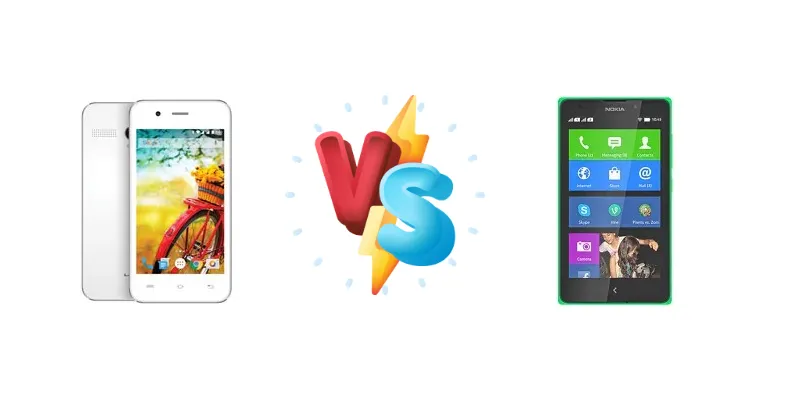
The Lava Iris Atom and Nokia XL represent distinct approaches to the ultra-budget smartphone market. The Atom prioritizes a more modern processor configuration, while the Nokia XL focuses on maximizing battery endurance. This comparison dissects their key differences to determine which device delivers the best value for users prioritizing performance versus longevity.
🏆 Quick Verdict
For the average user seeking the longest possible battery life, the Nokia XL is the clear winner, boasting a 62-hour endurance rating. However, users who prioritize responsiveness and multitasking will find the Lava Iris Atom’s quad-core processor a more appealing choice, despite the trade-off in battery performance.
| Network |
|---|
| 2G bands | GSM 900 / 1800 - SIM 1 & SIM 2 | GSM 850 / 900 / 1800 / 1900 - SIM 1 & SIM 2 (dual-SIM model only) |
| 3G bands | HSDPA 2100 | HSDPA 900 / 2100 |
| Speed | HSPA | HSPA 7.2/5.76 Mbps |
| Technology | GSM / HSPA | GSM / HSPA |
| | - | GSM 850 / 900 / 1800 / 1900 |
| Launch |
|---|
| Announced | 2015, December. Released 2015, December | 2014, February. Released 2014, May |
| Status | Discontinued | Discontinued |
| Body |
|---|
| Dimensions | 125.5 x 63.2 x 9.7 mm (4.94 x 2.49 x 0.38 in) | 141.4 x 77.7 x 10.9 mm, 109 cc (5.57 x 3.06 x 0.43 in) |
| SIM | Dual SIM | Single SIM (Micro-SIM) or Dual SIM (Micro-SIM, dual stand-by) |
| Weight | 110 g (3.88 oz) | 190 g (6.70 oz) |
| Display |
|---|
| Resolution | 480 x 800 pixels, 5:3 ratio (~233 ppi density) | 480 x 800 pixels, 5:3 ratio (~187 ppi density) |
| Size | 4.0 inches, 45.5 cm2 (~57.4% screen-to-body ratio) | 5.0 inches, 71.2 cm2 (~64.8% screen-to-body ratio) |
| Type | TFT, 256K colors | IPS LCD |
| Platform |
|---|
| CPU | Quad-core 1.3 GHz | Dual-core 1.0 GHz Cortex-A5 |
| Chipset | - | Qualcomm MSM8225 Snapdragon S4 Play |
| GPU | - | Adreno 203 |
| OS | Android 5.1 (Lollipop) | Android 4.1.2 (Jelly Bean), X platform 1 |
| Memory |
|---|
| Card slot | microSDHC | microSDHC (dedicated slot) |
| Internal | 8GB 512MB RAM | 4GB 768MB RAM |
| Main Camera |
|---|
| Features | LED flash, HDR, panorama | LED flash, panorama |
| Single | 5 MP | 5 MP, f/2.8, 32mm (standard), 1/4.0", AF |
| Video | Yes | 480p@30fps |
| Selfie camera |
|---|
| Single | VGA | 2 MP |
| Sound |
|---|
| 3.5mm jack | Yes | Yes |
| 35mm jack | Yes | Yes |
| Loudspeaker | Yes | Yes |
| Comms |
|---|
| Bluetooth | 2.1, EDR | 3.0, A2DP |
| NFC | No | No |
| Positioning | GPS | GPS |
| Radio | FM radio | Stereo FM radio |
| USB | microUSB 2.0 | microUSB 2.0 |
| WLAN | Wi-Fi 802.11 b/g/n | Wi-Fi 802.11 b/g/n, hotspot |
| Features |
|---|
| Sensors | Accelerometer | Accelerometer, proximity |
| Battery |
|---|
| Music play | - | Up to 37 h |
| Stand-by | Up to 150 h (3G) | Up to 720 h |
| Talk time | Up to 12 h 30 min (3G) | Up to 16 h (2G) / Up to 13 h (3G) |
| Type | Li-Ion 1550 mAh, removable | Li-Ion 2000 mAh, removable (BN-02) |
| Misc |
|---|
| Colors | Black, White | Bright green, orange, cyan, yellow, black, white |
| Price | - | About 100 EUR |
| SAR | - | 0.89 W/kg (head) 1.07 W/kg (body) |
| SAR EU | - | 0.67 W/kg (head) |
| Tests |
|---|
| Battery life | - |
Endurance rating 62h
|
| Camera | - |
Photo |
| Display | - |
Contrast ratio: 874:1 (nominal), 1.204 (sunlight) |
| Loudspeaker | - |
Voice 66dB / Noise 65dB / Ring 76dB
|
Lava Iris Atom
- Faster quad-core processor for smoother multitasking.
- Potentially more responsive user experience.
- Likely benefits from a more modern chipset architecture.
- Battery life likely shorter than the Nokia XL.
- Camera specifications are unknown and potentially basic.
Nokia XL
- Exceptional 62-hour battery endurance.
- Good display contrast ratio for outdoor visibility.
- Qualcomm Snapdragon S4 Play chipset offers a stable platform.
- Dual-core processor may struggle with demanding tasks.
- Camera specifications are unknown and potentially basic.
Display Comparison
Both the Lava Iris Atom and Nokia XL share the same contrast ratio of 874:1 (nominal) and 1.204 (sunlight). This suggests similar outdoor visibility under direct sunlight. However, the context data lacks information regarding screen size, resolution, or panel technology (IPS, TFT). Given the price point, it's likely both utilize TFT panels. Without further data, it's difficult to assess which display offers superior color accuracy or viewing angles.
Camera Comparison
Both devices are listed as having a 'Photo' camera, which is insufficient detail for a meaningful comparison. Without knowing megapixel counts, sensor sizes, or aperture values, it’s impossible to determine which camera performs better. It’s reasonable to assume both cameras are basic and suited for casual snapshots, but the Atom’s potentially more modern image signal processor (ISP) within its newer chipset *could* offer slightly improved image quality. However, this is speculative without further data.
Performance
The core difference lies in the CPU. The Lava Iris Atom features a quad-core 1.3 GHz processor, while the Nokia XL is equipped with a dual-core 1.0 GHz Cortex-A5 processor based on the Qualcomm MSM8225 Snapdragon S4 Play chipset. While clock speed isn't everything, the Atom’s quad-core architecture should provide a noticeable advantage in multitasking and handling more demanding applications. The Snapdragon S4 Play, while a capable chip for its time, is significantly older and less efficient than modern quad-core designs. The Atom will likely exhibit faster app loading times and smoother performance in resource-intensive tasks.
Battery Life
The Nokia XL definitively wins in battery endurance, boasting a 62-hour rating. This suggests optimized power management and a larger battery capacity (though the actual mAh is not specified). The Lava Iris Atom’s battery capacity is unknown, but its more powerful processor will likely consume more energy, resulting in a shorter battery life. The XL is the clear choice for users who prioritize minimizing charging frequency.
Buying Guide
Buy the Lava Iris Atom if you need a phone for basic tasks, social media, and light gaming, and are willing to charge it more frequently. Its quad-core processor offers a smoother experience for everyday use. Buy the Nokia XL if you prioritize extended battery life above all else, and your usage primarily consists of calls, texts, and occasional web browsing. The XL is ideal for travelers or those with limited access to charging.
Frequently Asked Questions
❓ Is the Qualcomm Snapdragon S4 Play in the Nokia XL still capable of running modern apps?
While the Snapdragon S4 Play was a decent processor in its time, it's now several generations old. It can run basic Android apps and handle tasks like calls, texts, and web browsing, but it may struggle with more demanding applications or multitasking. Expect slower loading times and occasional lag.
❓ How much faster is the Lava Iris Atom's quad-core processor compared to the Nokia XL's dual-core processor?
The Lava Iris Atom’s quad-core processor should offer a noticeable performance improvement over the Nokia XL’s dual-core processor, particularly in multitasking and app loading times. While the clock speed difference isn't massive (1.3 GHz vs 1.0 GHz), the additional cores allow the Atom to handle more tasks simultaneously without significant slowdown.
❓ What type of charging port do these phones use?
The context data does not specify the charging port type. However, given the age and price point of these devices, it's highly probable they both utilize a Micro-USB port. Expect slower charging speeds compared to modern USB-C devices.