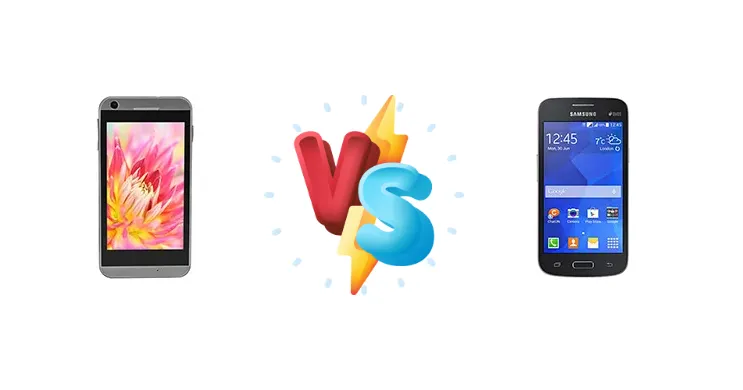
The Lava Iris 405+ and Samsung Galaxy Star 2 Plus represent the extreme end of the smartphone spectrum – devices designed for first-time smartphone users or those needing a reliable secondary device. Both aim to deliver essential functionality at an incredibly low price point, but their approaches to achieving this differ, primarily in their processor choices. This comparison dissects those differences to determine which phone offers the best value.
🏆 Quick Verdict
For the average user prioritizing a slightly smoother experience, the Samsung Galaxy Star 2 Plus edges out the Lava Iris 405+. While the Lava boasts a marginally higher clock speed, the Cortex-A7 architecture in the Samsung provides a more efficient and generally responsive user experience, making it the better choice for everyday tasks.
| Network |
|---|
| 2G bands | GSM 900 / 1800 - SIM 1 & SIM 2 | GSM 850 / 900 / 1800 / 1900 - SIM 1 & SIM 2 (dual-SIM model only) |
| 3G bands | HSDPA 2100 | - |
| EDGE | - | Yes |
| GPRS | - | Yes |
| Speed | HSPA 21.1/5.76 Mbps | - |
| Technology | GSM / HSPA | GSM |
| Launch |
|---|
| Announced | 2013, December. Released 2013, December | 2014, July. Released 2014, August |
| Status | Discontinued | Discontinued |
| Body |
|---|
| Dimensions | 125 x 64 x 9 mm (4.92 x 2.52 x 0.35 in) | 129.7 x 65.9 x 9.4 mm (5.11 x 2.59 x 0.37 in) |
| SIM | Dual SIM | Single SIM (Micro-SIM) or Dual SIM (Micro-SIM, dual stand-by) |
| Weight | 127 g (4.48 oz) | 129 g (4.55 oz) |
| Display |
|---|
| Resolution | 480 x 800 pixels, 5:3 ratio (~233 ppi density) | 480 x 800 pixels, 5:3 ratio (~217 ppi density) |
| Size | 4.0 inches, 45.5 cm2 (~56.9% screen-to-body ratio) | 4.3 inches, 52.6 cm2 (~61.6% screen-to-body ratio) |
| Type | TFT | TFT |
| Platform |
|---|
| CPU | Dual-core 1.3 GHz | 1.2 GHz Cortex-A7 |
| GPU | Mali-400 | - |
| OS | Android 4.2 (Jelly Bean) | Android 4.4.2 (KitKat) |
| Memory |
|---|
| Card slot | microSDHC | microSDHC (dedicated slot) |
| Internal | 4GB 512MB RAM | 4GB 512MB RAM |
| Main Camera |
|---|
| Features | LED flash | LED flash |
| Single | 5 MP | 3.15 MP |
| Video | Yes | 320p |
| Selfie camera |
|---|
| Single | VGA | - |
| | - | No |
| Sound |
|---|
| 3.5mm jack | - | Yes |
| 35mm jack | Yes | Yes |
| Loudspeaker | Yes | Yes |
| Comms |
|---|
| Bluetooth | Yes | 4.0, A2DP |
| NFC | No | No |
| Positioning | A-GPS only | No |
| Radio | FM radio, recording | FM radio |
| USB | microUSB 2.0 | microUSB 2.0 |
| WLAN | Wi-Fi 802.11 b/g/n | Wi-Fi 802.11 b/g/n, Wi-Fi Direct, hotspot |
| Features |
|---|
| Sensors | Accelerometer, proximity | Accelerometer |
| Battery |
|---|
| Music play | - | Up to 32 h |
| Stand-by | Up to 200 h | - |
| Talk time | Up to 6 h 30 min | Up to 17 h |
| Type | Li-Po 1400 mAh, removable | Li-Ion 1800 mAh, removable |
| Misc |
|---|
| Colors | Black, White | Black, White |
| Models | - | SM-G350E, SM-G350 |
| Price | About 70 EUR | About 90 EUR |
| SAR | - | 0.75 W/kg (head) 1.12 W/kg (body) |
| SAR EU | - | 0.48 W/kg (head) 0.49 W/kg (body) |
Lava Iris 405+
- Slightly higher CPU clock speed (potentially faster app loading in very basic scenarios)
- May be available at a lower price point in certain markets
- Simple and straightforward Android experience
- Less efficient processor architecture (Cortex-A7 is superior)
- Potentially less responsive user interface
- Likely similar or worse camera performance compared to the Samsung
Samsung Galaxy Star 2 Plus
- More efficient Cortex-A7 processor architecture
- Smoother user experience for everyday tasks
- Proven processor design for reliable performance
- Slightly lower CPU clock speed
- May be slightly more expensive than the Lava Iris 405+
- Similar limitations in camera quality
Display Comparison
Neither device is expected to feature a high-quality display. Given their price point, both likely utilize TN panels with limited viewing angles and color accuracy. Specifics like resolution and screen size are unavailable, but both are likely around 4-5 inches and a resolution of 480x800. The focus here isn't on visual fidelity, but on basic readability.
Camera Comparison
Camera performance on both devices will be extremely limited. Expect low-resolution sensors (likely 2MP or 3MP) with poor image quality, especially in low-light conditions. Details regarding sensor size and aperture are unavailable, but it's safe to assume they are small and lack advanced features like optical image stabilization (OIS). Any 'macro' mode will be largely ineffective due to the low sensor resolution. These cameras are suitable for basic snapshots in good lighting, but not much else.
Performance
The core difference lies in the CPUs. The Lava Iris 405+ features a dual-core 1.3 GHz processor, while the Samsung Galaxy Star 2 Plus utilizes a 1.2 GHz Cortex-A7. While the Lava has a higher clock speed, the Cortex-A7 architecture is significantly more efficient and offers better Instructions Per Clock (IPC). This means the Samsung's processor can accomplish more with each clock cycle, resulting in a smoother user experience, especially when multitasking or running even moderately demanding apps. The Cortex-A7 is a proven architecture, widely used in entry-level smartphones for its balance of performance and power efficiency. RAM capacity is also likely similar (around 512MB-1GB), further leveling the playing field, but the processor architecture will be the deciding factor.
Battery Life
Battery capacity is likely similar, around 1500-1600 mAh. Given the low-power processors and basic displays, both phones should be able to last a full day on a single charge with moderate use (primarily calls and texts). Charging wattage is likely very low (5W or less), meaning a full charge will take several hours. Battery life will be more dependent on network conditions and usage patterns than on the battery capacity itself.
Buying Guide
Buy the Lava Iris 405+ if you need a phone primarily for calls and texts, and are comfortable with a potentially less fluid interface. Its slightly higher CPU clock speed *might* offer a marginal benefit in very basic app loading. Buy the Samsung Galaxy Star 2 Plus if you prefer a more refined, albeit still basic, Android experience with a processor architecture known for its efficiency and responsiveness, even at lower clock speeds. The Star 2 Plus is the better option for those who occasionally browse the web or use light social media apps.
Frequently Asked Questions
❓ Will the Samsung Galaxy Star 2 Plus struggle with WhatsApp or Facebook?
While not ideal for heavy usage, the Cortex-A7 processor in the Star 2 Plus should handle basic WhatsApp and Facebook functionality reasonably well. Expect some lag when loading images or videos, but it should be usable for checking messages and browsing feeds. The Lava Iris 405+ may exhibit more noticeable lag.
❓ Is either phone suitable for playing games?
Neither phone is designed for gaming. The processors are too weak, and the graphics capabilities are extremely limited. Simple, older 2D games might be playable at low settings, but don't expect to run any modern or graphically demanding games.
❓ Can I upgrade the storage on either device?
It's highly unlikely that either phone supports storage expansion via microSD card. Both devices are designed to be as affordable as possible, and microSD card support adds to the cost. Internal storage is likely very limited (around 4GB), so managing storage will be crucial.