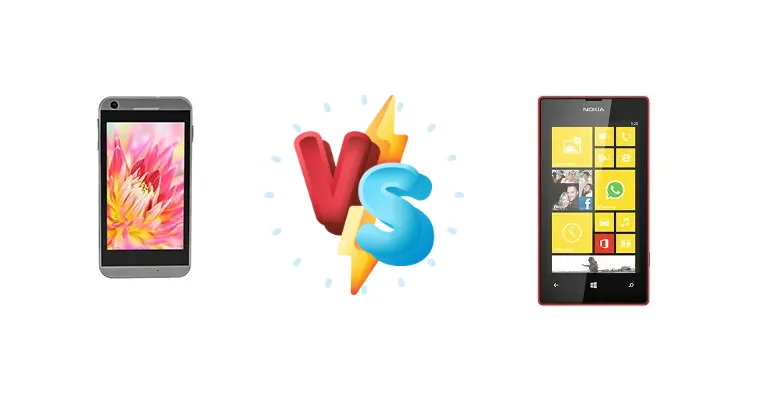
Released in different eras of the budget smartphone market, the Lava Iris 405+ and Nokia Lumia 520 represent distinct approaches to affordability. The Lumia 520, running Windows Phone 8, aimed to disrupt with a smooth user experience, while the Iris 405+ offered a more traditional Android experience. This comparison dissects their specifications to determine which device holds up better in retrospect.
🏆 Quick Verdict
For users prioritizing a slightly more responsive experience and a marginally faster processor, the Lava Iris 405+ is the better choice. However, the Nokia Lumia 520’s exceptional 49-hour battery endurance and established ecosystem offer compelling advantages, especially for those accustomed to the Windows Phone interface.
| Network |
|---|
| 2G bands | GSM 900 / 1800 - SIM 1 & SIM 2 | GSM 850 / 900 / 1800 / 1900 - all versions |
| 3G bands | HSDPA 2100 | HSDPA 900 / 2100 - RM-914 |
| Speed | HSPA 21.1/5.76 Mbps | HSPA 21.1/5.76 Mbps |
| Technology | GSM / HSPA | GSM / HSPA |
| | - | HSDPA 850 / 1700 / 1900 / 2100 - RM-917 |
| Launch |
|---|
| Announced | 2013, December. Released 2013, December | 2013, February. Released 2013, April |
| Status | Discontinued | Discontinued |
| Body |
|---|
| Build | - | Glass front, plastic back, plastic frame |
| Dimensions | 125 x 64 x 9 mm (4.92 x 2.52 x 0.35 in) | 119.9 x 64 x 9.9 mm, 75.7 cc (4.72 x 2.52 x 0.39 in) |
| SIM | Dual SIM | Micro-SIM |
| Weight | 127 g (4.48 oz) | 124 g (4.37 oz) |
| Display |
|---|
| Protection | - | Scratch-resistant glass |
| Resolution | 480 x 800 pixels, 5:3 ratio (~233 ppi density) | 480 x 800 pixels, 5:3 ratio (~233 ppi density) |
| Size | 4.0 inches, 45.5 cm2 (~56.9% screen-to-body ratio) | 4.0 inches, 45.5 cm2 (~59.3% screen-to-body ratio) |
| Type | TFT | IPS LCD |
| Platform |
|---|
| CPU | Dual-core 1.3 GHz | Dual-core 1.0 GHz |
| Chipset | - | Qualcomm MSM8227 |
| GPU | Mali-400 | Adreno 305 |
| OS | Android 4.2 (Jelly Bean) | Microsoft Windows Phone 8, upgradable to 8.1 |
| Memory |
|---|
| Card slot | microSDHC | microSDXC (dedicated slot) |
| Internal | 4GB 512MB RAM | 8GB 512MB RAM |
| Main Camera |
|---|
| Features | LED flash | - |
| Single | 5 MP | 5 MP, f/2.4, 28mm (wide), 1/4.0", AF |
| Video | Yes | 720p@30fps |
| Selfie camera |
|---|
| Single | VGA | - |
| | - | No |
| Sound |
|---|
| 3.5mm jack | - | Yes |
| 35mm jack | Yes | Yes |
| Loudspeaker | Yes | Yes |
| Comms |
|---|
| Bluetooth | Yes | 4.0, A2DP, LE/ aptX after WP8 Denim update |
| NFC | No | No |
| Positioning | A-GPS only | GPS, GLONASS |
| Radio | FM radio, recording | FM Radio |
| USB | microUSB 2.0 | microUSB 2.0 |
| WLAN | Wi-Fi 802.11 b/g/n | Wi-Fi 802.11 b/g/n, hotspot |
| Features |
|---|
| Sensors | Accelerometer, proximity | Accelerometer, proximity |
| Battery |
|---|
| Music play | - | Up to 61 h |
| Stand-by | Up to 200 h | Up to 360 h (3G) |
| Talk time | Up to 6 h 30 min | Up to 14 h 40 min (2G) / Up to 9 h 40 min (3G) |
| Type | Li-Po 1400 mAh, removable | Li-Ion 1430 mAh, removable (BL-5J) |
| Misc |
|---|
| Colors | Black, White | Yellow, red, cyan, white/black |
| Price | About 70 EUR | About 70 EUR |
| SAR | - | 0.77 W/kg (head) |
| SAR EU | - | 1.09 W/kg (head) |
| Tests |
|---|
| Audio quality | - |
Noise -82.3dB / Crosstalk -81.8dB |
| Battery life | - |
Endurance rating 49h
|
| Camera | - |
Photo / Video |
| Display | - |
Contrast ratio: 834:1 (nominal) / 1.161:1 (sunlight) |
| Loudspeaker | - |
Voice 68dB / Noise 69dB / Ring 66dB
|
Lava Iris 405+
- Slightly faster processor (1.3 GHz vs 1.0 GHz)
- Runs Android, offering wider app compatibility
- Potentially more customization options
- Battery life likely inferior to the Lumia 520
- Android experience may be less optimized than Windows Phone
Nokia Lumia 520
- Exceptional 49-hour battery endurance
- Smooth and responsive Windows Phone 8 experience
- Compact and lightweight design
- Limited app availability compared to Android
- Slower processor (1.0 GHz)
Display Comparison
Both the Lava Iris 405+ and Nokia Lumia 520 share a contrast ratio of 834:1 (nominal) and 1.161:1 (sunlight). This suggests a similar viewing experience in both indoor and outdoor conditions, though neither is expected to deliver vibrant colors or deep blacks. The specific panel technology and resolution are not provided for either device, but given their price points, they likely utilize TFT LCD panels. Bezels are expected to be substantial on both, reflecting the design trends of the time.
Camera Comparison
Both devices feature photo and video capabilities, but lack detailed specifications regarding sensor size, aperture, or image processing. Given their budget nature, image quality is likely to be subpar, particularly in low-light conditions. The absence of Optical Image Stabilization (OIS) on either device further limits their photographic potential. The camera should be considered adequate for casual snapshots but not for serious photography.
Performance
The Lava Iris 405+ boasts a dual-core 1.3 GHz CPU, while the Nokia Lumia 520 is equipped with a dual-core 1.0 GHz processor based on the Qualcomm MSM8227 chipset. This 300 MHz clock speed difference, while seemingly small, translates to a noticeable performance advantage for the Iris 405+ in most tasks. The MSM8227 is a known quantity, offering adequate performance for basic smartphone functions, but the Iris 405+'s CPU provides a slight edge in responsiveness. Neither device is expected to handle demanding applications or multitasking effectively.
Battery Life
The Nokia Lumia 520 shines in the battery department, achieving an impressive endurance rating of 49 hours. This is a significant advantage over what would be expected from a typical Android device of this era. While the Lava Iris 405+'s battery capacity and charging wattage are unknown, it's unlikely to match the Lumia 520’s exceptional endurance. The Lumia 520’s efficient Windows Phone operating system and optimized hardware contribute to its long-lasting battery life.
Buying Guide
Buy the Lava Iris 405+ if you need a basic Android smartphone with a slightly faster processor for everyday tasks like browsing and social media. Buy the Nokia Lumia 520 if you prefer a streamlined, tile-based interface, prioritize exceptional battery life, and are comfortable with the Windows Phone ecosystem, understanding its limited app availability compared to Android.
Frequently Asked Questions
❓ Is the Nokia Lumia 520 still usable in 2024, given its age and the end of Windows Phone support?
While Microsoft has ended support for Windows Phone 8, the Lumia 520 can still function for basic tasks like calls, texts, and limited app usage. However, security updates are no longer available, making it vulnerable to potential threats. Its primary appeal now lies in its exceptional battery life for a simple, offline device.
❓ What kind of apps can I expect to run smoothly on the Lava Iris 405+?
The Lava Iris 405+ is best suited for lightweight apps like basic web browsers, social media clients (Facebook Lite, Twitter), and messaging apps. Demanding games or resource-intensive applications will likely experience significant lag or may not run at all. Expect a basic, functional Android experience.
❓ Does the Qualcomm MSM8227 chipset in the Nokia Lumia 520 support modern internet standards?
The MSM8227 supports older versions of Wi-Fi and cellular data standards. While it can connect to the internet, browsing speeds will be significantly slower than modern smartphones. Expect compatibility issues with some websites and apps that require newer technologies.