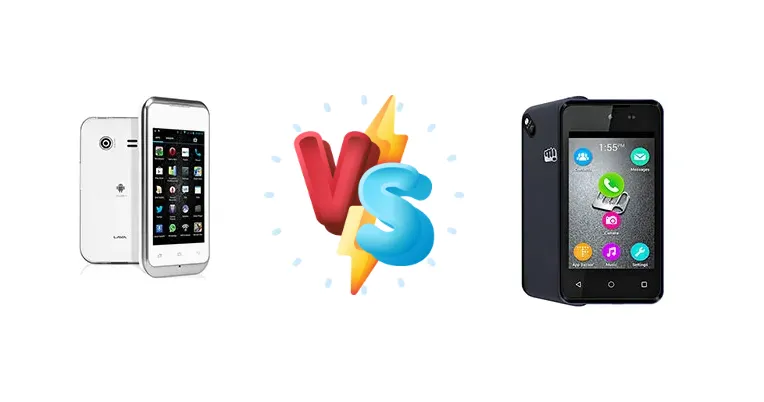
The Lava Iris 349+ and Micromax Bolt D303 represent the extreme end of the smartphone price spectrum. Both aim to deliver basic smartphone functionality at an incredibly low cost, but they approach this goal with different hardware choices. This comparison dissects those choices to determine which device offers the best value for users prioritizing affordability.
🏆 Quick Verdict
For the average user needing a functional, albeit basic, smartphone, the Micromax Bolt D303 emerges as the better choice. Its Mediatek MT6572M chipset, with dual-core processing at 1.3 GHz, provides a noticeable performance advantage over the Lava Iris 349+'s single-core 1.0 GHz CPU, making everyday tasks smoother.
| Network |
|---|
| 2G bands | GSM 900 / 1800 - SIM 1 & SIM 2 | GSM 850 / 900 / 1800 / 1900 - SIM 1 & SIM 2 |
| 3G bands | - | HSDPA 900 / 2100 |
| EDGE | Yes | - |
| GPRS | Yes | - |
| Speed | - | HSPA 21.1/5.76 Mbps |
| Technology | GSM | GSM / HSPA |
| Launch |
|---|
| Announced | 2013, July. Released 2013, July | 2015, July. Released 2015, July |
| Status | Discontinued | Discontinued |
| Body |
|---|
| Dimensions | 115 x 61.5 x 13.3 mm (4.53 x 2.42 x 0.52 in) | - |
| SIM | Dual SIM | Dual SIM |
| Weight | 115.4 g (4.06 oz) | - |
| Display |
|---|
| Resolution | 320 x 480 pixels, 3:2 ratio (~165 ppi density) | 480 x 800 pixels, 5:3 ratio (~233 ppi density) |
| Size | 3.5 inches, 36.5 cm2 (~51.6% screen-to-body ratio) | 4.0 inches, 45.5 cm2 |
| Type | TFT, 256K colors | TFT, 256K colors |
| Platform |
|---|
| CPU | 1.0 GHz | Dual-core 1.3 GHz Cortex-A7 |
| Chipset | - | Mediatek MT6572M (28 nm) |
| GPU | - | Mali-400 |
| OS | Android 2.3 (Gingerbread) | Android 4.4.2 (KitKat) |
| Memory |
|---|
| Card slot | microSDHC | microSDHC |
| Internal | 512MB 256MB RAM | 4GB 512MB RAM |
| Main Camera |
|---|
| Features | - | LED flash |
| Single | 2 MP | 3.15 MP |
| Video | Yes | 480p@30fps |
| Sound |
|---|
| 3.5mm jack | - | Yes |
| 35mm jack | Yes | Yes |
| Loudspeaker | Yes | Yes |
| Comms |
|---|
| Bluetooth | Yes | 4.0, A2DP |
| NFC | No | No |
| Positioning | GPS | GPS |
| Radio | FM radio | FM radio |
| USB | Proprietary | microUSB 2.0 |
| WLAN | Wi-Fi 802.11 b/g/n | Wi-Fi 802.11 b/g/n, hotspot |
| Features |
|---|
| Sensors | Accelerometer | Accelerometer |
| Battery |
|---|
| Stand-by | Up to 250 h | Up to 245 h (3G) |
| Talk time | Up to 5 h | Up to 4 h 40 min (3G) |
| Type | Li-Ion 1400 mAh, removable | Li-Ion 1300 mAh, removable |
| Misc |
|---|
| Colors | Brown/cool gold | Black |
| Price | About 40 EUR | - |
| SAR | - | 0.39 W/kg (head) 0.64 W/kg (body) |
Lava Iris 349+
- Likely the most affordable option
- Simple and easy to use
- Functional for basic communication
- Significantly slower performance
- Limited multitasking capabilities
- Poor camera quality
Micromax Bolt D303
- Faster processor for smoother performance
- More efficient chipset
- Better multitasking capabilities
- Slightly higher price point
- Still limited by low-end hardware
- Camera quality remains basic
Display Comparison
Neither device boasts a standout display. Given the price point, details like panel type (IPS vs TFT) and resolution are likely low. The focus here is on functionality, not fidelity. Without specific display specs, it's safe to assume both offer basic viewing experiences suitable for essential tasks. Bezels are likely substantial on both, maximizing screen real estate within a compact form factor.
Camera Comparison
Both devices likely feature basic camera setups geared towards casual snapshots. Without specific sensor details, it’s reasonable to assume both utilize low-resolution sensors. Image quality will be heavily dependent on lighting conditions. The absence of Optical Image Stabilization (OIS) on either device means low-light performance will be limited. Any claims of 'macro' capabilities should be viewed skeptically, as a 2MP macro sensor offers minimal detail.
Performance
The core difference lies in the processing power. The Micromax Bolt D303’s Mediatek MT6572M, built on a 28nm process, features a dual-core Cortex-A7 CPU clocked at 1.3 GHz. This is a significant upgrade over the Lava Iris 349+'s 1.0 GHz CPU. The 28nm fabrication process of the MT6572M also implies better power efficiency compared to an older, potentially larger-node CPU in the Lava. This translates to smoother multitasking and faster app loading times on the Micromax, particularly noticeable when running multiple apps or browsing the web. The Cortex-A7 architecture, while dated, is still more capable than the likely Cortex-A5 architecture found in the Lava, given the CPU speed.
Battery Life
Battery capacity is not specified for either device. However, given the low-power chipsets and basic displays, both should offer at least a full day of standby time and moderate usage. Charging wattage is also unknown, but likely slow, requiring several hours to fully charge from 0-100%. The more efficient Mediatek chipset in the Micromax Bolt D303 may contribute to slightly longer battery life during active use.
Buying Guide
Buy the Lava Iris 349+ if your primary need is a very basic phone for calls and texts, and you are on the absolute tightest budget. It will function, but expect limitations. Buy the Micromax Bolt D303 if you want a slightly more responsive experience for light web browsing, social media, and basic app usage, and are willing to spend a little more for a tangible performance boost.
Frequently Asked Questions
❓ Will the Micromax Bolt D303 struggle with WhatsApp and Facebook?
While not ideal for heavy usage, the Micromax Bolt D303’s 1.3 GHz dual-core processor should handle basic WhatsApp and Facebook functionality – sending messages, viewing photos, and scrolling through feeds – without significant lag. Expect longer loading times compared to more powerful devices.
❓ Can the Lava Iris 349+ run popular games like PUBG Mobile?
No. The Lava Iris 349+’s 1.0 GHz CPU and likely limited GPU are insufficient to run graphically demanding games like PUBG Mobile. Even if the game were to install, performance would be unplayable due to severe frame rate drops and lag.
❓ Is the Mediatek MT6572M chipset in the Micromax Bolt D303 known to overheat?
The Mediatek MT6572M is a low-power chipset and generally does not suffer from overheating issues, even under moderate load. Its 28nm process contributes to its thermal efficiency. However, prolonged, intensive use could lead to some warming, but not to the point of causing performance throttling.