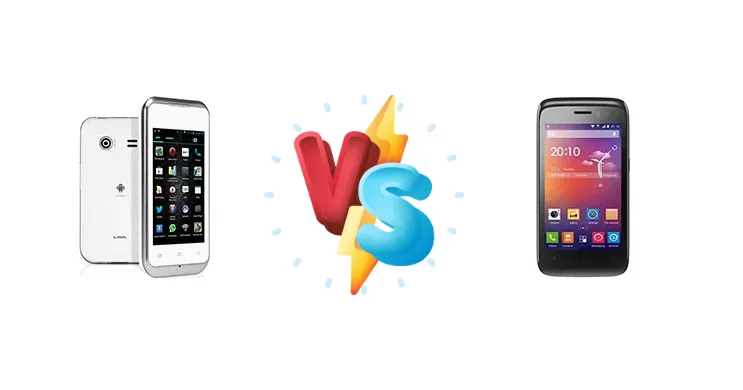
In the fiercely competitive sub-$100 smartphone market, the Lava Iris 349+ and Karbonn Titanium S1 Plus represent attempts to deliver functionality at an accessible price. While both devices target first-time smartphone users or those seeking a secondary device, a key differentiator lies in their processing power. This comparison dissects the implications of the Karbonn’s quad-core 1.2 GHz CPU versus the Lava’s single-core 1.0 GHz processor, revealing which phone offers a smoother and more responsive user experience.
🏆 Quick Verdict
For the average user prioritizing responsiveness and multitasking, the Karbonn Titanium S1 Plus is the clear winner. Its quad-core 1.2 GHz processor provides a significant performance advantage over the Lava Iris 349+'s 1.0 GHz CPU, translating to faster app loading times and smoother operation, even with multiple apps open.
| Network |
|---|
| 2G bands | GSM 900 / 1800 - SIM 1 & SIM 2 | GSM 900 / 1800 - SIM 1 & SIM 2 |
| 3G bands | - | HSDPA 2100 |
| EDGE | Yes | - |
| GPRS | Yes | - |
| Speed | - | HSPA |
| Technology | GSM | GSM / HSPA |
| Launch |
|---|
| Announced | 2013, July. Released 2013, July | 2014, May. Released 2014, May |
| Status | Discontinued | Discontinued |
| Body |
|---|
| Dimensions | 115 x 61.5 x 13.3 mm (4.53 x 2.42 x 0.52 in) | 124 x 64 x 10.3 mm (4.88 x 2.52 x 0.41 in) |
| SIM | Dual SIM | Dual SIM |
| Weight | 115.4 g (4.06 oz) | 129 g (4.55 oz) |
| Display |
|---|
| Resolution | 320 x 480 pixels, 3:2 ratio (~165 ppi density) | 480 x 800 pixels, 5:3 ratio (~233 ppi density) |
| Size | 3.5 inches, 36.5 cm2 (~51.6% screen-to-body ratio) | 4.0 inches, 45.5 cm2 (~57.4% screen-to-body ratio) |
| Type | TFT, 256K colors | TFT |
| Platform |
|---|
| CPU | 1.0 GHz | Quad-core 1.2 GHz |
| GPU | - | Adreno 302 |
| OS | Android 2.3 (Gingerbread) | Android 4.3 (Jelly Bean) |
| Memory |
|---|
| Card slot | microSDHC | microSDHC |
| Internal | 512MB 256MB RAM | 4GB 1GB RAM |
| Main Camera |
|---|
| Features | - | LED flash |
| Single | 2 MP | 5 MP, AF |
| Video | Yes | Yes |
| Sound |
|---|
| 3.5mm jack | - | Yes |
| 35mm jack | Yes | Yes |
| Loudspeaker | Yes | Yes |
| Comms |
|---|
| Bluetooth | Yes | 2.0 |
| NFC | No | No |
| Positioning | GPS | GPS |
| Radio | FM radio | FM radio |
| USB | Proprietary | microUSB 2.0 |
| WLAN | Wi-Fi 802.11 b/g/n | Wi-Fi 802.11 b/g/n, hotspot |
| Features |
|---|
| Sensors | Accelerometer | Accelerometer, proximity |
| Battery |
|---|
| Stand-by | Up to 250 h | - |
| Talk time | Up to 5 h | - |
| Type | Li-Ion 1400 mAh, removable | Li-Ion 1500 mAh battery |
| Misc |
|---|
| Colors | Brown/cool gold | White |
| Price | About 40 EUR | About 80 EUR |
Lava Iris 349+
- Potentially better battery life due to lower CPU power draw.
- Likely more affordable price point.
- Simpler user experience for basic tasks.
- Significantly slower performance compared to the Karbonn.
- Struggles with multitasking and demanding apps.
- Limited future-proofing.
Karbonn Titanium S1 Plus
- Faster and more responsive performance thanks to the quad-core CPU.
- Better multitasking capabilities.
- More capable of handling modern Android apps.
- Potentially shorter battery life.
- May be slightly more expensive.
- Performance still limited by other hardware components.
Display Comparison
Given the limited data, we can assume both devices feature displays geared towards cost-effectiveness. Expect TN or low-grade IPS panels with resolutions likely around 480x854. The absence of specifications regarding brightness, color gamut, or refresh rate suggests neither phone prioritizes display quality. Bezels are likely to be substantial on both models, maximizing screen real estate within a compact form factor.
Camera Comparison
Without detailed camera specifications, it’s safe to assume both phones feature basic camera setups geared towards casual photography. The absence of information regarding sensor size, aperture, or image stabilization suggests image quality will be heavily dependent on lighting conditions. Any mention of megapixel count beyond 5MP should be viewed with skepticism, as sensor size is a more critical factor in image quality. Expect limited low-light performance and a reliance on software processing to enhance images.
Performance
The Karbonn Titanium S1 Plus’s quad-core 1.2 GHz CPU represents a substantial leap in processing power compared to the Lava Iris 349+'s 1.0 GHz single-core processor. While the specific architecture of these CPUs is unknown, the core count advantage allows the Karbonn to handle multiple tasks concurrently with significantly less lag. The Lava, limited to a single core, will struggle with multitasking and may exhibit noticeable slowdowns when running demanding applications. This difference is particularly crucial for modern Android, which is increasingly reliant on multi-core processing.
Battery Life
Battery capacity is not specified for either device. However, the Lava Iris 349+'s less demanding processor *could* translate to slightly longer battery life, assuming both phones have similarly sized batteries. The Karbonn’s more powerful CPU will consume more power, potentially requiring more frequent charging. Charging wattage is also unknown, suggesting both phones likely utilize slow charging speeds.
Buying Guide
Buy the Lava Iris 349+ if you need a basic, extremely affordable smartphone primarily for calls, texts, and light web browsing. Its simpler processor is sufficient for these tasks and may offer slightly better battery life due to lower power consumption. Buy the Karbonn Titanium S1 Plus if you prefer a more responsive experience, plan to use multiple apps simultaneously, or occasionally engage in light gaming. The quad-core processor provides a noticeable performance boost for everyday tasks and offers a more future-proof experience.
Frequently Asked Questions
❓ Will the Karbonn Titanium S1 Plus be able to run popular social media apps like Facebook and WhatsApp smoothly?
Yes, the quad-core 1.2 GHz processor in the Karbonn Titanium S1 Plus should handle Facebook, WhatsApp, and similar social media apps without significant lag. While not a high-end experience, it will provide a usable and responsive experience for these common applications.
❓ Is the Lava Iris 349+ suitable for someone who primarily uses their phone for making calls and sending texts?
Absolutely. The Lava Iris 349+ is well-suited for basic communication tasks like calls and texts. Its simpler processor is sufficient for these functions, and it will likely offer good battery life for extended talk time.
❓ Can I expect to play games on either of these phones?
Light gaming is possible on the Karbonn Titanium S1 Plus, but don't expect high frame rates or detailed graphics. The Lava Iris 349+ will struggle with even basic games due to its limited processing power. Both phones are best suited for simple, 2D games.