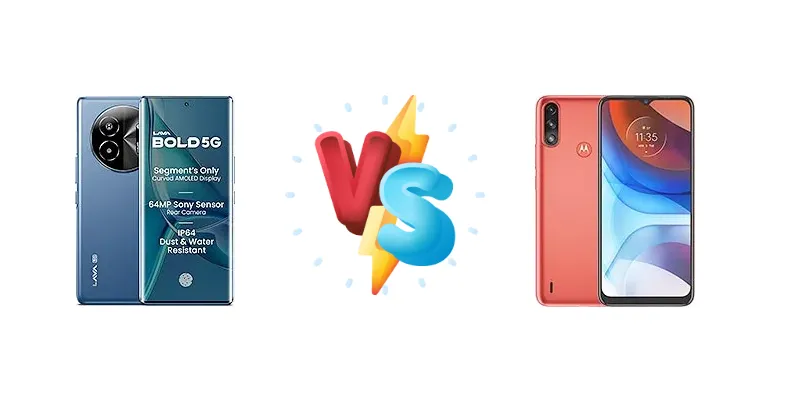
The Lava Bold and Motorola Moto E7 Power represent two distinct approaches to the budget smartphone market. The Lava Bold aims for a performance edge with a newer chipset and faster charging, while the Moto E7 Power prioritizes affordability and potentially longer battery life through a more efficient, albeit less powerful, processor. This comparison dissects their key differences to determine which phone best suits your needs.
🏆 Quick Verdict
For users prioritizing responsiveness and future-proofing, the Lava Bold is the clear winner. Its Mediatek Dimensity 6300 chipset offers a significant performance leap over the Moto E7 Power’s Helio G25, coupled with substantially faster 33W charging. However, the Moto E7 Power remains a viable option for those on a very tight budget who prioritize basic functionality.
| Network |
|---|
| 2G bands | GSM 900 / 1800 | GSM 850 / 900 / 1800 / 1900 |
| 3G bands | HSDPA 850 / 900 / 1900 / 2100 | HSDPA 850 / 900 / 1700(AWS) / 1900 / 2100 |
| 4G bands | 1, 3, 5, 7, 8, 20, 28, 38, 40, 41 | 1, 3, 5, 7, 8, 20, 38, 40, 41 |
| 5G bands | 1, 3, 5, 7, 8, 20, 28, 38, 40, 41, 66, 77, 78 SA/NSA | - |
| Speed | HSPA, LTE, 5G | HSPA, LTE |
| Technology | GSM / HSPA / LTE / 5G | GSM / HSPA / LTE |
| Launch |
|---|
| Announced | 2025, April 02 | 2021, February 19 |
| Status | Available. Released 2025, April 08 | Available. Released 2021, February 26 |
| Body |
|---|
| Build | - | Glass front, plastic back, plastic frame |
| Dimensions | 162.4 x 73.9 x 8.5 mm (6.39 x 2.91 x 0.33 in) | 165.1 x 75.9 x 9.2 mm (6.5 x 2.99 x 0.36 in) |
| SIM | Nano-SIM + Nano-SIM | Nano-SIM + Nano-SIM |
| Weight | 183 g (6.46 oz) | 200 g (7.05 oz) |
| | - | Water-repellent design |
| Display |
|---|
| Resolution | 1080 x 2400 pixels, 20:9 ratio (~395 ppi density) | 720 x 1600 pixels, 20:9 ratio (~269 ppi density) |
| Size | 6.67 inches, 107.4 cm2 (~89.5% screen-to-body ratio) | 6.51 inches, 103.1 cm2 (~82.3% screen-to-body ratio) |
| Type | AMOLED, 120Hz | IPS LCD, 380 nits (typ) |
| Platform |
|---|
| CPU | Octa-core (2x2.4 GHz Cortex-A76 & 6x2.0 GHz Cortex-A55) | Octa-core (4x2.0 GHz Cortex-A53 & 4x1.5 GHz Cortex-A53) |
| Chipset | Mediatek Dimensity 6300 (6 nm) | Mediatek MT6762G Helio G25 (12 nm) |
| GPU | Mali-G57 MC2 | PowerVR GE8320 |
| OS | Android 14, planned upgrade to Android 15 | Android 10 |
| Memory |
|---|
| Card slot | microSDXC | microSDXC (uses shared SIM slot) |
| Internal | 128GB 4GB RAM, 128GB 6GB RAM, 128GB 8GB RAM | 32GB 2GB RAM, 64GB 4GB RAM |
| | - | eMCP |
| Main Camera |
|---|
| Dual | 64 MP, (wide), AF
2 MP (macro) | 13 MP, f/2.0, 26mm (wide), 1/3.1", 1.12µm, PDAF
2 MP (macro) |
| Features | LED flash, HDR, panorama | LED flash, HDR, panorama |
| Video | 1080p@30fps | 1080p@30fps |
| Selfie camera |
|---|
| Features | - | HDR |
| Single | 16 MP | 5 MP, f/2.2, 27mm (wide), 1.12µm |
| Video | 1080p@30fps | 1080p@30fps |
| Sound |
|---|
| 3.5mm jack | - | Yes |
| 35mm jack | No | Yes |
| Loudspeaker | Yes | Yes |
| Comms |
|---|
| Bluetooth | 5.2, A2DP, LE | 5.0, A2DP, LE |
| NFC | No | No |
| Positioning | GPS | GPS, GLONASS, GALILEO |
| Radio | Unspecified | FM radio |
| USB | USB Type-C 2.0, OTG | USB Type-C 2.0, OTG |
| WLAN | Wi-Fi 802.11 b/g/n/ac | Wi-Fi 802.11 b/g/n |
| Features |
|---|
| Sensors | Fingerprint (under display, optical), accelerometer, gyro, proximity, compass | Fingerprint (rear-mounted), accelerometer, proximity |
| Battery |
|---|
| Charging | 33W wired | 10W wired |
| Type | Li-Po 5000 mAh | Li-Ion 5000 mAh |
| Misc |
|---|
| Colors | Sapphire Blue | Tahiti Blue, Coral Red |
| Models | - | PAMH0001IN, PAMH0010IN, PAMH0019IN |
| Price | About 110 EUR | About 140 EUR |
Lava Bold
- Significantly faster processor for smoother performance
- 33W fast charging dramatically reduces charging time
- More efficient 6nm chipset for better battery life under load
- Likely a higher price point than the Moto E7 Power
- May not have a significantly larger battery capacity
Motorola Moto E7 Power
- More affordable price point
- Potentially longer battery life during light usage due to efficient processor
- Simple and easy-to-use interface
- Slow 10W charging
- Underpowered processor struggles with demanding tasks
- Limited multitasking capabilities
Display Comparison
Neither device's display specifications are provided, so a direct comparison is limited. However, given the Lava Bold's focus on a more modern chipset, it's reasonable to expect a higher-quality panel with potentially better color accuracy and brightness. The Moto E7 Power, targeting a lower price point, likely utilizes a more basic LCD panel. Bezels are likely to be larger on the Moto E7 Power to reduce manufacturing costs.
Camera Comparison
Without specific camera sensor details, a definitive comparison is difficult. However, the Lava Bold’s more powerful chipset likely enables more sophisticated image processing algorithms, potentially resulting in better dynamic range and low-light performance. It’s probable that the Lava Bold will have a more capable main sensor. The Moto E7 Power likely relies on simpler image processing, and any included 'macro' or 'depth' sensors are likely to be of low resolution and limited utility.
Performance
The Lava Bold’s Mediatek Dimensity 6300 (6nm) represents a substantial upgrade over the Motorola Moto E7 Power’s Mediatek MT6762G Helio G25 (12nm). The Dimensity 6300’s Cortex-A76 cores, clocked at 2.4 GHz, deliver significantly higher single-core performance than the Helio G25’s Cortex-A53 cores at 2.0 GHz. The 6nm process node further enhances efficiency, leading to better thermal management and sustained performance. The Helio G25, while capable of handling basic tasks, will struggle with demanding applications and multitasking. The Lava Bold will provide a noticeably smoother and more responsive user experience, particularly for gaming and content creation.
Battery Life
While battery capacity isn't specified, the charging speeds tell a crucial story. The Lava Bold’s 33W wired charging is a game-changer compared to the Moto E7 Power’s 10W charging. This means the Lava Bold can replenish its battery much faster, minimizing downtime. Even if the Moto E7 Power has a slightly larger battery capacity, the Lava Bold’s faster charging will likely result in less perceived battery anxiety for most users. A full charge on the Moto E7 Power could take well over 3 hours, while the Lava Bold could achieve a full charge in under 90 minutes.
Buying Guide
Buy the Lava Bold if you need a phone capable of handling multitasking, moderate gaming, and benefit from quicker app loading times. It’s ideal for users who value a smoother overall experience and don’t want to wait hours for a full charge. Buy the Motorola Moto E7 Power if you prefer a no-frills device for essential tasks like calls, messaging, and light social media browsing, and if maximizing battery life on a limited budget is your primary concern.
Frequently Asked Questions
❓ Will the Lava Bold’s Dimensity 6300 handle popular games like PUBG Mobile or Call of Duty Mobile?
The Mediatek Dimensity 6300 is capable of running PUBG Mobile and Call of Duty Mobile, but likely at medium settings to maintain a stable frame rate. The Helio G25 in the Moto E7 Power will struggle with these titles, even at the lowest settings.
❓ How much faster is the 33W charging on the Lava Bold compared to the 10W charging on the Moto E7 Power in real-world use?
The 33W charging on the Lava Bold can realistically cut charging times in half or even more. Expect a full charge in around 90 minutes, while the Moto E7 Power could take 3+ hours. This difference is significant for users who need to quickly top up their battery.
❓ Is the Motorola Moto E7 Power a good choice for elderly users who primarily use their phone for calls and messaging?
Yes, the Moto E7 Power is a suitable option for elderly users with basic needs. Its simplicity, affordability, and potentially long battery life make it a practical choice for calls, messaging, and essential functions.
❓ Does the Lava Bold support 5G connectivity?
The Mediatek Dimensity 6300 supports 5G connectivity, giving the Lava Bold a future-proof advantage over the Moto E7 Power, which is limited to 4G.