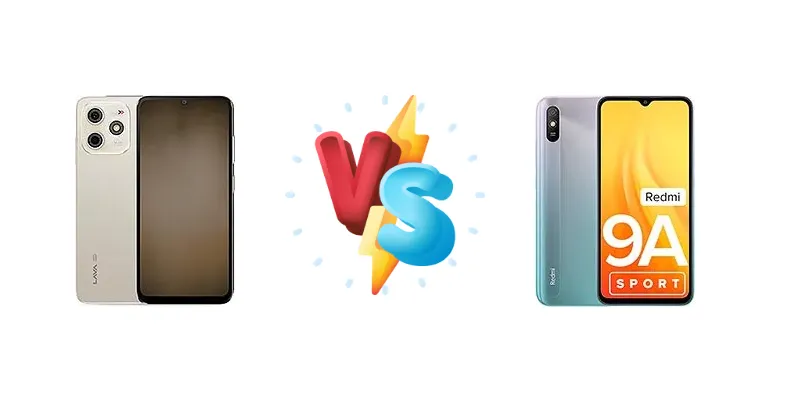
The sub-$150 smartphone market is fiercely competitive. The Lava Bold N1 and Xiaomi Redmi 9A Sport represent two compelling options for users prioritizing affordability. However, they take different approaches to achieving that price point, particularly in their core processing power. This comparison dissects the key differences to help you choose the right device.
🏆 Quick Verdict
For most users, the Lava Bold N1 emerges as the stronger choice. Its Unisoc T765 chipset, built on a more efficient 6nm process, offers a noticeable performance advantage over the Redmi 9A Sport’s Helio G25, translating to smoother multitasking and a better overall user experience. While both offer 10W charging, the N1’s superior processing power justifies its slight price premium.
| Network |
|---|
| 2G bands | GSM 850 / 900 / 1800 / 1900 | GSM 850 / 900 / 1800 / 1900 |
| 3G bands | HSDPA 850 / 900 / 2100 | HSDPA 850 / 900 / 2100 |
| 4G bands | 1, 3, 5, 8, 28, 40, 41 | 1, 3, 5, 8, 40, 41 |
| 5G bands | 1, 3, 5, 8, 28, 40, 77, 78 SA/NSA | - |
| Speed | HSPA, LTE, 5G | HSPA, LTE |
| Technology | GSM / HSPA / LTE / 5G | GSM / HSPA / LTE |
| Launch |
|---|
| Announced | 2025, September 05 | 2021, September 28 |
| Status | Available. Released 2025, September 05 | Available. Released 2021, September 28 |
| Body |
|---|
| Dimensions | 165.9 x 76.6 x 8.2 mm (6.53 x 3.02 x 0.32 in) | 164.9 x 77.1 x 9 mm (6.49 x 3.04 x 0.35 in) |
| SIM | Nano-SIM + Nano-SIM | Nano-SIM + Nano-SIM |
| Weight | 198 g (6.98 oz) | 194 g (6.84 oz) |
| | - | Water-repellent coating |
| Display |
|---|
| Resolution | 720 x 1600 pixels, 20:9 ratio (~260 ppi density) | 720 x 1600 pixels, 20:9 ratio (~269 ppi density) |
| Size | 6.75 inches, 110.0 cm2 (~86.6% screen-to-body ratio) | 6.53 inches, 102.9 cm2 (~81.0% screen-to-body ratio) |
| Type | IPS LCD, 90Hz | IPS LCD, 400 nits (typ) |
| Platform |
|---|
| CPU | Octa-core (2x2.3 GHz Cortex-A76 & 6x2.1 GHz Cortex-A55) | Octa-core (4x2.0 GHz Cortex-A53 & 4x1.5 GHz Cortex-A53) |
| Chipset | Unisoc T765 (6 nm) | Mediatek MT6762G Helio G25 (12 nm) |
| GPU | Mali-G57 MC2 | PowerVR GE8320 |
| OS | Android 15 | Android 10, MIUI 12 |
| Memory |
|---|
| Card slot | microSDXC | microSDXC (dedicated slot) |
| Internal | 64GB 4GB RAM, 128GB 4GB RAM | 32GB 2GB RAM, 32GB 3GB RAM |
| | - | eMMC 5.1 |
| Main Camera |
|---|
| Features | LED flash, HDR, panorama | LED flash, HDR |
| Single | 13 MP, (wide) | 13 MP, f/2.2, 28mm (wide), 1.0µm, PDAF |
| Video | 4K@30fps, 1080p@30fps | 1080p@30/60fps |
| Selfie camera |
|---|
| Features | - | HDR |
| Single | 5 MP | 5 MP, f/2.2, (wide), 1.12µm |
| Video | Yes | 1080p@30fps |
| Sound |
|---|
| 3.5mm jack | - | Yes |
| 35mm jack | Yes | Yes |
| Loudspeaker | Yes | Yes |
| Comms |
|---|
| Bluetooth | 4.2, A2DP, LE | 5.0, A2DP, LE |
| NFC | No | No |
| Positioning | GPS, GLONASS | GPS, GLONASS, BDS |
| Radio | FM radio | FM radio |
| USB | USB Type-C, OTG | microUSB 2.0, OTG |
| WLAN | Wi-Fi 802.11 b/g/n/ac, dual-band | Wi-Fi 802.11 a/b/g/n, Wi-Fi Direct |
| Features |
|---|
| Sensors | Fingerprint (side-mounted), accelerometer | Accelerometer, proximity |
| Battery |
|---|
| Charging | 10W wired | 10W wired |
| Type | Li-Ion 5000 mAh | Li-Po 5000 mAh |
| Misc |
|---|
| Colors | Royal Blue, Champagne Gold | Carbon Black, Coral Green, Metallic Blue |
| Price | ₹ 7,499 | About 100 EUR |
Lava Bold N1
- More powerful Unisoc T765 chipset
- 6nm process for better efficiency
- Potentially smoother multitasking experience
- Brand recognition is lower than Xiaomi
- Battery capacity currently unknown
Xiaomi Redmi 9A Sport
- Well-established brand with wider support
- Potentially lower price point
- Readily available accessories
- Less powerful MediaTek Helio G25 chipset
- 12nm process is less efficient
- Likely slower performance in demanding tasks
Display Comparison
Neither device boasts a standout display. Both likely utilize LCD panels, a common cost-saving measure in this segment. The key difference lies under the hood: the Lava Bold N1’s Unisoc T765 benefits from a more modern manufacturing process, potentially allowing for more efficient display power delivery. However, without specific brightness or color gamut data, it’s difficult to definitively declare a winner. Expect both to perform adequately in indoor environments but struggle in direct sunlight.
Camera Comparison
Both phones likely feature basic camera setups focused on affordability. Without detailed sensor information, it’s safe to assume both will struggle in low-light conditions. The Redmi 9A Sport often includes a 13MP main sensor, while the Lava Bold N1’s sensor resolution is currently unknown. However, the chipset’s image signal processor (ISP) plays a crucial role. The Unisoc T765’s ISP is likely more advanced than the Helio G25’s, potentially leading to better image processing and noise reduction. The prevalence of 2MP macro/depth sensors on both devices suggests limited utility; these are primarily for marketing purposes.
Performance
The performance gap is the most significant differentiator. The Lava Bold N1’s Unisoc T765, fabricated on a 6nm process, is a clear upgrade over the Redmi 9A Sport’s MediaTek Helio G25 (12nm). The T765’s Cortex-A76 cores (2x2.3 GHz) offer substantially more processing power than the G25’s Cortex-A53 cores (4x2.0 GHz). This translates to faster app loading times, smoother multitasking, and a more responsive user interface. The G25’s reliance on four Cortex-A53 cores for all tasks will likely result in noticeable slowdowns when running multiple apps or demanding applications. The 6nm process also implies better thermal efficiency for the N1, potentially reducing throttling during sustained workloads.
Battery Life
Both devices are equipped with 10W wired charging, indicating similar charging speeds. Without knowing the battery capacity of the Lava Bold N1, it’s difficult to assess battery life definitively. However, the Unisoc T765’s 6nm process efficiency could offset a potentially smaller battery capacity, resulting in comparable or even better real-world battery performance compared to the Redmi 9A Sport. Expect both phones to require daily charging with moderate usage.
Buying Guide
Buy the Lava Bold N1 if you need a phone capable of handling everyday tasks with relative ease, and appreciate a more modern chipset architecture for future software support. Buy the Xiaomi Redmi 9A Sport if your primary needs are extremely basic – calls, texts, and light social media – and you prioritize a well-established brand ecosystem and potentially wider availability of accessories.
Frequently Asked Questions
❓ Will the Lava Bold N1 handle popular games like PUBG Mobile?
While the Lava Bold N1 won't deliver a high-end gaming experience, the Unisoc T765 is significantly more capable than the Helio G25. Expect playable frame rates at lower settings. However, sustained gaming may lead to some throttling due to the phone's budget thermal design.
❓ Is the Xiaomi Redmi 9A Sport a good choice for elderly users who primarily make calls and send texts?
Yes, the Redmi 9A Sport is a perfectly adequate choice for basic communication. Its simple interface and established brand reliability make it a suitable option for users with minimal smartphone experience. The Helio G25 is sufficient for these core functions.
❓ How does the Unisoc T765 compare to other chipsets in this price range?
The Unisoc T765 generally outperforms the Helio G25 and Snapdragon 460 commonly found in this segment. It sits closer in performance to some older Snapdragon 6-series chips, offering a noticeable step up in processing power and efficiency.
❓ What kind of software updates can I expect on the Lava Bold N1?
Lava's software update track record is less established than Xiaomi's. While the Bold N1 likely ships with a recent version of Android, long-term software support and security patches may be less frequent compared to a Xiaomi device.