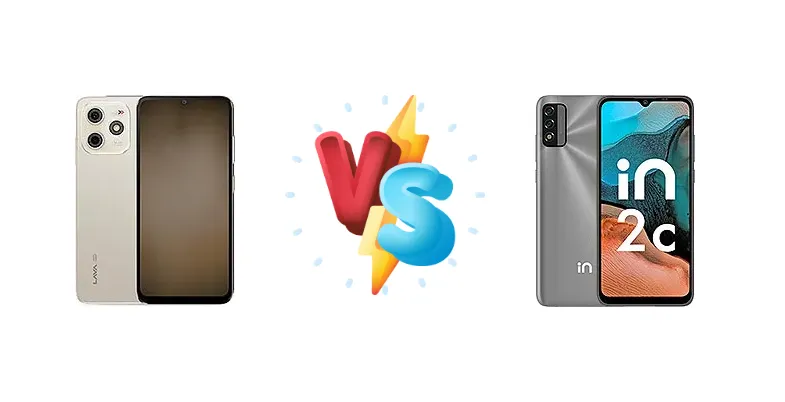
The Lava Bold N1 and Micromax In 2c represent the increasingly competitive sub-$100 smartphone market. Both rely on Unisoc chipsets, but significant architectural differences exist. This comparison dissects those differences, focusing on performance, efficiency, and real-world usability to determine which device offers the best value.
🏆 Quick Verdict
For most users, the Lava Bold N1 emerges as the stronger choice. Its Unisoc T765, built on a more efficient 6nm process, delivers noticeably better performance than the Micromax In 2c’s T610. While both offer 10W charging, the N1’s superior processing power justifies its slightly higher price point.
| Network |
|---|
| 2G bands | GSM 850 / 900 / 1800 / 1900 | GSM 850 / 900 / 1800 / 1900 |
| 3G bands | HSDPA 850 / 900 / 2100 | HSDPA 850 / 2100 |
| 4G bands | 1, 3, 5, 8, 28, 40, 41 | 1, 3, 5, 8, 38, 40, 41 |
| 5G bands | 1, 3, 5, 8, 28, 40, 77, 78 SA/NSA | - |
| Speed | HSPA, LTE, 5G | HSPA, LTE |
| Technology | GSM / HSPA / LTE / 5G | GSM / HSPA / LTE |
| Launch |
|---|
| Announced | 2025, September 05 | 2022, April 26 |
| Status | Available. Released 2025, September 05 | Available. Released 2022, May 01 |
| Body |
|---|
| Dimensions | 165.9 x 76.6 x 8.2 mm (6.53 x 3.02 x 0.32 in) | 164.3 x 75.7 x 8.6 mm (6.47 x 2.98 x 0.34 in) |
| SIM | Nano-SIM + Nano-SIM | Nano-SIM + Nano-SIM |
| Weight | 198 g (6.98 oz) | 198 g (6.98 oz) |
| Display |
|---|
| Resolution | 720 x 1600 pixels, 20:9 ratio (~260 ppi density) | 720 x 1600 pixels, 20:9 ratio (~269 ppi density) |
| Size | 6.75 inches, 110.0 cm2 (~86.6% screen-to-body ratio) | 6.52 inches, 102.6 cm2 (~82.5% screen-to-body ratio) |
| Type | IPS LCD, 90Hz | IPS LCD, 420 nits |
| Platform |
|---|
| CPU | Octa-core (2x2.3 GHz Cortex-A76 & 6x2.1 GHz Cortex-A55) | Octa-core (2x1.8 GHz Cortex-A75 & 6x1.8 GHz Cortex-A55) |
| Chipset | Unisoc T765 (6 nm) | Unisoc T610 (12 nm) |
| GPU | Mali-G57 MC2 | Mali-G52 MP2 |
| OS | Android 15 | Android 11 |
| Memory |
|---|
| Card slot | microSDXC | microSDXC (dedicated slot) |
| Internal | 64GB 4GB RAM, 128GB 4GB RAM | 32GB 3GB RAM |
| | - | eMMC 5.1 |
| Main Camera |
|---|
| Dual | - | 8 MP, (wide), AF
Auxiliary lens |
| Features | LED flash, HDR, panorama | LED flash, HDR, panorama |
| Single | 13 MP, (wide) | 5 MP, AF |
| Video | 4K@30fps, 1080p@30fps | 1080p@30fps |
| Selfie camera |
|---|
| Single | 5 MP | 5 MP, AF |
| Video | Yes | Unspecified |
| Sound |
|---|
| 3.5mm jack | - | Yes |
| 35mm jack | Yes | Yes |
| Loudspeaker | Yes | Yes |
| Comms |
|---|
| Bluetooth | 4.2, A2DP, LE | 5.0, A2DP, LE |
| NFC | No | No |
| Positioning | GPS, GLONASS | GPS |
| Radio | FM radio | No |
| USB | USB Type-C, OTG | USB Type-C 2.0, OTG |
| WLAN | Wi-Fi 802.11 b/g/n/ac, dual-band | Wi-Fi 802.11 a/b/g/n/ac, Wi-Fi Direct |
| Features |
|---|
| Sensors | Fingerprint (side-mounted), accelerometer | Accelerometer, proximity |
| Battery |
|---|
| Charging | 10W wired | 10W wired |
| Type | Li-Ion 5000 mAh | Li-Po 5000 mAh |
| Misc |
|---|
| Colors | Royal Blue, Champagne Gold | Brown, Silver |
| Models | - | E6533 |
| Price | ₹ 7,499 | About 100 EUR |
Lava Bold N1
- More powerful Unisoc T765 chipset
- 6nm process for better efficiency
- Potentially smoother UI experience
- May be slightly more expensive
- Limited information on display quality
Micromax In 2c
- Lower price point
- Functional for basic smartphone tasks
- Acceptable for minimal usage
- Less powerful Unisoc T610 chipset
- 12nm process is less efficient
- May struggle with demanding apps
Display Comparison
Neither Lava nor Micromax provide display specifications beyond size. However, given the price bracket, both likely utilize LCD panels. The key difference lies in the processing power driving them. The Bold N1’s T765 can handle more complex UI rendering, potentially resulting in smoother animations. Without knowing panel quality, it’s difficult to assess color accuracy or brightness, but the chipset advantage favors the Lava.
Camera Comparison
Both phones likely feature basic camera setups, and detailed sensor information is unavailable. Given the market segment, image quality will be heavily reliant on software processing. The T765 in the Lava Bold N1 has more processing headroom, potentially allowing for better noise reduction and image sharpening. However, without knowing the sensor sizes and lens apertures, it’s impossible to definitively declare a camera winner. Expect both to struggle in low-light conditions.
Performance
The core distinction here is the chipset architecture. The Lava Bold N1’s Unisoc T765 (6nm) features two Cortex-A76 cores clocked at 2.3 GHz, paired with six Cortex-A55 cores at 2.1 GHz. This is a significant upgrade over the Micromax In 2c’s Unisoc T610 (12nm), which uses two Cortex-A75 cores at 1.8 GHz and six Cortex-A55 cores also at 1.8 GHz. The 6nm fabrication process of the T765 is more efficient, leading to better thermal management and sustained performance. The A76 cores in the N1 are also architecturally superior to the A75 cores in the In 2c, offering a performance boost in CPU-intensive tasks. This translates to faster app loading times and a more responsive user experience on the Lava.
Battery Life
Both devices are equipped with 10W wired charging, indicating a similar charging experience – expect over 2 hours for a full charge. Battery capacity is not specified for either device. However, the Unisoc T765’s 6nm process in the Lava Bold N1 is more power-efficient. This means the N1 is likely to achieve comparable or better battery life despite potentially having a similar capacity battery to the In 2c, due to reduced power consumption during operation.
Buying Guide
Buy the Lava Bold N1 if you prioritize responsiveness for everyday tasks, occasional gaming, and future-proofing. The more modern chipset will handle software updates and demanding apps more gracefully. Buy the Micromax In 2c if your primary needs are basic communication – calls, texts, and light social media – and you’re seeking the absolute lowest possible price point. It’s a functional device for minimal smartphone usage.
Frequently Asked Questions
❓ Will the Lava Bold N1 handle popular games like PUBG Mobile or Call of Duty?
While not designed for high-end gaming, the Lava Bold N1’s Unisoc T765 offers a noticeable improvement over the T610. You’ll likely be able to play PUBG Mobile at lower settings (balanced graphics, medium frame rate) with acceptable performance. Expect some frame drops during intense action. The Micromax In 2c will struggle significantly with these titles.
❓ How much faster is the Lava Bold N1 in everyday tasks like browsing and social media?
The difference won’t be dramatic, but the Lava Bold N1 will feel noticeably snappier. App loading times will be quicker, scrolling will be smoother, and multitasking will be more responsive. The Unisoc T765’s more powerful cores and efficient architecture contribute to a more fluid user experience.
❓ Is the 10W charging on either phone considered slow by today's standards?
Yes, 10W charging is relatively slow compared to the fast charging options available on many modern smartphones. Expect over two hours to fully charge either device from 0%. This is a common trade-off in the ultra-budget segment.
❓ Does the Lava Bold N1 support VoLTE and Wi-Fi calling?
While not explicitly stated, it's highly probable that the Lava Bold N1 supports VoLTE (Voice over LTE) and Wi-Fi calling, as these are standard features for smartphones in this price range. However, compatibility depends on your carrier.