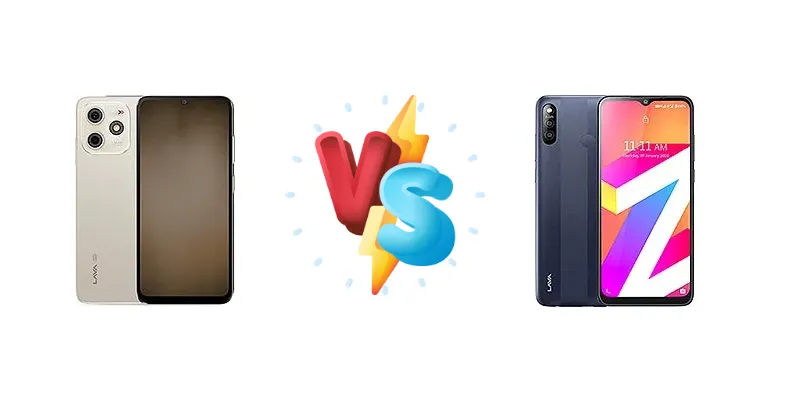
Lava is targeting the entry-level smartphone market with the Bold N1 and Z3 Pro, but these phones take distinctly different approaches. The Bold N1 leverages a newer, more powerful Unisoc T765 chipset, while the Z3 Pro opts for the established, but less potent, MediaTek Helio A25. This comparison dissects the implications of these chipset choices and determines which device delivers the best experience for your money.
🏆 Quick Verdict
For most users, the Lava Bold N1 is the superior choice. Its Unisoc T765 chipset offers a significant performance advantage over the Helio A25 in the Z3 Pro, translating to smoother multitasking and a more responsive user experience. While charging is slower, the performance gains justify the trade-off.
| Network |
|---|
| 2G bands | GSM 850 / 900 / 1800 / 1900 | GSM 900 / 1800 |
| 3G bands | HSDPA 850 / 900 / 2100 | HSDPA 900 / 2100 |
| 4G bands | 1, 3, 5, 8, 28, 40, 41 | 1, 3, 5, 8, 40, 41 |
| 5G bands | 1, 3, 5, 8, 28, 40, 77, 78 SA/NSA | - |
| Speed | HSPA, LTE, 5G | HSPA 42.2/5.76 Mbps, LTE Cat4 150/50 Mbps |
| Technology | GSM / HSPA / LTE / 5G | GSM / HSPA / LTE |
| Launch |
|---|
| Announced | 2025, September 05 | 2022, May 18 |
| Status | Available. Released 2025, September 05 | Available. Released 2022, May 18 |
| Body |
|---|
| Build | - | Glass front, plastic back, plastic frame |
| Dimensions | 165.9 x 76.6 x 8.2 mm (6.53 x 3.02 x 0.32 in) | 164.5 x 75.8 x 8.9 mm (6.48 x 2.98 x 0.35 in) |
| SIM | Nano-SIM + Nano-SIM | Nano-SIM + Nano-SIM |
| Weight | 198 g (6.98 oz) | 192 g (6.77 oz) |
| Display |
|---|
| Resolution | 720 x 1600 pixels, 20:9 ratio (~260 ppi density) | 720 x 1600 pixels, 20:9 ratio (~269 ppi density) |
| Size | 6.75 inches, 110.0 cm2 (~86.6% screen-to-body ratio) | 6.52 inches, 102.6 cm2 (~82.3% screen-to-body ratio) |
| Type | IPS LCD, 90Hz | IPS LCD |
| Platform |
|---|
| CPU | Octa-core (2x2.3 GHz Cortex-A76 & 6x2.1 GHz Cortex-A55) | Octa-core (4x1.8 GHz Cortex-A53 & 4x1.5 GHz Cortex-A53) |
| Chipset | Unisoc T765 (6 nm) | Mediatek MT6762D Helio A25 (12 nm) |
| GPU | Mali-G57 MC2 | PowerVR GE8320 |
| OS | Android 15 | Android 11 |
| Memory |
|---|
| Card slot | microSDXC | microSDXC (dedicated slot) |
| Internal | 64GB 4GB RAM, 128GB 4GB RAM | 32GB 3GB RAM |
| Main Camera |
|---|
| Dual | - | 8 MP, f/2.0, (wide), 1.12µm, AF
Auxiliary lens |
| Features | LED flash, HDR, panorama | LED flash |
| Single | 13 MP, (wide) | - |
| Video | 4K@30fps, 1080p@30fps | 1080p@30fps |
| Selfie camera |
|---|
| Single | 5 MP | 5 MP, f/2.2, (wide) |
| Video | Yes | - |
| Sound |
|---|
| 35mm jack | Yes | Yes |
| Loudspeaker | Yes | Yes |
| Comms |
|---|
| Bluetooth | 4.2, A2DP, LE | 5.0, A2DP, LE |
| NFC | No | No |
| Positioning | GPS, GLONASS | GPS |
| Radio | FM radio | FM radio |
| USB | USB Type-C, OTG | USB Type-C 2.0, OTG |
| WLAN | Wi-Fi 802.11 b/g/n/ac, dual-band | Wi-Fi 802.11 b/g/n/ac, Wi-Fi Direct |
| Features |
|---|
| Sensors | Fingerprint (side-mounted), accelerometer | Fingerprint (rear-mounted), accelerometer, proximity |
| Battery |
|---|
| Charging | 10W wired | - |
| Type | Li-Ion 5000 mAh | Li-Po 5000 mAh |
| Misc |
|---|
| Colors | Royal Blue, Champagne Gold | Blue, Dark Blue |
| Price | ₹ 7,499 | About 80 EUR |
Lava Bold N1
- Significantly faster processor for smoother performance
- More modern chipset architecture (Unisoc T765)
- Potentially better image processing capabilities
- Slower 10W charging
- Potentially shorter battery life due to more powerful processor
- Display specifications unknown
Lava Z3 Pro
- More power-efficient chipset (Helio A25)
- Potentially longer battery life with light usage
- Lower price point (likely)
- Noticeably slower processor for demanding tasks
- Older chipset architecture
- Limited multitasking capabilities
Display Comparison
Display specifications are not provided, so a direct comparison is limited. However, given the price points, both devices likely utilize LCD panels. The Z3 Pro's older chipset suggests a potentially lower display refresh rate. The Bold N1, benefiting from a more modern SoC, *may* support a higher refresh rate, though this is unconfirmed. Bezels are likely comparable, reflecting the budget nature of both phones. Color accuracy will likely be standard for this segment, prioritizing saturation over fidelity.
Camera Comparison
Camera details are limited. Both phones likely feature a multi-camera setup, but the quality will heavily depend on sensor size and image processing. Without specific sensor information, it’s difficult to make a definitive judgment. However, the Bold N1’s more powerful chipset allows for more sophisticated image processing algorithms, potentially resulting in better dynamic range and noise reduction. The presence of a 2MP macro camera on either device is likely a marketing feature with limited real-world utility.
Performance
The core difference lies in the chipsets. The Lava Bold N1’s Unisoc T765, built on a 6nm process, boasts a significant architectural advantage over the Lava Z3 Pro’s MediaTek Helio A25 (12nm). The T765’s octa-core configuration, featuring two Cortex-A76 cores clocked at 2.3 GHz, provides substantially more processing power than the A25’s four Cortex-A53 cores at 1.8 GHz. This translates to faster app loading times, smoother multitasking, and a more fluid overall user experience. The 6nm node also implies better thermal efficiency, potentially reducing throttling during sustained workloads. The A25, while adequate for basic tasks, will struggle with demanding applications and multitasking.
Battery Life
Battery capacity is not specified. However, the Helio A25 in the Z3 Pro is more power-efficient due to its older, less powerful architecture and larger 12nm process. This *could* translate to longer battery life, especially with light usage. The Bold N1’s Unisoc T765, while more powerful, consumes more energy. The Bold N1’s 10W charging is significantly slower than what is commonly found in competing devices, meaning longer recharge times. The Z3 Pro’s charging speed is unknown, but likely similar or slightly faster.
Buying Guide
Buy the Lava Bold N1 if you prioritize performance for social media, light gaming, and everyday tasks. Its more modern chipset will provide a noticeably snappier experience. Buy the Lava Z3 Pro if your primary needs are basic communication – calls, texts, and very light app usage – and you value potential battery longevity over speed. The Helio A25 is more power-efficient, but at the cost of responsiveness.
Frequently Asked Questions
❓ Will the Unisoc T765 in the Lava Bold N1 overheat during prolonged gaming sessions?
While the Unisoc T765 is more powerful, its 6nm process offers improved thermal efficiency compared to the Helio A25's 12nm process. However, given the budget nature of the phone, passive cooling is likely limited. Expect some throttling during extended gaming, but it should be manageable for casual gaming sessions.
❓ Is the Helio A25 in the Lava Z3 Pro sufficient for running popular social media apps like Facebook and WhatsApp?
Yes, the Helio A25 is perfectly adequate for running basic social media applications like Facebook and WhatsApp. These apps are not particularly demanding, and the A25 has enough processing power to handle them smoothly. However, expect slower loading times and potential lag when switching between multiple apps.
❓ Does the Lava Bold N1 support fast charging, and how long does it take to fully charge?
Unfortunately, the Lava Bold N1 only supports 10W wired charging, which is relatively slow compared to modern smartphones. A full charge from 0% to 100% will likely take around 2-3 hours, depending on the charger and battery capacity.
❓ What kind of gaming performance can I expect from the Lava Z3 Pro?
The Lava Z3 Pro is best suited for casual gaming with less demanding titles. Expect low frame rates and graphical settings on popular games like PUBG Mobile. The Helio A25 will struggle with more graphically intensive games.