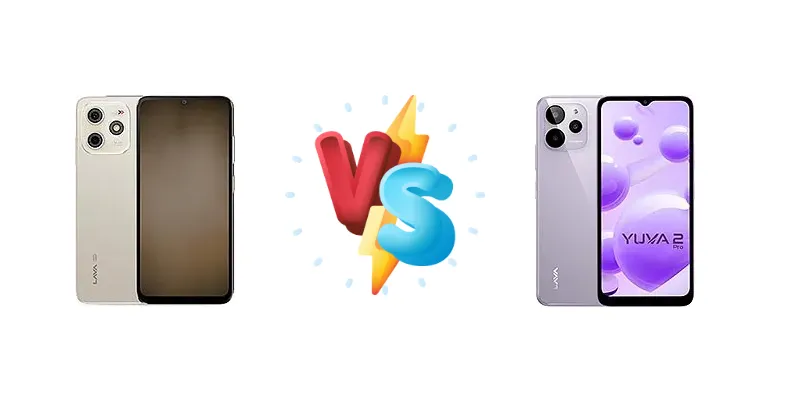
Lava is aggressively targeting the budget smartphone segment with the Bold N1 and Yuva 2 Pro. While both aim to deliver essential features at competitive prices, they diverge significantly in their core processing power. This comparison dissects the architectural differences between the Unisoc T765 and MediaTek Helio G37, revealing which device offers a superior user experience for demanding tasks and everyday use.
🏆 Quick Verdict
For the average user prioritizing responsiveness and future-proofing, the Lava Bold N1 is the better choice. Its Unisoc T765, built on a 6nm process, provides a noticeable performance advantage over the Yuva 2 Pro’s 12nm Helio G37, despite both phones sharing the same 10W charging.
| Network |
|---|
| 2G bands | GSM 850 / 900 / 1800 / 1900 | GSM 900 / 1800 |
| 3G bands | HSDPA 850 / 900 / 2100 | HSDPA 900 / 2100 |
| 4G bands | 1, 3, 5, 8, 28, 40, 41 | 1, 3, 5, 8, 40, 41 |
| 5G bands | 1, 3, 5, 8, 28, 40, 77, 78 SA/NSA | - |
| Speed | HSPA, LTE, 5G | HSPA, LTE |
| Technology | GSM / HSPA / LTE / 5G | GSM / HSPA / LTE |
| Launch |
|---|
| Announced | 2025, September 05 | 2023, February 22 |
| Status | Available. Released 2025, September 05 | Available. Released 2023, February 22 |
| Body |
|---|
| Dimensions | 165.9 x 76.6 x 8.2 mm (6.53 x 3.02 x 0.32 in) | 164.5 x 76 x 9 mm (6.48 x 2.99 x 0.35 in) |
| SIM | Nano-SIM + Nano-SIM | Nano-SIM + Nano-SIM |
| Weight | 198 g (6.98 oz) | 204 g (7.20 oz) |
| Display |
|---|
| Resolution | 720 x 1600 pixels, 20:9 ratio (~260 ppi density) | 720 x 1600 pixels, 20:9 ratio (~269 ppi density) |
| Size | 6.75 inches, 110.0 cm2 (~86.6% screen-to-body ratio) | 6.52 inches, 102.6 cm2 (~82.1% screen-to-body ratio) |
| Type | IPS LCD, 90Hz | IPS LCD |
| Platform |
|---|
| CPU | Octa-core (2x2.3 GHz Cortex-A76 & 6x2.1 GHz Cortex-A55) | Octa-core (4x2.3 GHz Cortex-A53 & 4x1.8 GHz Cortex-A53) |
| Chipset | Unisoc T765 (6 nm) | Mediatek MT6765 Helio G37 (12 nm) |
| GPU | Mali-G57 MC2 | PowerVR GE8320 |
| OS | Android 15 | Android 12 |
| Memory |
|---|
| Card slot | microSDXC | microSDXC (dedicated slot) |
| Internal | 64GB 4GB RAM, 128GB 4GB RAM | 64GB 4GB RAM |
| | - | eMMC 5.1 |
| Main Camera |
|---|
| Features | LED flash, HDR, panorama | LED flash |
| Single | 13 MP, (wide) | 5 MP |
| Triple | - | 13 MP, (wide), AF
VGA
VGA |
| Video | 4K@30fps, 1080p@30fps | 1080p@30fps |
| Selfie camera |
|---|
| Single | 5 MP | 5 MP |
| Video | Yes | Yes |
| Sound |
|---|
| 3.5mm jack | - | Yes |
| 35mm jack | Yes | Yes |
| Loudspeaker | Yes | Yes |
| Comms |
|---|
| Bluetooth | 4.2, A2DP, LE | 5.1, A2DP, LE |
| NFC | No | No |
| Positioning | GPS, GLONASS | GPS |
| Radio | FM radio | FM radio |
| USB | USB Type-C, OTG | USB Type-C 2.0, OTG |
| WLAN | Wi-Fi 802.11 b/g/n/ac, dual-band | Wi-Fi 802.11 b/g/n/ac |
| Features |
|---|
| Sensors | Fingerprint (side-mounted), accelerometer | Fingerprint (side-mounted), accelerometer, proximity |
| Battery |
|---|
| Charging | 10W wired | 10W wired |
| Type | Li-Ion 5000 mAh | Li-Po 5000 mAh |
| Misc |
|---|
| Colors | Royal Blue, Champagne Gold | Glass Lavender, Glass Green, Glass White |
| Models | - | LZX408 |
| Price | ₹ 7,499 | About 90 EUR |
Lava Bold N1
- More powerful Unisoc T765 chipset
- 6nm process for better efficiency
- Superior CPU architecture (Cortex-A76 cores)
- 10W charging is slow
- Display specifications unknown, potentially basic
Lava Yuva 2 Pro
- Potentially lower price point
- Adequate for basic smartphone tasks
- 10W charging is standard for the segment
- Less powerful Helio G37 chipset
- 12nm process less efficient
- Older CPU architecture (Cortex-A53 cores)
Display Comparison
Display specifications are not provided, so a direct comparison is impossible. However, given the price points, both devices likely utilize LCD panels with 720p+ resolution. The absence of information regarding refresh rates or peak brightness suggests neither phone will excel in this area. Users should expect standard viewing experiences suitable for everyday tasks.
Camera Comparison
Camera details are limited. Without sensor size or aperture information, a meaningful comparison is difficult. Both phones likely feature a primary camera alongside auxiliary lenses, potentially including a 2MP macro lens on each. Image processing capabilities will likely be similar, focusing on basic scene optimization. Users shouldn't expect flagship-level camera performance from either device.
Performance
The core difference lies in the chipsets. The Lava Bold N1’s Unisoc T765 (6nm) features a more modern CPU architecture with 2x2.3 GHz Cortex-A76 cores and 6x2.1 GHz Cortex-A55 cores. This contrasts with the Yuva 2 Pro’s MediaTek Helio G37 (12nm) which utilizes 4x2.3 GHz Cortex-A53 cores and 4x1.8 GHz Cortex-A53 cores. The Cortex-A76 cores in the Bold N1 offer significantly higher single-core performance, crucial for app launch speeds and responsiveness. The 6nm fabrication process of the T765 also contributes to improved thermal efficiency, reducing the likelihood of throttling during prolonged use. The Helio G37, while adequate for basic tasks, will struggle with demanding applications and multitasking.
Battery Life
Both the Lava Bold N1 and Yuva 2 Pro support 10W wired charging. While battery capacity isn't specified, the more efficient Unisoc T765 in the Bold N1 will likely result in better real-world battery life despite potentially having a similar capacity to the Yuva 2 Pro. The 6nm process consumes less power, extending usage time between charges. Expect approximately 2-3 hours to fully charge both devices.
Buying Guide
Buy the Lava Bold N1 if you frequently multitask, play graphically intensive games, or value a smoother overall user experience. The more efficient Unisoc T765 chipset will translate to better sustained performance. Buy the Lava Yuva 2 Pro if your primary needs are basic communication, light social media use, and extended battery life with minimal performance demands. It represents a cost-effective option for those prioritizing simplicity and affordability.
Frequently Asked Questions
❓ Will the Lava Bold N1 handle demanding games like PUBG Mobile smoothly?
The Unisoc T765 in the Bold N1 is significantly more capable than the Helio G37. While it won't deliver flagship-level performance, it should be able to run PUBG Mobile at medium settings with acceptable frame rates. The 6nm process will also help mitigate thermal throttling during extended gaming sessions.
❓ Is the 10W charging speed on either phone a significant drawback?
Yes, 10W charging is relatively slow by today's standards. Expect approximately 2-3 hours for a full charge on both devices. This is a compromise to keep the price point low. If fast charging is a priority, you'll need to consider phones in a higher price bracket.
❓ How much of a real-world performance difference will I notice between the Unisoc T765 and Helio G37?
You'll notice a tangible difference in app launch speeds, multitasking, and overall system responsiveness with the Bold N1. The Helio G37 in the Yuva 2 Pro will feel sluggish when handling multiple apps or demanding tasks. The Bold N1 provides a smoother, more fluid user experience.