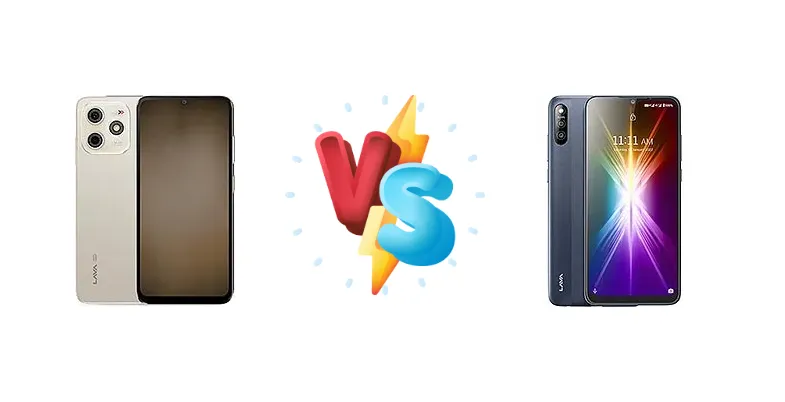
Lava is targeting the budget-conscious smartphone user with the Bold N1 and X2. While both devices aim to deliver essential smartphone functionality, they diverge significantly in their core processing power. The Bold N1 leverages the newer, 6nm Unisoc T765, while the X2 relies on the older, 12nm MediaTek Helio G35. This comparison will dissect these differences to determine which device best suits your needs.
🏆 Quick Verdict
For the average user prioritizing responsiveness and future-proofing, the Lava Bold N1 is the superior choice. Its Unisoc T765 chipset, built on a more efficient 6nm process, delivers noticeably better performance than the Helio G35 in the X2. While the X2 may offer slightly better battery life due to the less powerful chip, the performance gap is significant enough to sway most buyers.
| Network |
|---|
| 2G bands | GSM 850 / 900 / 1800 / 1900 | GSM 900 / 1800 |
| 3G bands | HSDPA 850 / 900 / 2100 | HSDPA 900 / 2100 |
| 4G bands | 1, 3, 5, 8, 28, 40, 41 | 1, 3, 5, 8, 40, 41 |
| 5G bands | 1, 3, 5, 8, 28, 40, 77, 78 SA/NSA | - |
| Speed | HSPA, LTE, 5G | HSPA 42.2/5.76 Mbps, LTE Cat4 150/50 Mbps |
| Technology | GSM / HSPA / LTE / 5G | GSM / HSPA / LTE |
| Launch |
|---|
| Announced | 2025, September 05 | 2022, March 04 |
| Status | Available. Released 2025, September 05 | Available. Released 2022, March 12 |
| Body |
|---|
| Build | - | Glass front, plastic back, plastic frame |
| Dimensions | 165.9 x 76.6 x 8.2 mm (6.53 x 3.02 x 0.32 in) | 165 x 76 x 9 mm (6.50 x 2.99 x 0.35 in) |
| SIM | Nano-SIM + Nano-SIM | Nano-SIM + Nano-SIM |
| Weight | 198 g (6.98 oz) | 192 g (6.77 oz) |
| Display |
|---|
| Resolution | 720 x 1600 pixels, 20:9 ratio (~260 ppi density) | 720 x 1600 pixels, 20:9 ratio (~270 ppi density) |
| Size | 6.75 inches, 110.0 cm2 (~86.6% screen-to-body ratio) | 6.5 inches, 102.0 cm2 (~81.3% screen-to-body ratio) |
| Type | IPS LCD, 90Hz | IPS LCD |
| Platform |
|---|
| CPU | Octa-core (2x2.3 GHz Cortex-A76 & 6x2.1 GHz Cortex-A55) | Octa-core (4x2.3 GHz Cortex-A53 & 4x1.8 GHz Cortex-A53) |
| Chipset | Unisoc T765 (6 nm) | Mediatek MT6765G Helio G35 (12 nm) |
| GPU | Mali-G57 MC2 | PowerVR GE8320 |
| OS | Android 15 | Android 11 (Go edition) |
| Memory |
|---|
| Card slot | microSDXC | microSDXC (dedicated slot) |
| Internal | 64GB 4GB RAM, 128GB 4GB RAM | 32GB 2GB RAM |
| | - | eMMC 5.1 |
| Main Camera |
|---|
| Dual | - | 8 MP, f/2.0, (wide), 1.12µm, AF
Auxiliary lens |
| Features | LED flash, HDR, panorama | LED flash |
| Single | 13 MP, (wide) | - |
| Video | 4K@30fps, 1080p@30fps | 1080p@30fps |
| Selfie camera |
|---|
| Single | 5 MP | 5 MP, f/2.2, (wide) |
| Video | Yes | - |
| Sound |
|---|
| 3.5mm jack | - | Yes |
| 35mm jack | Yes | Yes |
| Loudspeaker | Yes | Yes |
| Comms |
|---|
| Bluetooth | 4.2, A2DP, LE | 5.0, A2DP, LE |
| NFC | No | No |
| Positioning | GPS, GLONASS | GPS |
| Radio | FM radio | FM radio |
| USB | USB Type-C, OTG | USB Type-C 2.0, OTG |
| WLAN | Wi-Fi 802.11 b/g/n/ac, dual-band | Wi-Fi 802.11 b/g/n, Wi-Fi Direct |
| Features |
|---|
| Sensors | Fingerprint (side-mounted), accelerometer | Fingerprint (rear-mounted), accelerometer, proximity |
| Battery |
|---|
| Charging | 10W wired | - |
| Type | Li-Ion 5000 mAh | Li-Po 5000 mAh |
| Misc |
|---|
| Colors | Royal Blue, Champagne Gold | Blue, Cyan |
| Price | ₹ 7,499 | About 80 EUR |
Lava Bold N1
- Significantly faster processor for smoother multitasking.
- More efficient 6nm chipset for better thermal management.
- Potentially better camera performance (assuming a superior main sensor).
- More future-proof for software updates and app compatibility.
- May have slightly shorter battery life compared to the X2.
- 10W charging is relatively slow.
Lava X2
- Potentially longer battery life due to the less powerful chipset.
- More affordable price point.
- Sufficient for basic smartphone tasks.
- 10W charging is standard for this price range.
- Noticeably slower processor, impacting responsiveness.
- Less efficient 12nm chipset, potentially leading to throttling.
- Limited gaming capabilities.
- May struggle with demanding apps and future software updates.
Display Comparison
Display specifications are not provided, so a direct comparison is impossible. However, given the price points, both devices likely feature LCD panels with 720p+ resolution. The X2, with its less powerful chipset, may benefit from a simpler display to conserve power. Expect similar bezel sizes and color accuracy across both models, leaning towards the budget-friendly side.
Camera Comparison
Camera details are limited. Both phones likely feature a multi-camera setup, but without sensor size or aperture information, a meaningful comparison is difficult. It's reasonable to assume the Bold N1, being the higher-tier device, may have a slightly better main sensor. However, the presence of low-resolution auxiliary cameras (often 2MP) on budget phones suggests image quality will be similar in most scenarios, relying heavily on software processing. Expect both to perform adequately in good lighting conditions but struggle in low light.
Performance
The core difference lies in the chipsets. The Lava Bold N1’s Unisoc T765, fabricated on a 6nm process, boasts a more modern CPU architecture – two Cortex-A76 cores alongside six Cortex-A55 cores – compared to the X2’s Helio G35, which uses four Cortex-A53 cores and another four Cortex-A53 cores. The A76 cores in the Bold N1 offer significantly higher single-core performance, crucial for app launch speeds and general responsiveness. The 6nm process also contributes to better thermal efficiency, meaning the Bold N1 is less likely to throttle under sustained load. The Helio G35, while adequate for basic tasks, will struggle with demanding applications and multitasking.
Battery Life
Both devices feature 10W wired charging, indicating a similar charging experience. The X2, with its less power-hungry Helio G35 chipset, will likely exhibit slightly longer battery life on a single charge. However, the Bold N1’s more efficient 6nm process may partially offset this difference. Real-world battery life will depend heavily on usage patterns, but the X2 has a slight advantage in this area.
Buying Guide
Buy the Lava Bold N1 if you frequently multitask, enjoy mobile gaming (even at moderate settings), or want a phone that feels more responsive overall. Its more modern chipset will handle demanding apps and future software updates with greater ease. Buy the Lava X2 if your primary needs are basic communication – calls, texts, and light social media – and you prioritize maximizing battery life above all else. The Helio G35 is sufficient for these tasks, and its lower power draw will translate to longer usage times between charges.
Frequently Asked Questions
❓ Will the Unisoc T765 in the Lava Bold N1 handle popular games like PUBG Mobile?
The Unisoc T765 is capable of running PUBG Mobile, but expect to play at medium settings to maintain a stable frame rate. The GPU isn't a powerhouse, so demanding graphics settings will likely lead to stuttering. The Helio G35 in the X2 will struggle significantly with PUBG Mobile, even at the lowest settings.
❓ Is the 10W charging speed on both phones a significant drawback?
Yes, 10W charging is relatively slow by today's standards. Expect a full charge to take around 2-3 hours. However, given the price points of these devices, faster charging isn't typically expected. Prioritizing battery life and using the phone overnight are viable workarounds.
❓ How much of a real-world performance difference will I notice between the Unisoc T765 and the Helio G35?
The difference will be quite noticeable in everyday tasks. The Bold N1 will feel significantly snappier when opening apps, switching between them, and browsing the web. The X2 may exhibit lag and slowdowns, especially when multitasking. The architectural advantages of the T765 are substantial.