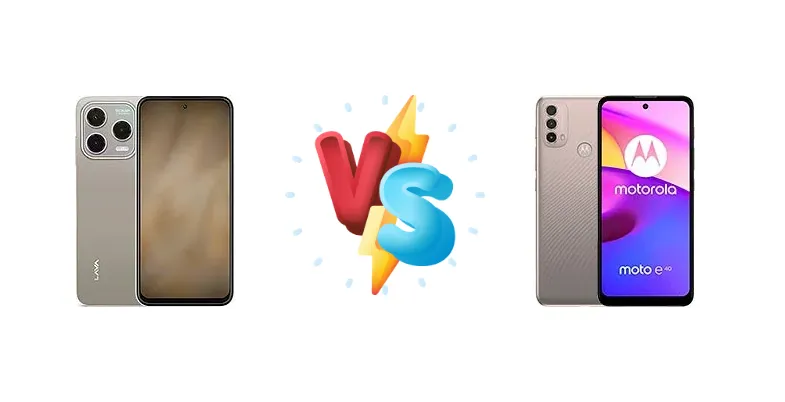
The Lava Bold N1 Pro and Motorola Moto E40 represent the fiercely competitive sub-$150 smartphone market. Both devices rely on Unisoc chipsets to deliver a functional Android experience, but key differences in processing power and architecture dictate which phone offers a smoother, more responsive user experience. This comparison breaks down those differences to help you choose the right device.
🏆 Quick Verdict
For most users, the Motorola Moto E40 emerges as the better choice. Its Unisoc T700 chipset, clocked at 1.8 GHz, provides a noticeable performance advantage over the Lava Bold N1 Pro’s Unisoc T606. While both phones share the same slow 10W charging, the E40’s extra processing headroom makes it more suitable for everyday tasks and light multitasking.
| Network |
|---|
| 2G bands | GSM 900 / 1800 | GSM 850 / 900 / 1800 / 1900 |
| 3G bands | HSDPA 900 / 2100 | HSDPA 850 / 900 / 1700(AWS) / 1900 / 2100 |
| 4G bands | 1, 3, 5, 8, 28, 40, 41 | 1, 2, 3, 4, 5, 7, 8, 19, 28, 40, 66 - Brazil |
| Speed | HSPA, LTE | HSPA 42.2/5.76 Mbps, LTE Cat4 150/50 Mbps |
| Technology | GSM / HSPA / LTE | GSM / HSPA / LTE |
| Launch |
|---|
| Announced | 2025, June 04 | 2021, October 07 |
| Status | Available. Released 2025, June 04 | Available. Released 2021, October 11 |
| Body |
|---|
| Build | - | Glass front, plastic frame, plastic back |
| Dimensions | 165.8 x 77.2 x 8.4 mm (6.53 x 3.04 x 0.33 in) | 165.1 x 75.7 x 9.1 mm (6.5 x 2.98 x 0.36 in) |
| SIM | Nano-SIM + Nano-SIM | · Nano-SIM· Nano-SIM + Nano-SIM |
| Weight | 200 g (7.05 oz) | 198 g (6.98 oz) |
| Display |
|---|
| Resolution | 720 x 1600 pixels, 20:9 ratio (~263 ppi density) | 720 x 1600 pixels, 20:9 ratio (~270 ppi density) |
| Size | 6.67 inches, 107.4 cm2 (~83.9% screen-to-body ratio) | 6.5 inches, 102.0 cm2 (~81.6% screen-to-body ratio) |
| Type | IPS LCD, 120Hz | IPS LCD, 90Hz |
| Platform |
|---|
| CPU | Octa-core (2x1.6 GHz Cortex-A75 & 6x1.6 GHz Cortex-A55) | Octa-core 1.8 GHz |
| Chipset | Unisoc T606 (12 nm) | Unisoc T700 |
| GPU | Mali-G57 MP1 | Mali G52 |
| OS | Android 14 | Android 11 |
| Memory |
|---|
| Card slot | microSDXC | microSDXC (dedicated slot) |
| Internal | 128GB 4GB RAM | 64GB 4GB RAM |
| | - | eMMC 5.1 |
| Main Camera |
|---|
| Features | LED flash, HDR, panorama | LED flash, HDR, panorama |
| Single | 50 MP, (wide), PDAF | - |
| Triple | - | 48 MP, f/2.0, 26mm (wide), PDAF
2 MP (macro)
Auxiliary lens |
| Video | 1080p@30fps | 1080p@30fps |
| Selfie camera |
|---|
| Features | - | HDR |
| Single | 8 MP | 8 MP, f/2.0 |
| Video | Yes | 1080p@30fps |
| Sound |
|---|
| 3.5mm jack | - | Yes |
| 35mm jack | Yes | Yes |
| Loudspeaker | Yes | Yes |
| Comms |
|---|
| Bluetooth | 5.0, A2DP, LE | 5.0, A2DP, LE |
| NFC | No | No |
| Positioning | GPS, GLONASS | GPS, GLONASS, GALILEO |
| Radio | FM radio | FM radio |
| USB | USB Type-C, OTG | USB Type-C 2.0 |
| WLAN | Wi-Fi 802.11 b/g/n/ac | Wi-Fi 802.11 b/g/n |
| Features |
|---|
| Sensors | Fingerprint (side-mounted), accelerometer, proximity | Fingerprint (rear-mounted), accelerometer, proximity |
| Battery |
|---|
| Charging | 10W wired | 10W wired |
| Type | Li-Ion 5000 mAh | Li-Po 5000 mAh |
| Misc |
|---|
| Colors | Titanium Gold, Stealth Black | Carbon Gray, Pink Clay |
| Price | ₹ 6,799 | About 90 EUR |
Lava Bold N1 Pro
- Potentially more durable build quality (Lava brand reputation)
- Functional for basic smartphone tasks
- Affordable price point
- Slower Unisoc T606 chipset
- Limited performance for multitasking
- Slow 10W charging
Motorola Moto E40
- Faster Unisoc T700 chipset
- Smoother app launches and multitasking
- More responsive user interface
- Slow 10W charging
- Basic camera system
- Potentially less robust build quality
Display Comparison
Neither Lava nor Motorola provide detailed display specifications beyond the basic panel type. Given the price point, both likely utilize IPS LCD panels. The key difference lies in the processing power driving them. A faster chipset, like the T700 in the Moto E40, can contribute to smoother scrolling and animations, even on an identical panel. Without knowing the peak brightness or color gamut coverage, it’s difficult to definitively declare a winner, but the E40’s superior processing power indirectly benefits the display experience.
Camera Comparison
Both phones likely feature basic camera setups geared towards casual photography. Without detailed sensor size or aperture information, it’s challenging to make a direct comparison. However, the processing power of the Unisoc T700 in the Moto E40 will likely result in faster image processing and potentially better low-light performance. The inclusion of a 2MP macro camera on both devices is largely a marketing tactic, offering limited practical benefit due to the small sensor size and lack of optical image stabilization. The primary camera’s performance will be the deciding factor, and the E40’s chipset gives it an edge.
Performance
The Motorola Moto E40’s Unisoc T700 is the clear performance leader. While both chipsets are octa-core, the T700’s 1.8 GHz clock speed represents a 12.5% increase over the Lava Bold N1 Pro’s 1.6 GHz. Furthermore, the T700’s core configuration, while not explicitly detailed, is likely optimized for sustained performance. The Lava Bold N1 Pro utilizes a Cortex-A75/A55 mix, which is a good architecture for its class, but the lower clock speed limits its potential. This translates to faster app loading times and smoother multitasking on the Moto E40, particularly noticeable when switching between several applications.
Battery Life
Both the Lava Bold N1 Pro and Motorola Moto E40 are equipped with 10W wired charging, a significant limitation in today’s market. This slow charging speed means both phones will take a considerable amount of time to fully charge – likely exceeding 3 hours. Battery capacity isn’t specified, but given the price point, both likely house batteries in the 4000-5000 mAh range. The Moto E40’s more efficient chipset may contribute to slightly better battery life, but the difference will likely be marginal. The slow charging speed is the biggest drawback for both devices.
Buying Guide
Buy the Lava Bold N1 Pro if you prioritize a potentially more durable build quality (based on Lava’s brand reputation) and are comfortable with a slightly slower overall experience. Buy the Motorola Moto E40 if you value smoother app launches, quicker multitasking, and a more responsive user interface, even if it means sacrificing a small amount of perceived build robustness. Both are excellent choices for first-time smartphone users or those needing a reliable secondary device.
Frequently Asked Questions
❓ Will the Motorola Moto E40 struggle with popular apps like WhatsApp and Facebook?
While the Moto E40 isn't a powerhouse, the Unisoc T700 chipset is sufficiently capable of running popular apps like WhatsApp and Facebook smoothly. You may experience slight delays when loading these apps initially, but everyday usage should be acceptable. Avoid running too many apps simultaneously to prevent performance slowdown.
❓ Is the 10W charging on either phone really that bad?
Yes, 10W charging is significantly slower than the charging speeds offered by many modern smartphones. Expect a full charge to take over 3 hours. This is a major drawback for both devices, making overnight charging essential. It's best to top up the battery whenever possible rather than waiting for it to drain completely.
❓ Can the Lava Bold N1 Pro handle basic mobile gaming?
The Lava Bold N1 Pro can handle very basic mobile games, but don't expect a smooth experience with graphically demanding titles. The Unisoc T606 chipset will struggle with higher frame rates and detailed graphics. Stick to simpler games to avoid significant lag and stuttering.
❓ Does the Motorola Moto E40 support VoLTE and VoWiFi?
The Motorola Moto E40 *should* support VoLTE (Voice over LTE) and VoWiFi (Voice over Wi-Fi), but compatibility depends on your carrier. It's crucial to check with your mobile network operator to ensure these features are supported in your region before purchasing.