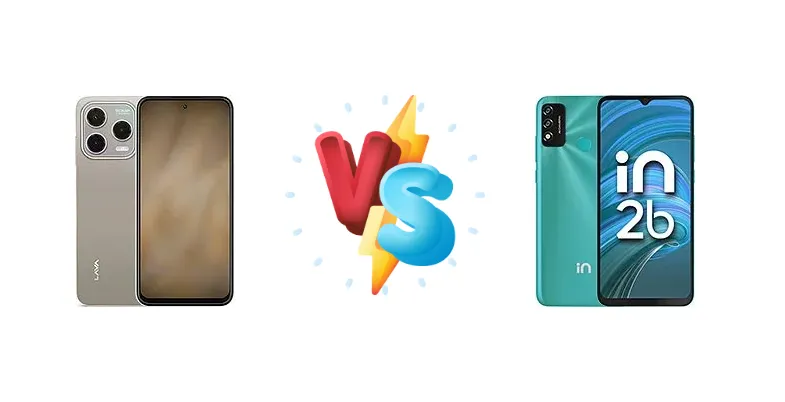
The Lava Bold N1 Pro and Micromax In 2b represent a resurgence of Indian smartphone brands aiming for the value-conscious consumer. Both devices leverage Unisoc chipsets to deliver an affordable Android experience, but subtle differences in processing power and overall design create distinct user experiences. This comparison dissects these nuances to determine which phone offers the most compelling package.
🏆 Quick Verdict
For most users, the Micromax In 2b emerges as the slightly better choice. Its Unisoc T610, with higher clocked Cortex-A75 cores, provides a noticeable performance edge in everyday tasks and light gaming. While both phones share the same slow 10W charging, the In 2b’s marginal performance boost justifies the likely price difference.
| Network |
|---|
| 2G bands | GSM 900 / 1800 | GSM 850 / 900 / 1800 / 1900 |
| 3G bands | HSDPA 900 / 2100 | HSDPA 850 / 2100 |
| 4G bands | 1, 3, 5, 8, 28, 40, 41 | 1, 3, 5, 8, 38, 40, 41 |
| Speed | HSPA, LTE | HSPA, LTE |
| Technology | GSM / HSPA / LTE | GSM / HSPA / LTE |
| Launch |
|---|
| Announced | 2025, June 04 | 2021, July 30. Released 2021, August 06 |
| Status | Available. Released 2025, June 04 | Discontinued |
| Body |
|---|
| Dimensions | 165.8 x 77.2 x 8.4 mm (6.53 x 3.04 x 0.33 in) | 164.3 x 75.7 x 8.6 mm (6.47 x 2.98 x 0.34 in) |
| SIM | Nano-SIM + Nano-SIM | Nano-SIM + Nano-SIM |
| Weight | 200 g (7.05 oz) | 190 g (6.70 oz) |
| Display |
|---|
| Resolution | 720 x 1600 pixels, 20:9 ratio (~263 ppi density) | 720 x 1600 pixels, 20:9 ratio (~269 ppi density) |
| Size | 6.67 inches, 107.4 cm2 (~83.9% screen-to-body ratio) | 6.52 inches, 102.6 cm2 (~82.5% screen-to-body ratio) |
| Type | IPS LCD, 120Hz | IPS LCD, 400 nits (typ) |
| Platform |
|---|
| CPU | Octa-core (2x1.6 GHz Cortex-A75 & 6x1.6 GHz Cortex-A55) | Octa-core (2x1.8 GHz Cortex-A75 & 6x1.8 GHz Cortex-A55) |
| Chipset | Unisoc T606 (12 nm) | Unisoc T610 (12 nm) |
| GPU | Mali-G57 MP1 | Mali-G52 MP2 |
| OS | Android 14 | Android 11 |
| Memory |
|---|
| Card slot | microSDXC | microSDXC (dedicated slot) |
| Internal | 128GB 4GB RAM | 64GB 4GB RAM, 64GB 6GB RAM |
| | - | eMMC 5.1 |
| Main Camera |
|---|
| Dual | - | 13 MP, f/1.8, 27mm (wide), 1/3.0", 1.12µm, PDAF
Auxiliary lens |
| Features | LED flash, HDR, panorama | LED flash, HDR, panorama |
| Single | 50 MP, (wide), PDAF | 5 MP, f/2.2 |
| Video | 1080p@30fps | 1080p@30fps |
| Selfie camera |
|---|
| Features | - | HDR |
| Single | 8 MP | 5 MP, f/2.2 |
| Video | Yes | Unspecified |
| Sound |
|---|
| 3.5mm jack | - | Yes |
| 35mm jack | Yes | Yes |
| Loudspeaker | Yes | Yes |
| Comms |
|---|
| Bluetooth | 5.0, A2DP, LE | 5.0, A2DP, LE |
| NFC | No | No |
| Positioning | GPS, GLONASS | GPS, GLONASS, GALILEO, BDS |
| Radio | FM radio | Unspecified |
| USB | USB Type-C, OTG | USB Type-C 2.0, OTG |
| WLAN | Wi-Fi 802.11 b/g/n/ac | Wi-Fi 802.11 a/b/g/n/ac, Wi-Fi Direct |
| Features |
|---|
| Sensors | Fingerprint (side-mounted), accelerometer, proximity | Fingerprint (rear-mounted), accelerometer, proximity |
| Battery |
|---|
| Charging | 10W wired | 10W wired |
| Type | Li-Ion 5000 mAh | Li-Po 5000 mAh |
| Misc |
|---|
| Colors | Titanium Gold, Stealth Black | Blue, Black, Green |
| Models | - | E7544 |
| Price | ₹ 6,799 | About 90 EUR |
| SAR | - | 0.85 W/kg (head) 1.13 W/kg (body) |
Lava Bold N1 Pro
- Potentially lower price point
- Reliable brand reputation (Lava)
- Adequate for basic smartphone tasks
- Slower processor (Unisoc T606)
- Slow 10W charging
- Limited detailed specifications
Micromax In 2b
- Faster processor (Unisoc T610)
- Slightly smoother user experience
- Potentially better multitasking
- Slow 10W charging
- Limited detailed specifications
- May be slightly more expensive
Display Comparison
Neither Lava nor Micromax provide detailed display specifications beyond resolution. Given the price bracket, both likely utilize IPS LCD panels. The absence of information regarding peak brightness, color gamut coverage, or refresh rates suggests a focus on cost reduction. Bezels are expected to be relatively thick on both devices, impacting the overall screen-to-body ratio. Color accuracy is likely to be standard for this segment, prioritizing power efficiency over vibrant visuals.
Camera Comparison
Detailed camera specifications are scarce for both devices. It’s safe to assume both feature a primary camera and potentially a depth or macro sensor. However, without knowing sensor sizes, lens apertures, or image processing algorithms, a direct comparison is difficult. The marketing materials for both phones tend to emphasize megapixel count over image quality, suggesting a focus on appealing to less discerning consumers. Users shouldn't expect flagship-level camera performance from either device; they are adequate for casual snapshots in good lighting conditions.
Performance
The core difference lies in the chipsets: the Lava Bold N1 Pro features the Unisoc T606, while the Micromax In 2b utilizes the Unisoc T610. Both are 12nm chips with an octa-core configuration (2x Cortex-A75 & 6x Cortex-A55), but the In 2b’s T610 boasts a higher clock speed of 1.8 GHz for both the A75 and A55 cores, compared to the N1 Pro’s 1.6 GHz. This 200 MHz increase translates to a tangible, albeit not massive, performance improvement in CPU-bound tasks. While both likely pair with similar amounts of LPDDR4X RAM, the faster CPU in the In 2b will result in snappier app launches and smoother multitasking. Thermal management is unlikely to be a significant concern with these low-power chipsets, but sustained loads may lead to some throttling.
Battery Life
Both the Lava Bold N1 Pro and Micromax In 2b are equipped with 10W wired charging, a significant drawback in today’s fast-charging landscape. Expect a full charge to take well over two hours. Battery capacity is not specified, but given the target price point, both likely house batteries in the 4000-5000 mAh range. Real-world battery life will depend heavily on usage patterns, but both phones should comfortably last a full day with moderate use. The slow charging speed means topping up throughout the day is inconvenient.
Buying Guide
Buy the Lava Bold N1 Pro if you prioritize a potentially lower price point and are primarily focused on basic smartphone functions like calling, texting, and light social media use. Buy the Micromax In 2b if you prefer a smoother experience with slightly faster app loading times and a bit more headroom for multitasking and casual gaming, even if it means spending a little more.
Frequently Asked Questions
❓ Will the Micromax In 2b handle popular games like PUBG Mobile or Call of Duty?
While the Unisoc T610 can run these games, expect to play them at low to medium settings to maintain a playable frame rate. The chip isn't designed for demanding graphics, and prolonged gaming sessions may result in some thermal throttling. It's suitable for casual gaming, but not for competitive, high-graphics experiences.
❓ Is the 10W charging speed a dealbreaker in 2024?
Yes, the 10W charging is a significant drawback. Modern smartphones often offer 33W or even 65W charging, drastically reducing charge times. With these phones, a full charge will take over two hours, making it inconvenient to quickly top up the battery during the day. This is a clear cost-saving measure by both manufacturers.
❓ How does the Unisoc T610 compare to the MediaTek Helio G85 in terms of gaming performance?
The MediaTek Helio G85 generally offers slightly better GPU performance than the Unisoc T610, making it a marginally better choice for gaming. However, the difference isn't massive, and both chips are suitable for casual gaming at lower settings. The T610's CPU performance is competitive with the G85.