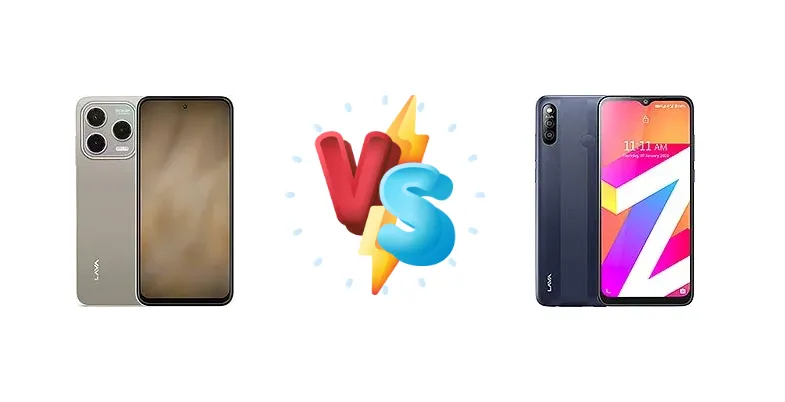
Lava is making waves in the budget smartphone space with the Bold N1 Pro and Z3 Pro, both aiming to deliver essential features at incredibly competitive prices. However, beneath the similar price points lie significant differences in their core hardware, particularly in the chipset. This comparison dissects those differences to determine which phone offers the best value for your money.
🏆 Quick Verdict
For the average user prioritizing responsiveness and sustained performance, the Lava Bold N1 Pro is the better choice. Its Unisoc T606 chipset, featuring Cortex-A75 cores, provides a noticeable advantage over the Z3 Pro’s Helio A25, especially when multitasking or running demanding applications. While both offer similar battery capacity, the N1 Pro’s more efficient processor translates to potentially longer real-world usage.
| Network |
|---|
| 2G bands | GSM 900 / 1800 | GSM 900 / 1800 |
| 3G bands | HSDPA 900 / 2100 | HSDPA 900 / 2100 |
| 4G bands | 1, 3, 5, 8, 28, 40, 41 | 1, 3, 5, 8, 40, 41 |
| Speed | HSPA, LTE | HSPA 42.2/5.76 Mbps, LTE Cat4 150/50 Mbps |
| Technology | GSM / HSPA / LTE | GSM / HSPA / LTE |
| Launch |
|---|
| Announced | 2025, June 04 | 2022, May 18 |
| Status | Available. Released 2025, June 04 | Available. Released 2022, May 18 |
| Body |
|---|
| Build | - | Glass front, plastic back, plastic frame |
| Dimensions | 165.8 x 77.2 x 8.4 mm (6.53 x 3.04 x 0.33 in) | 164.5 x 75.8 x 8.9 mm (6.48 x 2.98 x 0.35 in) |
| SIM | Nano-SIM + Nano-SIM | Nano-SIM + Nano-SIM |
| Weight | 200 g (7.05 oz) | 192 g (6.77 oz) |
| Display |
|---|
| Resolution | 720 x 1600 pixels, 20:9 ratio (~263 ppi density) | 720 x 1600 pixels, 20:9 ratio (~269 ppi density) |
| Size | 6.67 inches, 107.4 cm2 (~83.9% screen-to-body ratio) | 6.52 inches, 102.6 cm2 (~82.3% screen-to-body ratio) |
| Type | IPS LCD, 120Hz | IPS LCD |
| Platform |
|---|
| CPU | Octa-core (2x1.6 GHz Cortex-A75 & 6x1.6 GHz Cortex-A55) | Octa-core (4x1.8 GHz Cortex-A53 & 4x1.5 GHz Cortex-A53) |
| Chipset | Unisoc T606 (12 nm) | Mediatek MT6762D Helio A25 (12 nm) |
| GPU | Mali-G57 MP1 | PowerVR GE8320 |
| OS | Android 14 | Android 11 |
| Memory |
|---|
| Card slot | microSDXC | microSDXC (dedicated slot) |
| Internal | 128GB 4GB RAM | 32GB 3GB RAM |
| Main Camera |
|---|
| Dual | - | 8 MP, f/2.0, (wide), 1.12µm, AF
Auxiliary lens |
| Features | LED flash, HDR, panorama | LED flash |
| Single | 50 MP, (wide), PDAF | - |
| Video | 1080p@30fps | 1080p@30fps |
| Selfie camera |
|---|
| Single | 8 MP | 5 MP, f/2.2, (wide) |
| Video | Yes | - |
| Sound |
|---|
| 35mm jack | Yes | Yes |
| Loudspeaker | Yes | Yes |
| Comms |
|---|
| Bluetooth | 5.0, A2DP, LE | 5.0, A2DP, LE |
| NFC | No | No |
| Positioning | GPS, GLONASS | GPS |
| Radio | FM radio | FM radio |
| USB | USB Type-C, OTG | USB Type-C 2.0, OTG |
| WLAN | Wi-Fi 802.11 b/g/n/ac | Wi-Fi 802.11 b/g/n/ac, Wi-Fi Direct |
| Features |
|---|
| Sensors | Fingerprint (side-mounted), accelerometer, proximity | Fingerprint (rear-mounted), accelerometer, proximity |
| Battery |
|---|
| Charging | 10W wired | - |
| Type | Li-Ion 5000 mAh | Li-Po 5000 mAh |
| Misc |
|---|
| Colors | Titanium Gold, Stealth Black | Blue, Dark Blue |
| Price | ₹ 6,799 | About 80 EUR |
Lava Bold N1 Pro
- More powerful Unisoc T606 chipset
- More efficient CPU architecture for better battery life
- Potentially smoother multitasking experience
- 10W charging is slow
- Camera specs are currently unknown
Lava Z3 Pro
- Lower price point (likely)
- Suitable for basic smartphone tasks
- Simple and easy-to-use interface
- Less powerful Helio A25 chipset
- Less responsive user experience
- Struggles with multitasking and demanding apps
Display Comparison
Both the Lava Bold N1 Pro and Z3 Pro likely feature similar LCD panels, given their price bracket. Specific details like resolution and peak brightness are not provided, but we can assume they target a standard 720p+ resolution. The absence of information regarding PWM dimming rates makes it difficult to assess potential eye strain, but users sensitive to flicker should research further. Bezels are expected to be relatively thick on both devices, consistent with their budget positioning.
Camera Comparison
Without detailed camera specifications, a direct comparison is challenging. However, it’s safe to assume both phones feature basic camera setups. The presence of a 2MP macro camera on either device is likely more for marketing than practical use. Image quality will heavily rely on software processing and sensor size, which are currently unknown. The aperture of the main sensor will be a critical factor, but without that information, it’s difficult to determine which phone will perform better in low-light conditions.
Performance
The core difference lies in the chipsets. The Lava Bold N1 Pro’s Unisoc T606 utilizes a more modern CPU architecture with 2x 1.6 GHz Cortex-A75 cores and 6x 1.6 GHz Cortex-A55 cores. This configuration provides a significant performance boost over the Lava Z3 Pro’s MediaTek Helio A25, which employs 4x 1.8 GHz Cortex-A53 cores and 4x 1.5 GHz Cortex-A53 cores. The A75 cores in the N1 Pro are substantially more powerful than the A53 cores in the Z3 Pro, resulting in faster app loading times and smoother multitasking. While both are 12nm chips, the architectural advantage of the T606 is key. The Z3 Pro’s Helio A25 is geared towards basic tasks, while the N1 Pro can handle more demanding applications with greater ease.
Battery Life
Both devices are expected to have similar battery capacities, typical for this price range (likely around 4000-5000 mAh). However, the Unisoc T606 in the Lava Bold N1 Pro is more power-efficient than the Helio A25 in the Z3 Pro. This efficiency translates to potentially longer battery life for the N1 Pro, despite both phones featuring slow 10W wired charging. Expect approximately 2.5-3.5 hours to fully charge either device.
Buying Guide
Buy the Lava Bold N1 Pro if you need a phone capable of handling moderate multitasking, occasional gaming, and benefit from a slightly more responsive user experience. It’s ideal for users who frequently switch between apps or use social media extensively. Buy the Lava Z3 Pro if your primary needs are basic communication – calls, texts, and light web browsing – and you prioritize a lower upfront cost above all else. It’s a suitable option for first-time smartphone users or those on a very tight budget.
Frequently Asked Questions
❓ Will the Lava Bold N1 Pro handle popular games like PUBG Mobile or Call of Duty?
While the Unisoc T606 can run these games, expect to play at lower graphics settings and frame rates to maintain a stable experience. It's not a gaming powerhouse, but it's capable of casual gaming sessions. The Helio A25 in the Z3 Pro will struggle significantly with these titles.
❓ Is the 10W charging speed on both phones a major drawback?
Yes, 10W charging is quite slow by today's standards. Expect a full charge to take over 2.5 hours. This is a compromise made to keep the price down, and it's a significant inconvenience if you frequently need to top up your battery quickly.
❓ How much RAM does each phone have, and will that impact performance?
The context data doesn't specify RAM amounts. However, assuming both have 2-3GB of RAM, the Bold N1 Pro's more efficient processor will manage that RAM more effectively, leading to less app reloading and a smoother overall experience.
❓ Does the Lava Z3 Pro support VoLTE and VoWiFi for improved call quality?
This information isn't provided. However, given its target market, it's likely to support VoLTE, but VoWiFi support is less certain. Check with Lava's official specifications or your carrier for confirmation.