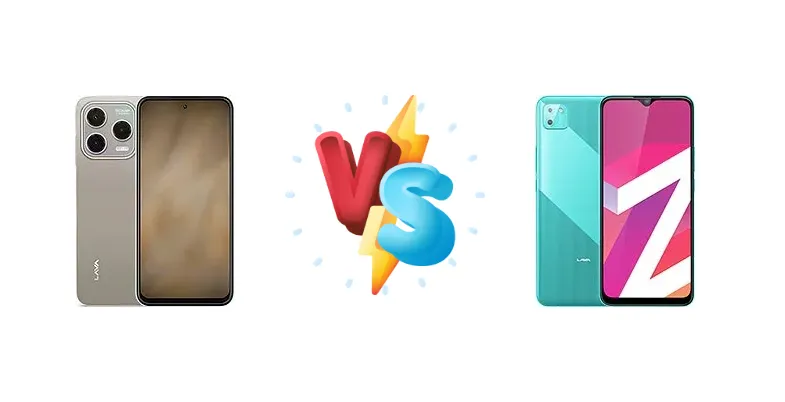
Lava is targeting the entry-level smartphone market with the Bold N1 Pro and Z2 Max. While both aim to provide affordable connectivity, they differ significantly in their internal hardware. This comparison dissects those differences, focusing on the core performance implications of the Unisoc T606 in the Bold N1 Pro versus the quad-core processor in the Z2 Max, helping you determine which device best suits your needs.
🏆 Quick Verdict
For the average user prioritizing responsiveness and multitasking, the Lava Bold N1 Pro is the clear winner. Its Unisoc T606 chipset, with its octa-core configuration, offers a substantial performance advantage over the Z2 Max’s quad-core processor, making it better suited for modern app usage and light gaming.
| Network |
|---|
| 2G bands | GSM 900 / 1800 | GSM 850 / 900 / 1800 / 1900 |
| 3G bands | HSDPA 900 / 2100 | HSDPA 900 / 2100 |
| 4G bands | 1, 3, 5, 8, 28, 40, 41 | 1, 3, 5, 8, 40, 41 |
| Speed | HSPA, LTE | HSPA 42.2/5.76 Mbps, LTE Cat4 150/50 Mbps |
| Technology | GSM / HSPA / LTE | GSM / HSPA / LTE |
| Launch |
|---|
| Announced | 2025, June 04 | 2021, May 11 |
| Status | Available. Released 2025, June 04 | Available. Released 2021, May 11 |
| Body |
|---|
| Build | - | Glass front, plastic back, plastic frame |
| Dimensions | 165.8 x 77.2 x 8.4 mm (6.53 x 3.04 x 0.33 in) | 174.7 x 78.6 x 9.1 mm (6.88 x 3.09 x 0.36 in) |
| SIM | Nano-SIM + Nano-SIM | Nano-SIM + Nano-SIM |
| Weight | 200 g (7.05 oz) | 216 g (7.62 oz) |
| Display |
|---|
| Protection | - | Corning Gorilla Glass 3 |
| Resolution | 720 x 1600 pixels, 20:9 ratio (~263 ppi density) | 720 x 1640 pixels (~256 ppi density) |
| Size | 6.67 inches, 107.4 cm2 (~83.9% screen-to-body ratio) | 7.0 inches, 116.4 cm2 (~84.7% screen-to-body ratio) |
| Type | IPS LCD, 120Hz | IPS LCD |
| Platform |
|---|
| CPU | Octa-core (2x1.6 GHz Cortex-A75 & 6x1.6 GHz Cortex-A55) | Quad-core 1.8 GHz |
| Chipset | Unisoc T606 (12 nm) | - |
| GPU | Mali-G57 MP1 | - |
| OS | Android 14 | Android 10 (Go edition) |
| Memory |
|---|
| Card slot | microSDXC | microSDXC (dedicated slot) |
| Internal | 128GB 4GB RAM | 32GB 2GB RAM |
| | - | eMMC 5.1 |
| Main Camera |
|---|
| Dual | - | 13 MP, f/1.9, (wide), 1/3.0", 1.12µm, AF
Auxiliary lens |
| Features | LED flash, HDR, panorama | LED flash |
| Single | 50 MP, (wide), PDAF | 8 MP, f/2.0, (wide), 1.12µm |
| Video | 1080p@30fps | 720p@30fps |
| Selfie camera |
|---|
| Single | 8 MP | 8 MP, f/2.0, (wide), 1.12µm |
| Video | Yes | - |
| Sound |
|---|
| 3.5mm jack | - | Yes |
| 35mm jack | Yes | Yes |
| Loudspeaker | Yes | Yes |
| Comms |
|---|
| Bluetooth | 5.0, A2DP, LE | 5.0, A2DP, LE |
| NFC | No | No |
| Positioning | GPS, GLONASS | GPS |
| Radio | FM radio | FM radio |
| USB | USB Type-C, OTG | USB Type-C 2.0, OTG |
| WLAN | Wi-Fi 802.11 b/g/n/ac | Wi-Fi 802.11 b/g/n, Wi-Fi Direct |
| Features |
|---|
| Sensors | Fingerprint (side-mounted), accelerometer, proximity | Accelerometer |
| Battery |
|---|
| Charging | 10W wired | - |
| Type | Li-Ion 5000 mAh | Li-Po 6000 mAh |
| Misc |
|---|
| Colors | Titanium Gold, Stealth Black | Stroked Blue, Stroked Cyan |
| Models | - | LS0001 |
| Price | ₹ 6,799 | About 90 EUR |
Lava Bold N1 Pro
- Significantly faster processor with octa-core architecture.
- More responsive user experience for multitasking.
- Potentially better power efficiency with the 12nm Unisoc T606.
- Slower 10W charging.
- Limited camera details suggest average image quality.
Lava Z2 Max
- Simpler user experience for basic tasks.
- Potentially longer battery life due to less demanding processor (speculative).
- Likely more affordable price point.
- Quad-core processor will struggle with multitasking and demanding apps.
- Limited performance for modern smartphone usage.
Display Comparison
Display specifications are not provided for either device. However, given the price point, it's reasonable to assume both utilize LCD panels. The absence of details like resolution, refresh rate, or brightness makes a direct comparison impossible. Users should prioritize in-person viewing to assess color accuracy and visibility in sunlight.
Camera Comparison
Camera details are limited. Without sensor size, aperture, or image processing information, a meaningful comparison is difficult. It’s likely both phones feature basic camera setups geared towards casual photography. The absence of details suggests neither phone will excel in low-light conditions or offer advanced features like optical image stabilization (OIS). Users should manage expectations accordingly.
Performance
The Lava Bold N1 Pro’s Unisoc T606 is a significant step up from the Z2 Max’s quad-core processor. The T606’s octa-core architecture, featuring two Cortex-A75 cores clocked at 1.6 GHz and six Cortex-A55 cores also at 1.6 GHz, provides a more balanced approach to performance. The A75 cores handle demanding tasks, while the A55 cores efficiently manage background processes. This contrasts sharply with the Z2 Max’s quad-core processor, which, while adequate for basic tasks, will likely struggle with multitasking or more resource-intensive applications. The T606’s 12nm process node also suggests better power efficiency compared to older, larger node processors often found in this price bracket.
Battery Life
Battery capacity is not specified for either device. However, the Lava Bold N1 Pro’s 10W wired charging suggests a slower charging speed. The Z2 Max, lacking charging specifications, may or may not offer faster charging. The more efficient Unisoc T606 in the Bold N1 Pro *could* offset a potentially smaller battery capacity, providing comparable real-world battery life, but this is speculative without knowing the battery sizes.
Buying Guide
Buy the Lava Bold N1 Pro if you need a phone capable of handling multiple apps simultaneously, enjoy occasional gaming, or simply want a smoother, more responsive user experience. Buy the Lava Z2 Max if your primary needs are basic communication – calls and texts – and you prioritize simplicity and potentially longer battery life due to the less demanding processor. The Z2 Max is best suited for first-time smartphone users or those with extremely limited usage patterns.
Frequently Asked Questions
❓ Will the Lava Bold N1 Pro be able to run popular social media apps like Facebook and Instagram smoothly?
Yes, the Unisoc T606 chipset in the Lava Bold N1 Pro is more than capable of running popular social media apps smoothly. The octa-core configuration and Cortex-A75 cores provide sufficient processing power for these applications, even with multiple apps open simultaneously.
❓ Is the Lava Z2 Max suitable for someone who primarily uses their phone for making calls and sending text messages?
Absolutely. The Lava Z2 Max is well-suited for users with basic communication needs. Its quad-core processor is sufficient for making calls, sending texts, and using simple applications. It prioritizes simplicity and potentially longer battery life over demanding performance.
❓ Can I expect to play modern mobile games on the Lava Bold N1 Pro?
While the Lava Bold N1 Pro can handle some mobile games, it's not a gaming powerhouse. Less demanding titles will run acceptably, but graphically intensive games may require lower settings to maintain a playable frame rate. The Unisoc T606 is an entry-level gaming chipset.