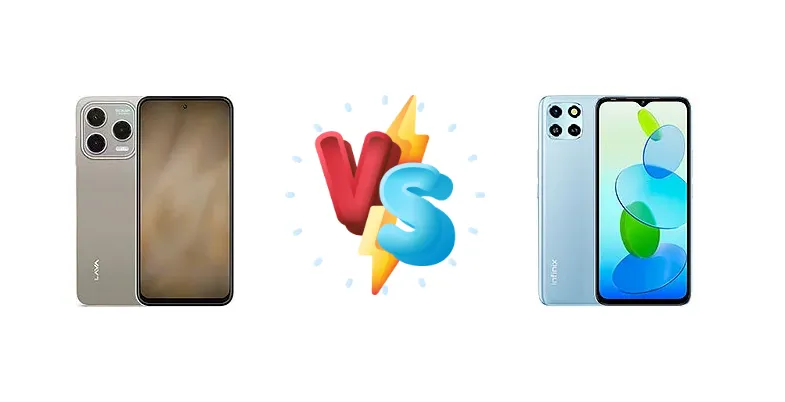
The Lava Bold N1 Pro and Infinix Smart 6 HD represent the fiercely competitive sub-$150 smartphone market. Both aim to deliver essential smartphone functionality at an accessible price point, but they take different approaches to achieving this. This comparison dissects their core components to determine which device offers the best experience for the budget-conscious user.
🏆 Quick Verdict
For most users, the Lava Bold N1 Pro emerges as the better choice. Its newer Unisoc T606 chipset, built on a more efficient 12nm process, provides a noticeable performance advantage over the Infinix Smart 6 HD’s older 28nm Unisoc SC9863A, making it more responsive for everyday tasks.
| Network |
|---|
| 2G bands | GSM 900 / 1800 | GSM 850 / 900 / 1800 / 1900 |
| 3G bands | HSDPA 900 / 2100 | HSDPA 850 / 900 / 2100 |
| 4G bands | 1, 3, 5, 8, 28, 40, 41 | 1, 3, 5, 8, 38, 40, 41 |
| Speed | HSPA, LTE | HSPA, LTE |
| Technology | GSM / HSPA / LTE | GSM / HSPA / LTE |
| | - | 1, 3, 7, 8, 20 |
| Launch |
|---|
| Announced | 2025, June 04 | 2022, April 26 |
| Status | Available. Released 2025, June 04 | Available. Released 2022, April 26 |
| Body |
|---|
| Build | - | Glass front, plastic back, plastic frame |
| Dimensions | 165.8 x 77.2 x 8.4 mm (6.53 x 3.04 x 0.33 in) | 165.6 x 76.4 x 9.1 mm (6.52 x 3.01 x 0.36 in) |
| SIM | Nano-SIM + Nano-SIM | Nano-SIM + Nano-SIM |
| Weight | 200 g (7.05 oz) | - |
| Display |
|---|
| Resolution | 720 x 1600 pixels, 20:9 ratio (~263 ppi density) | 720 x 1600 pixels, 20:9 ratio (~266 ppi density) |
| Size | 6.67 inches, 107.4 cm2 (~83.9% screen-to-body ratio) | 6.6 inches, 105.2 cm2 (~83.1% screen-to-body ratio) |
| Type | IPS LCD, 120Hz | IPS LCD, 500 nits (peak) |
| Platform |
|---|
| CPU | Octa-core (2x1.6 GHz Cortex-A75 & 6x1.6 GHz Cortex-A55) | Octa-core (4x1.6 GHz Cortex-A55 & 4x1.2 GHz Cortex-A55) |
| Chipset | Unisoc T606 (12 nm) | Unisoc SC9863A (28 nm) |
| GPU | Mali-G57 MP1 | IMG8322 |
| OS | Android 14 | Android 11 (Go edition), XOS 7.6 |
| Memory |
|---|
| Card slot | microSDXC | microSDXC (dedicated slot) |
| Internal | 128GB 4GB RAM | 32GB 2GB RAM, 64GB 3GB RAM |
| | - | eMMC 5.1 |
| Main Camera |
|---|
| Dual | - | 8 MP, AF
Auxiliary lens |
| Features | LED flash, HDR, panorama | Dual-LED flash |
| Single | 50 MP, (wide), PDAF | 5 MP |
| Video | 1080p@30fps | 1080p@30fps |
| Selfie camera |
|---|
| Features | - | LED flash |
| Single | 8 MP | 5 MP |
| Video | Yes | 720p@30fps |
| Sound |
|---|
| 3.5mm jack | - | Yes |
| 35mm jack | Yes | Yes |
| Loudspeaker | Yes | Yes |
| Comms |
|---|
| Bluetooth | 5.0, A2DP, LE | Yes |
| NFC | No | No |
| Positioning | GPS, GLONASS | GPS |
| Radio | FM radio | FM radio |
| USB | USB Type-C, OTG | microUSB 2.0, OTG |
| WLAN | Wi-Fi 802.11 b/g/n/ac | Wi-Fi 802.11 b/g/n |
| Features |
|---|
| Sensors | Fingerprint (side-mounted), accelerometer, proximity | Accelerometer, proximity |
| Battery |
|---|
| Charging | 10W wired | 10W wired |
| Type | Li-Ion 5000 mAh | 5000 mAh |
| Misc |
|---|
| Colors | Titanium Gold, Stealth Black | Force Black, Origin Blue, Aqua Sky |
| Models | - | X6512 |
| Price | ₹ 6,799 | About 80 EUR |
Lava Bold N1 Pro
- More powerful Unisoc T606 chipset
- More efficient 12nm process
- Potentially better image processing
- Smoother multitasking experience
- 10W charging is slow
- Display specifications are unknown
Infinix Smart 6 HD
- Extremely affordable price point
- Functional for basic communication
- 10W charging
- Simple and easy to use
- Outdated Unisoc SC9863A chipset
- Inefficient 28nm process
- Limited performance for modern apps
- Potential for throttling under load
Display Comparison
Neither Lava nor Infinix provide display specifications beyond resolution. However, given the price point, both likely utilize IPS LCD panels. The key difference lies in the underlying processing power to drive them. The T606 in the Lava Bold N1 Pro has a more capable GPU, potentially resulting in smoother scrolling and animations. The absence of higher refresh rates or advanced features like LTPO is expected in this segment.
Camera Comparison
Both phones likely feature basic camera setups. Without detailed sensor information, it’s difficult to make a definitive judgment. However, the Lava Bold N1 Pro’s more powerful chipset allows for potentially better image processing, leading to improved photo quality, especially in low-light conditions. The presence of a more capable ISP (Image Signal Processor) within the T606 is a key advantage. Expect both phones to struggle with complex scenes or demanding photography tasks.
Performance
The core differentiator is the chipset. The Lava Bold N1 Pro’s Unisoc T606 (12nm) features an octa-core configuration with 2x Cortex-A75 cores clocked at 1.6GHz and 6x Cortex-A55 cores, also at 1.6GHz. This is a significant upgrade over the Infinix Smart 6 HD’s Unisoc SC9863A (28nm), which uses 4x Cortex-A55 cores at 1.6GHz and 4x Cortex-A55 cores at 1.2GHz. The 12nm process of the T606 offers superior power efficiency and thermal performance, while the inclusion of the more powerful Cortex-A75 cores provides a tangible boost in CPU-intensive tasks. The SC9863A’s older 28nm node will likely result in more heat generation and throttling under sustained load. This translates to a snappier experience on the Lava for apps and multitasking.
Battery Life
Both devices offer 10W wired charging. While battery capacity isn’t specified, the Unisoc T606’s 12nm process in the Lava Bold N1 Pro contributes to better power efficiency. This means the Lava is likely to achieve comparable, if not better, battery life despite potentially having a similar capacity to the Infinix Smart 6 HD. The more efficient chipset reduces power draw during everyday use, extending the time between charges.
Buying Guide
Buy the Lava Bold N1 Pro if you prioritize smoother multitasking and a more future-proofed experience, even if it means sacrificing potentially slightly longer standby times. This phone is ideal for users who occasionally browse social media, use messaging apps, and need a reliable device for basic communication. Buy the Infinix Smart 6 HD if your primary need is a very basic smartphone for calls and texts, and you are extremely sensitive to price. It’s a functional device, but its older chipset will struggle with demanding applications.
Frequently Asked Questions
❓ Will the Lava Bold N1 Pro handle popular social media apps like Facebook and WhatsApp smoothly?
Yes, the Unisoc T606 chipset in the Lava Bold N1 Pro is sufficiently powerful to run social media apps like Facebook and WhatsApp without significant lag. The Cortex-A75 cores provide a performance boost that the Infinix Smart 6 HD’s SC9863A lacks, ensuring a smoother user experience.
❓ Is the Infinix Smart 6 HD suitable for playing mobile games?
The Infinix Smart 6 HD is not well-suited for gaming. The Unisoc SC9863A chipset and its older architecture will struggle with most modern mobile games, resulting in low frame rates and potential stuttering. The Lava Bold N1 Pro offers a slightly better gaming experience, but it’s still limited to less demanding titles.
❓ How long will it take to fully charge both phones with the 10W charger?
Expect both phones to take approximately 3-4 hours to fully charge from 0% to 100% with the included 10W charger. The charging speed is relatively slow, but it’s standard for devices in this price range. The Lava Bold N1 Pro’s more efficient chipset might slightly reduce charging times due to optimized power management.
❓ Does either phone support VoLTE or Wi-Fi calling?
Support for VoLTE and Wi-Fi calling will depend on the carrier and region. Neither manufacturer explicitly states support on their product pages. It's best to check with your mobile carrier to confirm compatibility before purchasing either device.