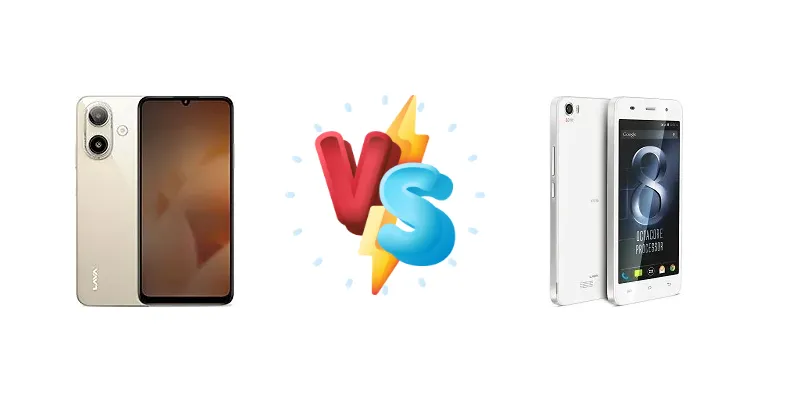
Lava's Bold N1 4G and Iris X8 represent two distinct approaches to the entry-level smartphone market. The Bold N1 4G, with its newer Unisoc chipset, aims for improved processing power, while the Iris X8 relies on a more established, albeit older, Cortex-A7 architecture. This comparison will dissect the key differences to help you determine which device best suits your needs.
🏆 Quick Verdict
For the average user prioritizing responsiveness and future-proofing, the Lava Bold N1 4G is the better choice. Its Unisoc SC9863A chipset, despite its 28nm process, offers a more modern CPU architecture that translates to a smoother user experience than the Iris X8's older Cortex-A7.
| Network |
|---|
| 2G bands | GSM 900 / 1800 | GSM 850 / 900 / 1800 / 1900 - SIM 1 & SIM 2 |
| 3G bands | HSDPA 850 / 900 / 1900 / 2100 | HSDPA 2100 |
| 4G bands | 1, 3, 5, 7, 8, 20, 28, 38, 40, 41 | - |
| Speed | HSPA, LTE | HSPA |
| Technology | GSM / HSPA / LTE | GSM / HSPA |
| Launch |
|---|
| Announced | 2025, June 04 | 2015, February. Released 2015, February |
| Status | Available. Released 2025, June 04 | Discontinued |
| Body |
|---|
| Dimensions | 165 x 76.1 x 8.8 mm (6.50 x 3.00 x 0.35 in) | 143.4 x 71 x 8.6 mm (5.65 x 2.80 x 0.34 in) |
| SIM | Nano-SIM + Nano-SIM | Dual SIM |
| Weight | 200 g (7.05 oz) | 160 g (5.64 oz) |
| Display |
|---|
| Protection | - | Asahi Dragontrail Glass |
| Resolution | 720 x 1600 pixels, 20:9 ratio (~260 ppi density) | 720 x 1280 pixels, 16:9 ratio (~294 ppi density) |
| Size | 6.75 inches, 110.0 cm2 (~87.6% screen-to-body ratio) | 5.0 inches, 68.9 cm2 (~67.7% screen-to-body ratio) |
| Type | IPS LCD, 90Hz | IPS LCD |
| Platform |
|---|
| CPU | Octa-core (4x1.6 GHz Cortex-A55 & 4x1.2 GHz Cortex-A55) | Octa-core 1.4 GHz Cortex-A7 |
| Chipset | Unisoc SC9863A (28 nm) | - |
| GPU | IMG8322 | - |
| OS | Android 14 (Go edition) | Android 4.4.2 (KitKat), upgradable to 5.1 (Lollipop) |
| Memory |
|---|
| Card slot | microSDXC | microSDHC (dedicated slot) |
| Internal | 64GB 4GB RAM | 8GB 1GB RAM, 16GB 2GB RAM |
| Main Camera |
|---|
| Features | LED flash, HDR, panorama | Dual-LED flash, HDR, panorama |
| Single | 13 MP, f/2.0, (wide), 1/3.1", 1.12µm, PDAF | 8 MP |
| Video | 1080p@30fps | Yes |
| Selfie camera |
|---|
| Single | 5 MP | 3 MP |
| Video | Yes | - |
| Sound |
|---|
| 3.5mm jack | - | Yes |
| 35mm jack | Yes | Yes |
| Loudspeaker | Yes | Yes |
| Comms |
|---|
| Bluetooth | 4.2, A2DP | 4.0, A2DP |
| NFC | No | No |
| Positioning | GPS | GPS |
| Radio | FM radio | FM radio |
| USB | USB Type-C, OTG | microUSB 2.0 |
| WLAN | Wi-Fi 802.11 b/g/n/ac | Wi-Fi 802.11 b/g/n, hotspot |
| Features |
|---|
| Sensors | Fingerprint (side-mounted), accelerometer | Accelerometer, proximity |
| Battery |
|---|
| Charging | 10W wired | - |
| Stand-by | - | Up to 291 h |
| Talk time | - | Up to 14 h (2G) / Up to 9 h 40 min (3G) |
| Type | Li-Ion 5000 mAh | Li-Po 2500 mAh, non-removable |
| Misc |
|---|
| Colors | Radiant Black, Sparkling Ivory | Black, White |
| Price | ₹ 5,999 | About 130 EUR |
Lava Bold N1 4G
- More modern CPU architecture (Cortex-A55)
- Potentially smoother multitasking
- 4G connectivity for faster data speeds
- Older 28nm fabrication process
- Limited charging speed (10W)
Lava Iris X8
- Simpler user experience (potentially)
- May be more affordable
- Established Cortex-A7 architecture
- Outdated CPU architecture (Cortex-A7)
- Likely slower app performance
- Potentially limited software support
Display Comparison
Display specifications are not provided for either device. However, given their market segment, it's reasonable to assume both utilize LCD panels with 720p resolution. The absence of details like peak brightness or color gamut makes a direct comparison impossible. Users should expect a standard viewing experience, prioritizing functionality over visual fidelity.
Camera Comparison
Camera details are limited. Without sensor size or aperture information, a meaningful comparison is difficult. It's safe to assume both phones feature basic camera setups geared towards casual photography. The presence of a 2MP macro camera on either device is unlikely to provide substantial image quality improvements, serving primarily as a marketing feature. Image processing capabilities will likely be limited on both devices.
Performance
The core difference lies in the chipsets. The Lava Bold N1 4G's Unisoc SC9863A features an octa-core configuration split between 1.6 GHz and 1.2 GHz Cortex-A55 cores. This is a significant architectural leap over the Lava Iris X8’s octa-core 1.4 GHz Cortex-A7. While the A7 was a capable processor in its time, the A55 offers improved efficiency and instruction set support, resulting in better performance per clock cycle. The 28nm fabrication process of the SC9863A is less efficient than modern nodes, but the architectural advantages likely outweigh this disadvantage in real-world usage. The Bold N1 4G will likely exhibit faster app launch times and smoother scrolling.
Battery Life
Battery capacity is not specified for either device. However, the Lava Bold N1 4G supports 10W wired charging. Without knowing the battery size of the Iris X8, it's difficult to assess charging speed differences. Users should expect moderate battery life on both devices, sufficient for a day of light to moderate use. The 10W charging on the Bold N1 4G suggests a standard charging time of several hours for a full charge.
Buying Guide
Buy the Lava Bold N1 4G if you need a phone capable of handling modern app workloads and occasional multitasking without significant slowdowns. It's ideal for users who want a device that feels relatively snappy for everyday tasks. Buy the Lava Iris X8 if you prioritize simplicity and are primarily focused on basic communication features like calls and messaging, and are less concerned with app performance or future software updates.
Frequently Asked Questions
❓ Will the Unisoc SC9863A in the Lava Bold N1 4G struggle with popular apps like WhatsApp and Facebook?
While not a high-end processor, the Unisoc SC9863A with its Cortex-A55 cores should handle apps like WhatsApp and Facebook without significant issues. However, running multiple apps simultaneously or using more demanding applications may result in some slowdowns. The Cortex-A7 in the Iris X8 will likely struggle more with these tasks.
❓ Is the Lava Iris X8 a good option for someone who primarily uses their phone for calls and texts?
Yes, the Lava Iris X8 is a suitable option for users who primarily need a phone for basic communication. Its older processor is sufficient for making calls, sending texts, and using simple applications. However, if you anticipate using your phone for anything beyond these basic functions, the Bold N1 4G is a better choice.
❓ Does the Lava Bold N1 4G support VoLTE for improved call quality?
Given the '4G' designation in the name, it's highly probable that the Lava Bold N1 4G supports VoLTE (Voice over LTE). This will provide improved call quality and faster connection times compared to older 2G/3G networks. The Iris X8's VoLTE support is less certain and would need to be verified.