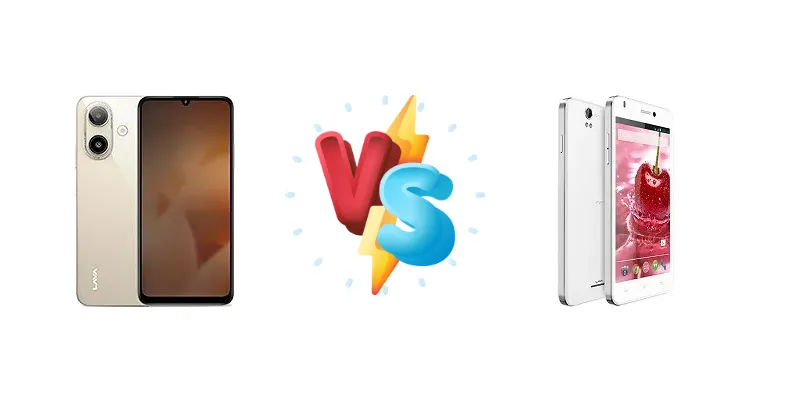
Lava's Bold N1 4G and Iris X1 Grand represent two distinct approaches to the ultra-budget smartphone market. The Bold N1 4G, with its newer Unisoc chipset, aims for a more modern experience, while the Iris X1 Grand relies on the older, but established, Mediatek platform. This comparison dissects their key differences to determine which offers the best value for users prioritizing affordability.
🏆 Quick Verdict
For the average user seeking a functional 4G smartphone, the Lava Bold N1 4G emerges as the better choice. Its octa-core processor and more modern architecture provide a noticeably smoother experience for everyday tasks, despite both phones sharing a similar price point and 28nm manufacturing process.
| Network |
|---|
| 2G bands | GSM 900 / 1800 | GSM 900 / 1800 - SIM 1 & SIM 2 |
| 3G bands | HSDPA 850 / 900 / 1900 / 2100 | HSDPA 2100 |
| 4G bands | 1, 3, 5, 7, 8, 20, 28, 38, 40, 41 | - |
| Speed | HSPA, LTE | HSPA |
| Technology | GSM / HSPA / LTE | GSM / HSPA |
| Launch |
|---|
| Announced | 2025, June 04 | 2015, January. Released 2015, January |
| Status | Available. Released 2025, June 04 | Discontinued |
| Body |
|---|
| Dimensions | 165 x 76.1 x 8.8 mm (6.50 x 3.00 x 0.35 in) | 144 x 72 x 9.2 mm (5.67 x 2.83 x 0.36 in) |
| SIM | Nano-SIM + Nano-SIM | Dual SIM |
| Weight | 200 g (7.05 oz) | 152 g (5.36 oz) |
| Display |
|---|
| Resolution | 720 x 1600 pixels, 20:9 ratio (~260 ppi density) | 480 x 854 pixels, 16:9 ratio (~196 ppi density) |
| Size | 6.75 inches, 110.0 cm2 (~87.6% screen-to-body ratio) | 5.0 inches, 68.9 cm2 (~66.4% screen-to-body ratio) |
| Type | IPS LCD, 90Hz | IPS LCD |
| Platform |
|---|
| CPU | Octa-core (4x1.6 GHz Cortex-A55 & 4x1.2 GHz Cortex-A55) | Quad-core 1.3 GHz Cortex-A7 |
| Chipset | Unisoc SC9863A (28 nm) | Mediatek MT6582M (28 nm) |
| GPU | IMG8322 | Mali-400MP2 |
| OS | Android 14 (Go edition) | Android 4.4.2 (KitKat), upgradable to 5.0 (Lollipop) |
| Memory |
|---|
| Card slot | microSDXC | microSDHC |
| Internal | 64GB 4GB RAM | 8GB 1GB RAM |
| Main Camera |
|---|
| Features | LED flash, HDR, panorama | Dual-LED flash |
| Single | 13 MP, f/2.0, (wide), 1/3.1", 1.12µm, PDAF | 8 MP, AF |
| Video | 1080p@30fps | 1080p@30fps |
| Selfie camera |
|---|
| Single | 5 MP | 2 MP |
| Video | Yes | - |
| Sound |
|---|
| 3.5mm jack | - | Yes |
| 35mm jack | Yes | Yes |
| Loudspeaker | Yes | Yes, dual speakers |
| Comms |
|---|
| Bluetooth | 4.2, A2DP | 4.0, LE |
| NFC | No | No |
| Positioning | GPS | A-GPS |
| Radio | FM radio | FM radio, recording |
| USB | USB Type-C, OTG | microUSB 2.0 |
| WLAN | Wi-Fi 802.11 b/g/n/ac | Wi-Fi 802.11 b/g/n |
| Features |
|---|
| Sensors | Fingerprint (side-mounted), accelerometer | Accelerometer, proximity |
| Battery |
|---|
| Charging | 10W wired | - |
| Stand-by | - | Up to 200 h (3G) |
| Talk time | - | Up to 10 h (3G) |
| Type | Li-Ion 5000 mAh | Li-Po 2200 mAh, removable |
| Misc |
|---|
| Colors | Radiant Black, Sparkling Ivory | Black-gold, White-silver, White-gold |
| Price | ₹ 5,999 | About 110 EUR |
Lava Bold N1 4G
- More powerful octa-core processor for smoother performance
- Modern Cortex-A55 architecture for improved efficiency
- Better multitasking capabilities
- Potential for slightly shorter battery life due to higher processing demands
- Limited information on display quality
Lava Iris X1 Grand
- Simpler user experience for basic tasks
- Potentially longer software support due to mature chipset
- Potentially slightly longer battery life
- Significantly slower processor for demanding tasks
- Outdated Cortex-A7 architecture
- Limited multitasking capabilities
Display Comparison
Neither Lava provides display specifications beyond size, so a direct comparison is limited. However, given the target market, both likely utilize IPS LCD panels. The focus here is on processing power to drive the UI, as display quality is unlikely to be a differentiating factor. Expect similar viewing angles and color reproduction, but potentially differing brightness levels.
Camera Comparison
Detailed camera specifications are unavailable for either device. However, given the price bracket, expectations should be tempered. Both phones likely feature a primary rear camera and a front-facing camera for video calls. Any additional sensors (like a macro lens) are likely to be low resolution and offer limited practical benefit. Image processing will be basic, relying heavily on software algorithms to enhance photos. The Bold N1 4G’s more powerful processor *could* translate to slightly faster image processing times, but the sensor quality will be the primary limiting factor.
Performance
The core difference lies in the chipsets. The Lava Bold N1 4G’s Unisoc SC9863A features an octa-core CPU comprised of four Cortex-A55 cores clocked at 1.6 GHz and four at 1.2 GHz. This contrasts sharply with the Iris X1 Grand’s Mediatek MT6582M, a quad-core processor utilizing Cortex-A7 cores clocked at 1.3 GHz. While both are built on a 28nm process, the Cortex-A55 architecture is significantly more efficient and offers improved performance per clock cycle than the older Cortex-A7. This translates to faster app loading times and smoother multitasking on the Bold N1 4G. The octa-core configuration further enhances multitasking capabilities, allowing for more apps to remain active in the background.
Battery Life
Battery capacity is not specified for either device. However, both phones feature 10W wired charging. Given the less demanding processor in the Iris X1 Grand, it *may* achieve slightly longer battery life on a single charge, but the difference is unlikely to be substantial. The Bold N1 4G’s more efficient processor could offset its potentially higher power draw during intensive tasks, resulting in comparable real-world battery performance.
Buying Guide
Buy the Lava Bold N1 4G if you need a phone capable of handling multiple apps simultaneously, enjoy occasional light gaming, and value a more responsive user interface. Buy the Lava Iris X1 Grand if your primary needs are basic communication – calls and texts – and you prioritize simplicity over performance, potentially benefiting from a slightly longer software support window due to the more mature chipset.
Frequently Asked Questions
❓ Will the Lava Bold N1 4G struggle with popular social media apps like Facebook and WhatsApp?
While not a powerhouse, the Unisoc SC9863A in the Bold N1 4G is sufficiently capable of running Facebook and WhatsApp smoothly. The octa-core processor and Cortex-A55 architecture provide enough headroom for these apps to function without significant lag, unlike the quad-core MT6582M in the Iris X1 Grand which may exhibit noticeable slowdowns.
❓ Is the Lava Iris X1 Grand a good option for first-time smartphone users?
The Lava Iris X1 Grand's simplicity could be appealing to first-time smartphone users. Its less powerful processor and basic software mean fewer features to learn and a more straightforward experience. However, its limited performance may become frustrating as users become more familiar with smartphone capabilities.
❓ Can either of these phones handle basic mobile gaming?
Basic 2D games will run on both devices, but don't expect a smooth experience with more demanding titles. The Lava Bold N1 4G's processor offers a slight advantage, allowing for playable frame rates in less intensive 3D games, while the Iris X1 Grand will likely struggle even with older titles.