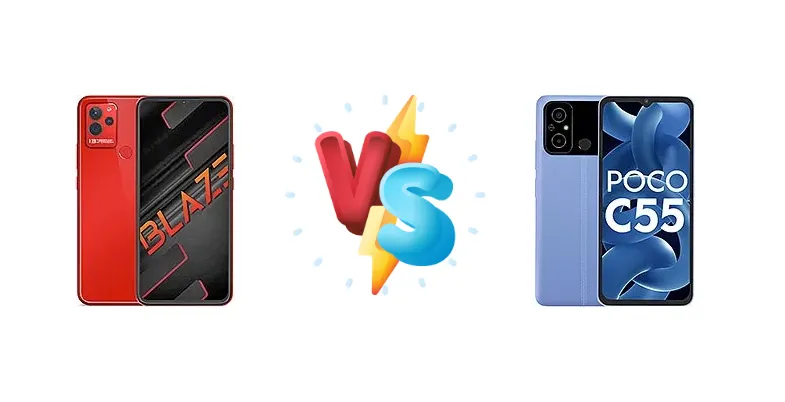
The sub-$150 smartphone market is fiercely competitive. The Lava Blaze and Xiaomi Poco C55 both aim to deliver essential smartphone functionality at an accessible price point, but they take drastically different approaches to achieving this. The Blaze prioritizes affordability, while the Poco C55 attempts to offer a more robust performance profile. This comparison will dissect their key differences to help you choose the right device.
🏆 Quick Verdict
For most users, the Xiaomi Poco C55 is the better choice. Its Helio G85 chipset provides a significantly more responsive experience for everyday tasks and light gaming, justifying the slight price premium. However, the Lava Blaze remains a viable option for those on the absolute tightest of budgets.
| Network |
|---|
| 2G bands | GSM 900 / 1800 | GSM 850 / 900 / 1800 / 1900 |
| 3G bands | HSDPA 900 / 2100 | HSDPA 850 / 900 / 2100 |
| 4G bands | 1, 3, 5, 8, 40, 41 | 1, 3, 5, 8, 40, 41 |
| Speed | HSPA 42.2/5.76 Mbps, LTE Cat4 150/50 Mbps | HSPA, LTE |
| Technology | GSM / HSPA / LTE | GSM / HSPA / LTE |
| Launch |
|---|
| Announced | 2022, July 07 | 2023, February 21 |
| Status | Available. Released 2022, July 14 | Available. Released 2023, February 28 |
| Body |
|---|
| Build | - | Glass front (Panda Glass), eco leather back |
| Dimensions | 164.8 x 76.3 x 8.9 mm (6.49 x 3.00 x 0.35 in) | 168.8 x 76.4 x 8.8 mm (6.65 x 3.01 x 0.35 in) |
| SIM | Nano-SIM + Nano-SIM | Nano-SIM + Nano-SIM |
| Weight | - | 192 g (6.77 oz) |
| | - | Dust and splash resistant |
| Display |
|---|
| Protection | - | Panda Glass |
| Resolution | 720 x 1600 pixels, 20:9 ratio (~269 ppi density) | 720 x 1650 pixels (~268 ppi density) |
| Size | 6.52 inches, 102.6 cm2 (~81.6% screen-to-body ratio) | 6.71 inches, 106.5 cm2 (~82.6% screen-to-body ratio) |
| Type | IPS LCD | IPS LCD |
| Platform |
|---|
| CPU | Quad-core 2.0 GHz Cortex-A53 | Octa-core (2x2.0 GHz Cortex-A75 & 6x1.8 GHz Cortex-A55) |
| Chipset | Mediatek MT6761 Helio A22 (12 nm) | Mediatek MT6769Z Helio G85 (12 nm) |
| GPU | PowerVR GE8320 | Mali-G52 MC2 |
| OS | Android 12 | Android 12, MIUI 13 for POCO |
| Memory |
|---|
| Card slot | microSDXC (dedicated slot) | microSDXC (dedicated slot) |
| Internal | 64GB 3GB RAM | 64GB 4GB RAM, 128GB 6GB RAM |
| | eMMC 5.1 | eMMC 5.1 |
| Main Camera |
|---|
| Dual | - | 50 MP, f/1.8, (wide), PDAF
0.08 MP (depth) |
| Features | LED flash | LED flash, HDR |
| Single | 13 MP, (wide), PDAF
Auxiliary lenses | 50 MP, f/1.8, (wide), PDAF
Auxiliary lens |
| Triple | 13 MP, (wide), AF
Other unspecified cameras | - |
| Video | 1080p@30fps | 1080p@30fps |
| Selfie camera |
|---|
| Features | - | HDR |
| Single | 8 MP, (wide) | 5 MP |
| Video | Yes | 1080p@30fps |
| Sound |
|---|
| 3.5mm jack | Yes | Yes |
| 35mm jack | Yes | Yes |
| Loudspeaker | Yes | Yes |
| Comms |
|---|
| Bluetooth | 5.0, A2DP, LE | 5.0, A2DP, LE |
| NFC | No | No |
| Positioning | GPS | GPS, GLONASS, GALILEO, BDS, QZSS |
| Radio | FM radio | FM radio, recording |
| USB | USB Type-C 2.0, OTG | microUSB 2.0, OTG |
| WLAN | Wi-Fi 802.11 b/g/n/ac | Wi-Fi 802.11 a/b/g/n/ac, dual-band |
| Features |
|---|
| Sensors | Fingerprint (rear-mounted), accelerometer, proximity | Fingerprint (rear-mounted), accelerometer |
| | - | Virtual proximity sensing |
| Battery |
|---|
| Charging | - | 10W wired |
| Type | Li-Po 5000 mAh | Li-Po 5000 mAh |
| Misc |
|---|
| Colors | Green, Red, Black, Blue | Cool Blue, Power Black, Forest Green |
| Models | LZX403, LZX411 | 22127PC95I |
| Price | About 110 EUR | About 110 EUR |
| SAR | - | 0.87 W/kg (head) 0.77 W/kg (body) |
Lava Blaze
- Lowest possible price point
- Simple and easy-to-use interface
- Potentially longer battery life due to less demanding processor
- Significantly slower performance
- Limited multitasking capabilities
- Poor gaming performance
Xiaomi Poco C55
- Faster and more responsive performance
- Better multitasking capabilities
- Improved gaming experience
- Slightly higher price
- 10W charging is relatively slow
- May not offer significant camera improvements
Display Comparison
Neither device boasts a standout display. Both are likely utilizing LCD panels, a common cost-saving measure in this segment. Without specific display specs, it's safe to assume similar color accuracy and viewing angles. The focus here is on functionality, not fidelity. Bezels are likely to be substantial on both, maximizing screen real estate within a compact form factor.
Camera Comparison
Camera performance is likely to be similar in real-world usage, given the focus on affordability. Both devices likely feature a primary camera and potentially a depth sensor. Without specific sensor details, it’s difficult to assess image quality. However, the Helio G85’s image signal processor (ISP) in the Poco C55 will likely offer slightly better image processing capabilities, potentially resulting in more detailed and vibrant photos. The Lava Blaze will likely rely more heavily on software processing to compensate for a less capable sensor.
Performance
The performance gap is the most significant differentiator. The Poco C55’s Mediatek Helio G85, an octa-core processor with 2x2.0 GHz Cortex-A75 and 6x1.8 GHz Cortex-A55 cores, represents a substantial upgrade over the Lava Blaze’s quad-core 2.0 GHz Cortex-A53 Helio A22. The G85’s core count and more modern architecture translate to faster app loading times, smoother multitasking, and a more responsive user interface. The A22, while adequate for basic tasks, will struggle with demanding applications. The G85’s GPU will also provide a noticeably better gaming experience, even if limited to lower settings. The Poco C55's performance advantage is not just about clock speed; it's about architectural efficiency.
Battery Life
Battery life will depend heavily on usage patterns. While the specific mAh capacities are unknown, the Poco C55’s more efficient Helio G85 chipset could potentially offset a smaller battery size compared to the Lava Blaze. The Poco C55’s 10W wired charging is a standard offering in this price range, and charge times will be relatively slow. The Lava Blaze’s charging speed is also likely to be similar, and neither device will offer fast charging capabilities.
Buying Guide
Buy the Lava Blaze if you need a functional smartphone for basic communication – calls, texts, and light social media – and prioritize minimizing upfront cost above all else. It's ideal for first-time smartphone users or as a reliable backup device. Buy the Xiaomi Poco C55 if you prefer a smoother, more capable experience for multitasking, streaming video, and playing casual games. The improved processor and potentially better software support make it a more future-proof investment.
Frequently Asked Questions
❓ Will the Poco C55 be able to run popular games like PUBG Mobile?
The Poco C55’s Helio G85 chipset can run PUBG Mobile, but you’ll likely need to play at lower graphics settings and frame rates to maintain a smooth experience. Expect to prioritize stability over visual fidelity. The Lava Blaze will struggle significantly with PUBG Mobile.
❓ Is the Lava Blaze a good option for elderly users who primarily make calls and send texts?
Yes, the Lava Blaze is an excellent choice for elderly users with basic needs. Its simplicity and affordability make it a practical and reliable communication device. The less demanding processor also means it's less likely to be bogged down by unnecessary features.
❓ Does the Poco C55 support software updates and for how long?
Xiaomi typically provides at least one major Android update and several security patches for their budget devices. However, the long-term software support for the Poco C55 is not guaranteed and will likely be shorter than that of higher-end Xiaomi phones. Lava's update track record is less consistent.