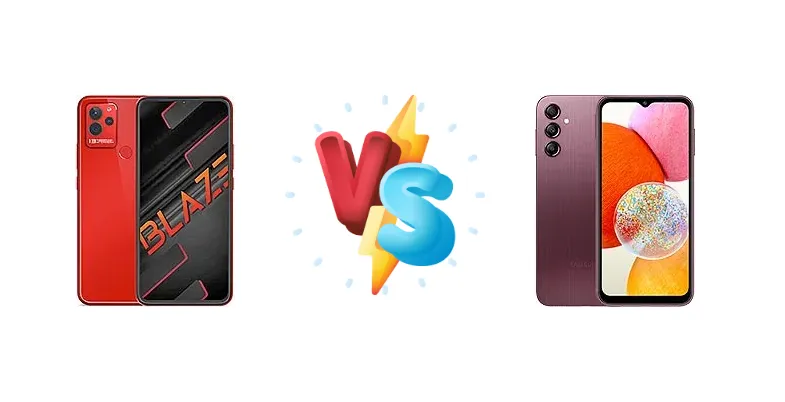
The sub-$150 smartphone market is fiercely competitive. The Lava Blaze and Samsung Galaxy A14 both aim to deliver essential smartphone functionality at an accessible price point, but they take drastically different approaches to achieving this. The Blaze prioritizes affordability, while the A14 attempts to offer a more well-rounded experience with a more capable chipset, albeit with variations in its implementation.
🏆 Quick Verdict
For most users, the Samsung Galaxy A14 is the better choice. While the Lava Blaze offers exceptional value, the A14’s Mediatek Helio G80 (or Exynos 850) provides a significantly smoother experience for multitasking and gaming, justifying the price difference. However, the Blaze remains a viable option for extremely budget-conscious users.
| Network |
|---|
| 2G bands | GSM 900 / 1800 | GSM 850 / 900 / 1800 / 1900 |
| 3G bands | HSDPA 900 / 2100 | HSDPA 850 / 900 / 2100 |
| 4G bands | 1, 3, 5, 8, 40, 41 | 1, 3, 5, 7, 8, 20, 28, 38, 40, 41 |
| Speed | HSPA 42.2/5.76 Mbps, LTE Cat4 150/50 Mbps | HSPA, LTE |
| Technology | GSM / HSPA / LTE | GSM / HSPA / LTE |
| Launch |
|---|
| Announced | 2022, July 07 | 2023, February 28 |
| Status | Available. Released 2022, July 14 | Available. Released 2023, March 27 |
| Body |
|---|
| Build | - | Glass front, plastic back, plastic frame |
| Dimensions | 164.8 x 76.3 x 8.9 mm (6.49 x 3.00 x 0.35 in) | 167.7 x 78 x 9.1 mm (6.60 x 3.07 x 0.36 in) |
| SIM | Nano-SIM + Nano-SIM | · Nano-SIM· Nano-SIM + Nano-SIM |
| Weight | - | 201 g (7.09 oz) |
| Display |
|---|
| Resolution | 720 x 1600 pixels, 20:9 ratio (~269 ppi density) | 1080 x 2408 pixels, 20:9 ratio (~400 ppi density) |
| Size | 6.52 inches, 102.6 cm2 (~81.6% screen-to-body ratio) | 6.6 inches, 104.9 cm2 (~80.2% screen-to-body ratio) |
| Type | IPS LCD | PLS LCD |
| Platform |
|---|
| CPU | Quad-core 2.0 GHz Cortex-A53 | Octa-core (2x2.0 GHz Cortex-A75 & 6x1.8 GHz Cortex-A55) - Version AOcta-core (4x2.0 GHz Cortex-A55 & 4x2.0 GHz Cortex-A55) - Version B |
| Chipset | Mediatek MT6761 Helio A22 (12 nm) | Mediatek MT6769 Helio G80 (12 nm) - Version AExynos 850 (8 nm) - Version B |
| GPU | PowerVR GE8320 | Mali-G52 MC2 |
| OS | Android 12 | Android 13, upgradable to Android 15, One UI 7 |
| Memory |
|---|
| Card slot | microSDXC (dedicated slot) | microSDXC (dedicated slot) |
| Internal | 64GB 3GB RAM | 64GB 4GB RAM, 128GB 4GB RAM, 128GB 6GB RAM |
| | eMMC 5.1 | - |
| Main Camera |
|---|
| Features | LED flash | LED flash, panorama, HDR |
| Single | 13 MP, (wide), PDAF
Auxiliary lenses | 13 MP, f/2.0, (wide) |
| Triple | 13 MP, (wide), AF
Other unspecified cameras | 50 MP, f/1.8, 26mm (wide), 1/2.75", 0.64µm, PDAF
5 MP, f/2.2, 17mm (ultrawide), 1/5.0", 1.12µm
2 MP (macro) |
| Video | 1080p@30fps | 1080p@30fps |
| Selfie camera |
|---|
| Single | 8 MP, (wide) | 13 MP, f/2.0, 26mm (wide), 1/3.1", 1.12µm |
| Video | Yes | 1080p@30fps |
| Sound |
|---|
| 3.5mm jack | Yes | Yes |
| 35mm jack | Yes | Yes |
| Loudspeaker | Yes | Yes |
| Comms |
|---|
| Bluetooth | 5.0, A2DP, LE | 5.1 or 5.3, A2DP, LE |
| NFC | No | Yes (market/region dependent) |
| Positioning | GPS | GPS, GALILEO, GLONASS, BDS, QZSS |
| Radio | FM radio | Unspecified |
| USB | USB Type-C 2.0, OTG | USB Type-C 2.0 |
| WLAN | Wi-Fi 802.11 b/g/n/ac | Wi-Fi 802.11 a/b/g/n/ac, dual-band, Wi-Fi Direct |
| Features |
|---|
| Sensors | Fingerprint (rear-mounted), accelerometer, proximity | Fingerprint (side-mounted), accelerometer, proximity, compass |
| Battery |
|---|
| Charging | - | 15W wired |
| Type | Li-Po 5000 mAh | Li-Po 5000 mAh |
| Misc |
|---|
| Colors | Green, Red, Black, Blue | Black, Dark Red, Silver, Green |
| Models | LZX403, LZX411 | SM-A145F, SM-A145F/DSN, SM-A145M, SM-A145M/DS, SM-A145P, SM-A145R |
| Price | About 110 EUR | € 85.76 / $ 147.60 / £ 79.95 |
| SAR EU | - | 0.46 W/kg (head) 1.37 W/kg (body) |
Lava Blaze
- Extremely affordable price point
- Potentially longer battery life during basic tasks
- Simple and straightforward user experience
- Significantly slower performance
- Limited multitasking capabilities
- Likely lower-quality display
Samsung Galaxy A14
- Much faster processor (Helio G80 or Exynos 850)
- Smoother multitasking and gaming experience
- 15W fast charging support
- Higher price compared to Lava Blaze
- Potential for software bloat (Samsung)
- Chipset variation (G80 vs Exynos 850) impacts performance
Display Comparison
Neither device boasts a standout display. Both utilize 12nm chipsets, suggesting a focus on cost reduction over premium display features. Specifics regarding panel type (IPS vs. TFT) and resolution are missing for the Lava Blaze, but given its price point, an IPS panel is unlikely. The Galaxy A14’s display details are also absent, but Samsung typically employs PLS LCDs in this segment, offering slightly better viewing angles than standard TFT. The lack of high refresh rates on either device indicates a focus on power efficiency rather than visual fluidity.
Camera Comparison
Camera performance is likely to be similar in real-world usage, with both phones targeting the entry-level segment. Details regarding sensor sizes and apertures are unavailable for both devices. However, the inclusion of a 2MP macro camera on the A14 is largely a marketing gimmick, offering limited practical benefit. The primary camera’s sensor size and image processing algorithms will be the determining factors in image quality, and without specific data, it’s difficult to declare a clear winner. Expect both phones to struggle in low-light conditions.
Performance
The performance gap is the most significant differentiator. The Lava Blaze’s Mediatek MT6761 Helio A22, a quad-core Cortex-A53 processor, is designed for basic smartphone functions. The Samsung Galaxy A14, however, offers two distinct chipset options. Version A features the Mediatek Helio G80, an octa-core processor with two Cortex-A75 performance cores and six Cortex-A55 efficiency cores, providing a substantial performance boost for multitasking and gaming. Version B utilizes the Samsung Exynos 850, also an octa-core chip, but with a different core configuration (4x Cortex-A55 @ 2.0 GHz and 4x Cortex-A55 @ 2.0 GHz). While the Exynos 850 is built on a more efficient 8nm process compared to the Helio G80’s 12nm, the A75 cores in the G80 offer superior single-core performance, crucial for app responsiveness. The A14’s potential for LPDDR4X RAM (likely) further enhances its performance advantage over the Blaze’s likely LPDDR3 RAM.
Battery Life
Battery life will depend heavily on usage patterns. While specific battery capacities are missing, both phones likely feature batteries in the 4000-5000 mAh range. The Lava Blaze, with its less powerful processor, may offer slightly longer battery life during basic tasks. However, the Samsung Galaxy A14’s 15W wired charging is a notable advantage, allowing for faster top-ups compared to the Blaze’s likely slower charging speed. The more efficient 8nm Exynos 850 (Version B) could also contribute to improved battery endurance under moderate load.
Buying Guide
Buy the Lava Blaze if you need a functional smartphone for basic tasks like calls, messaging, and light social media use, and your budget is extremely limited. It’s ideal for first-time smartphone owners or as a reliable backup device. Buy the Samsung Galaxy A14 if you prioritize a more responsive user experience, enjoy occasional gaming, or want a phone that will remain usable for a longer period thanks to its more powerful processor and potential for software updates.
Frequently Asked Questions
❓ Does the Samsung Galaxy A14’s Exynos 850 chip overheat during prolonged gaming sessions?
The Exynos 850 is generally known for its thermal efficiency. While it may get warm during extended gaming, it’s unlikely to experience significant throttling like more powerful, less efficient chipsets. The 8nm process node contributes to better heat dissipation compared to the 12nm Helio A22 in the Lava Blaze.
❓ Is the 2MP macro camera on the Samsung Galaxy A14 worth using?
Realistically, no. 2MP macro cameras typically produce low-resolution, soft images with limited detail. They are often included as a marketing feature rather than a genuinely useful camera component. The primary camera on the A14 will deliver far superior results for most photography scenarios.
❓ Can the Samsung Galaxy A14 run PUBG Mobile at 60fps?
The Helio G80 version of the A14 should be capable of running PUBG Mobile at balanced graphics settings and 60fps. The Exynos 850 version may require lower graphics settings to maintain a stable 60fps. The Lava Blaze will struggle to run PUBG Mobile smoothly, even at the lowest settings.
❓ What type of storage does the Lava Blaze use, and is it expandable?
Details regarding the Lava Blaze's storage type (eMMC vs. UFS) are unavailable. However, given its price point, eMMC storage is likely. It is expected to support microSD card expansion, allowing users to increase storage capacity.