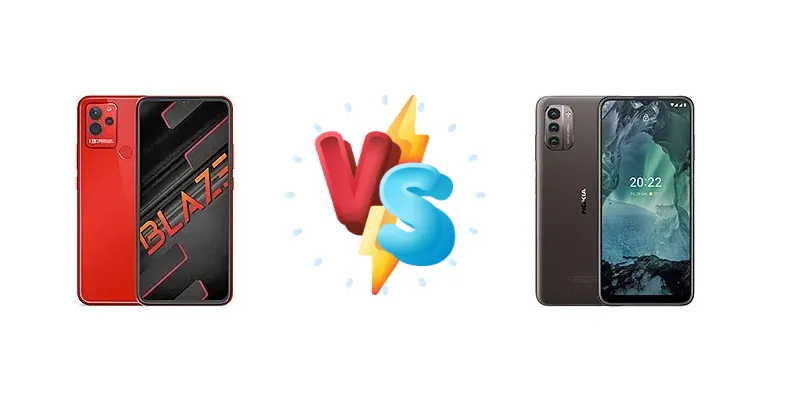
The sub-$150 smartphone market is fiercely competitive. The Lava Blaze and Nokia G21 both aim to deliver essential smartphone functionality at an accessible price point. However, they take different approaches to achieving this, with the Blaze prioritizing simplicity and the G21 focusing on extended battery life and a more modern chipset. This comparison dives deep into the specifications to determine which device offers the best value.
🏆 Quick Verdict
For most users, the Nokia G21 emerges as the better choice. Its Unisoc T606 chipset provides a significant performance uplift over the Lava Blaze’s Helio A22, offering a smoother experience for everyday tasks and even some light gaming. While both phones boast similar battery endurance ratings, the G21’s 18W PD3.0 charging is a welcome addition.
| Network |
|---|
| 2G bands | GSM 900 / 1800 | GSM 850 / 900 / 1800 / 1900 |
| 3G bands | HSDPA 900 / 2100 | HSDPA 850 / 900 / 2100 - International |
| 4G bands | 1, 3, 5, 8, 40, 41 | 1, 3, 5, 7, 8, 20, 28, 38, 40, 41 - International |
| Speed | HSPA 42.2/5.76 Mbps, LTE Cat4 150/50 Mbps | HSPA 42.2/5.76 Mbps, LTE Cat4 150/50 Mbps |
| Technology | GSM / HSPA / LTE | GSM / HSPA / LTE |
| | - | 1, 2, 3, 4, 5, 7, 8, 12, 17, 28, 40, 66 - LATAM |
| Launch |
|---|
| Announced | 2022, July 07 | 2022, February 14 |
| Status | Available. Released 2022, July 14 | Available. Released 2022, February 15 |
| Body |
|---|
| Build | - | Glass front, plastic frame, plastic back |
| Dimensions | 164.8 x 76.3 x 8.9 mm (6.49 x 3.00 x 0.35 in) | 164.6 x 75.9 x 8.5 mm (6.48 x 2.99 x 0.33 in) |
| SIM | Nano-SIM + Nano-SIM | · Nano-SIM· Nano-SIM + Nano-SIM |
| Weight | - | 190 g (6.70 oz) |
| Display |
|---|
| Resolution | 720 x 1600 pixels, 20:9 ratio (~269 ppi density) | 720 x 1600 pixels, 20:9 ratio (~270 ppi density) |
| Size | 6.52 inches, 102.6 cm2 (~81.6% screen-to-body ratio) | 6.5 inches, 102.0 cm2 (~81.6% screen-to-body ratio) |
| Type | IPS LCD | IPS LCD, 90Hz, 400 nits (typ) |
| Platform |
|---|
| CPU | Quad-core 2.0 GHz Cortex-A53 | Octa-core (2x1.6 GHz Cortex-A75 & 6x1.6 GHz Cortex-A55) |
| Chipset | Mediatek MT6761 Helio A22 (12 nm) | Unisoc T606 (12 nm) |
| GPU | PowerVR GE8320 | Mali-G57 MP1 |
| OS | Android 12 | Android 11, upgradable to Android 13 |
| Memory |
|---|
| Card slot | microSDXC (dedicated slot) | microSDXC (dedicated slot) |
| Internal | 64GB 3GB RAM | 64GB 3GB RAM, 64GB 4GB RAM, 128GB 4GB RAM, 128GB 6GB RAM |
| | eMMC 5.1 | eMMC 5.1 |
| Main Camera |
|---|
| Features | LED flash | LED flash, HDR, panorama |
| Single | 13 MP, (wide), PDAF
Auxiliary lenses | 8 MP, f/2.0, (wide) |
| Triple | 13 MP, (wide), AF
Other unspecified cameras | 50 MP, f/1.8, 28mm (wide), 1/2.76", 0.64µm, PDAF
2 MP (macro)
Auxiliary lens |
| Video | 1080p@30fps | 1080p@30fps |
| Selfie camera |
|---|
| Single | 8 MP, (wide) | 8 MP, f/2.0, (wide) |
| Video | Yes | 1080p@30fps |
| Sound |
|---|
| 3.5mm jack | Yes | Yes |
| 35mm jack | Yes | Yes |
| Loudspeaker | Yes | Yes |
| Comms |
|---|
| Bluetooth | 5.0, A2DP, LE | 5.0, A2DP, LE |
| NFC | No | Yes (market/region dependent) |
| Positioning | GPS | GPS, GLONASS, GALILEO |
| Radio | FM radio | FM radio, RDS |
| USB | USB Type-C 2.0, OTG | USB Type-C 2.0, OTG |
| WLAN | Wi-Fi 802.11 b/g/n/ac | Wi-Fi 802.11 a/b/g/n/ac, dual-band, Wi-Fi Direct |
| Features |
|---|
| Sensors | Fingerprint (rear-mounted), accelerometer, proximity | Fingerprint (side-mounted), accelerometer, proximity |
| Battery |
|---|
| Charging | - | 18W wired, PD3.0 |
| Type | Li-Po 5000 mAh | Li-Po 5050 mAh |
| Misc |
|---|
| Colors | Green, Red, Black, Blue | Nordic Blue, Dusk |
| Models | LZX403, LZX411 | TA-1418, TA-1477, TA-1415, TA-1405, TA-1404, TA-1412 |
| Price | About 110 EUR | About 90 EUR |
| SAR | - | 1.00 W/kg (head) 1.10 W/kg (body) |
| SAR EU | - | 0.34 W/kg (head) 1.05 W/kg (body) |
| Tests |
|---|
| Battery life | - |
Endurance rating 126h
|
| Camera | - |
Photo / Video |
| Display | - |
Contrast ratio: 1631:1 (nominal) |
| Loudspeaker | - |
-30.7 LUFS (Below average)
|
| Performance | - |
AnTuTu: 171299 (v9)
GeekBench: 1193 (v5.1)
GFXBench: 8.9fps (ES 3.1 onscreen) |
Lava Blaze
- Lowest possible price point
- Simple and easy to use
- Decent battery life (126h endurance)
- Weak processor (Helio A22)
- Slow performance
- Limited multitasking capabilities
Nokia G21
- More powerful processor (Unisoc T606)
- Faster charging (18W PD3.0)
- Better display brightness (500 nits)
- Slightly higher price
- Camera performance likely similar to Lava Blaze
- Software updates may be infrequent
Display Comparison
Both the Lava Blaze and Nokia G21 feature displays with a 1631:1 contrast ratio, suggesting similar visual pop. However, the Nokia G21 boasts a measured peak brightness of 500 nits, a crucial advantage for outdoor visibility. While neither manufacturer details panel technology, the G21’s higher brightness makes it the clear winner for users who frequently use their phones in sunlight. Bezels are likely comparable given the price points, and color accuracy is expected to be standard for this segment.
Camera Comparison
Both phones list 'Photo / Video' capabilities, but lack specific details. Given the price bracket, image quality will likely be similar – adequate for casual snapshots in good lighting conditions. The absence of sensor size or aperture information makes a detailed comparison impossible. It’s safe to assume both phones will rely heavily on software processing to enhance images. Any mention of a 2MP macro lens on either device should be viewed with skepticism; these sensors rarely deliver meaningful improvements in image quality.
Performance
The performance gap between these two devices is substantial. The Lava Blaze utilizes the Mediatek Helio A22, a quad-core processor based on a 12nm process. In contrast, the Nokia G21 is powered by the Unisoc T606, an octa-core chip (2x1.6 GHz Cortex-A75 & 6x1.6 GHz Cortex-A55) also built on a 12nm process. The T606’s octa-core configuration, including the more powerful Cortex-A75 cores, translates to significantly faster app loading times, smoother multitasking, and a more enjoyable overall user experience. The Helio A22 will struggle with demanding applications, while the T606 offers a degree of headroom for light gaming and social media. RAM configurations are not specified, but the chipset difference is the dominant factor.
Battery Life
Both the Lava Blaze and Nokia G21 achieve an endurance rating of 126 hours, indicating comparable battery life under similar usage conditions. However, the Nokia G21 gains a significant advantage with its 18W wired charging support and PD3.0 compatibility. This allows for faster charging speeds compared to the Blaze, which likely relies on a slower, standard charging protocol. While both phones should easily last a full day on a single charge for moderate users, the G21’s faster charging minimizes downtime.
Buying Guide
Buy the Lava Blaze if you absolutely need the lowest possible price and are primarily focused on basic communication – calls, texts, and light app usage. Its simplicity is its strength. Buy the Nokia G21 if you prioritize a more responsive user experience, occasional gaming, and the convenience of faster charging, even if it means spending slightly more. The G21 is the better all-rounder for most users.
Frequently Asked Questions
❓ Will the Nokia G21 be able to run popular games like PUBG Mobile?
The Unisoc T606 in the Nokia G21 can handle PUBG Mobile, but you'll likely need to play at lower graphics settings and frame rates to maintain a smooth experience. The Lava Blaze's Helio A22 would struggle significantly with this title.
❓ How long does it take to fully charge the Nokia G21 with the 18W charger?
While a precise 0-100% charging time isn't specified, the Nokia G21's 18W PD3.0 charging should take approximately 2-3 hours for a full charge, significantly faster than the Lava Blaze's likely slower charging speed.
❓ Is the Nokia G21 likely to receive Android updates?
Nokia has a relatively good track record for providing software updates, even on their budget devices. However, the G21 is an older model, so the number of major Android updates it will receive is limited. The Lava Blaze's update schedule is less predictable.