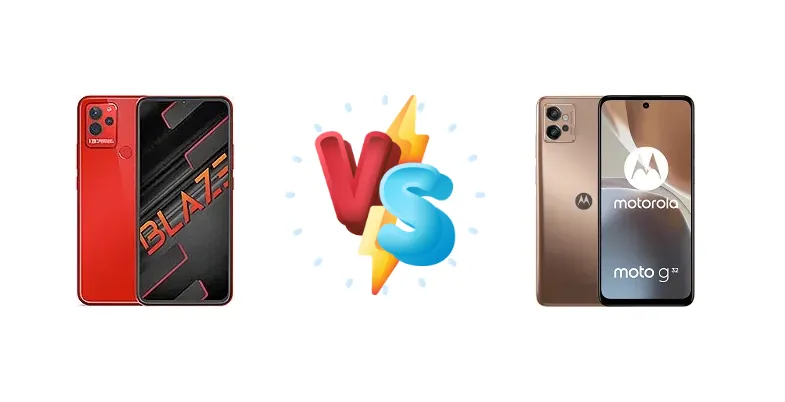
The Lava Blaze and Motorola Moto G32 represent distinct approaches to the budget smartphone market. The Blaze aims for extreme affordability, while the Moto G32 attempts to balance cost with a more modern chipset and faster charging. This comparison dissects their key differences to determine which device delivers the best experience for your money.
🏆 Quick Verdict
For most users, the Motorola Moto G32 is the superior choice. Its Snapdragon 680 chipset offers significantly improved performance and efficiency compared to the Lava Blaze’s Helio A22, justifying the price difference. However, the Lava Blaze remains a viable option for those on the absolute tightest of budgets.
| Network |
|---|
| 2G bands | GSM 900 / 1800 | GSM 850 / 900 / 1800 / 1900 |
| 3G bands | HSDPA 900 / 2100 | HSDPA 850 / 900 / 1900 / 2100 |
| 4G bands | 1, 3, 5, 8, 40, 41 | 1, 3, 5, 7, 8, 20, 28, 38, 40, 41 |
| Speed | HSPA 42.2/5.76 Mbps, LTE Cat4 150/50 Mbps | HSPA, LTE |
| Technology | GSM / HSPA / LTE | GSM / HSPA / LTE |
| Launch |
|---|
| Announced | 2022, July 07 | 2022, July 28 |
| Status | Available. Released 2022, July 14 | Available. Released 2022, August 16 |
| Body |
|---|
| Build | - | Glass front, plastic frame, plastic back |
| Dimensions | 164.8 x 76.3 x 8.9 mm (6.49 x 3.00 x 0.35 in) | 161.8 x 73.8 x 8.5 mm (6.37 x 2.91 x 0.33 in) |
| SIM | Nano-SIM + Nano-SIM | · Nano-SIM· Nano-SIM + Nano-SIM |
| Weight | - | 184 g (6.49 oz) |
| | - | Water-repellent design |
| Display |
|---|
| Resolution | 720 x 1600 pixels, 20:9 ratio (~269 ppi density) | 1080 x 2400 pixels, 20:9 ratio (~405 ppi density) |
| Size | 6.52 inches, 102.6 cm2 (~81.6% screen-to-body ratio) | 6.5 inches, 102.0 cm2 (~85.4% screen-to-body ratio) |
| Type | IPS LCD | IPS LCD, 90Hz |
| Platform |
|---|
| CPU | Quad-core 2.0 GHz Cortex-A53 | Octa-core (4x2.4 GHz Kryo 265 Gold & 4x1.9 GHz Kryo 265 Silver) |
| Chipset | Mediatek MT6761 Helio A22 (12 nm) | Qualcomm SM6225 Snapdragon 680 4G (6 nm) |
| GPU | PowerVR GE8320 | Adreno 610 |
| OS | Android 12 | Android 12, upgradable to Android 13 |
| Memory |
|---|
| Card slot | microSDXC (dedicated slot) | microSDXC (dedicated slot) |
| Internal | 64GB 3GB RAM | 64GB 4GB RAM, 128GB 4GB RAM, 128GB 6GB RAM, 128GB 8GB RAM, 256GB 8GB RAM |
| | eMMC 5.1 | - |
| Main Camera |
|---|
| Features | LED flash | LED flash, HDR, panorama |
| Single | 13 MP, (wide), PDAF
Auxiliary lenses | - |
| Triple | 13 MP, (wide), AF
Other unspecified cameras | 50 MP, f/1.8 (wide), 1/2.76", 0.64µm, PDAF
8 MP, f/2.2, 118˚ (ultrawide), 1/4.0", 1.12µm
2 MP, f/2.4, (macro/depth) |
| Video | 1080p@30fps | 1080p@30fps |
| Selfie camera |
|---|
| Single | 8 MP, (wide) | 16 MP, f/2.4, (wide), 1.0µm |
| Video | Yes | 1080p@30fps |
| Sound |
|---|
| 3.5mm jack | Yes | Yes |
| 35mm jack | Yes | Yes |
| Loudspeaker | Yes | Yes, with stereo speakers |
| Comms |
|---|
| Bluetooth | 5.0, A2DP, LE | 5.2, A2DP, LE |
| NFC | No | Yes (market/region dependent) |
| Positioning | GPS | GPS, GLONASS, GALILEO |
| Radio | FM radio | FM radio |
| USB | USB Type-C 2.0, OTG | USB Type-C 2.0 |
| WLAN | Wi-Fi 802.11 b/g/n/ac | Wi-Fi 802.11 a/b/g/n/ac, dual-band, Wi-Fi Direct |
| Features |
|---|
| Sensors | Fingerprint (rear-mounted), accelerometer, proximity | Fingerprint (side-mounted), accelerometer, gyro, proximity, compass |
| Battery |
|---|
| Charging | - | 30W wired |
| Type | Li-Po 5000 mAh | Li-Po 5000 mAh |
| Misc |
|---|
| Colors | Green, Red, Black, Blue | Mineral Grey, Satin Silver, Rose Gold |
| Models | LZX403, LZX411 | XT2235-2, XT2235-3 |
| Price | About 110 EUR | ₹ 8,990 |
Lava Blaze
- Extremely affordable price point
- Functional for basic smartphone tasks
- Potentially longer battery life due to less powerful chipset
- Significantly slower performance
- Less efficient chipset
- Likely limited software support
Motorola Moto G32
- Faster and more efficient Snapdragon 680 chipset
- 30W fast charging
- Better multitasking and gaming performance
- Higher price compared to Lava Blaze
- LCD display lacks vibrancy
- May not be a significant upgrade for very basic users
Display Comparison
Neither device boasts a standout display. While specific display specs (resolution, panel type) are missing for the Lava Blaze, its market positioning suggests a basic LCD panel. The Moto G32 also utilizes an LCD, but the focus here is on the chipset impact on UI smoothness. The lack of high refresh rates on either device means the display experience will be similar for everyday use, but the Snapdragon 680 will ensure a more responsive interface.
Camera Comparison
Camera performance is likely to be similar in real-world scenarios, given the budget nature of both devices. Without detailed sensor information for the Lava Blaze, it’s safe to assume a basic camera setup. The Moto G32’s camera specs are also not detailed, but Qualcomm’s image signal processor (ISP) within the Snapdragon 680 generally offers better image processing capabilities than MediaTek’s equivalent in the Helio A22. This means the Moto G32 is likely to produce more detailed and vibrant photos, especially in challenging lighting conditions. The presence of a dedicated ISP in the Snapdragon 680 also aids in faster image capture and processing.
Performance
The performance gap is the most significant differentiator. The Motorola Moto G32’s Qualcomm Snapdragon 680, built on a 6nm process, is a substantial upgrade over the Lava Blaze’s MediaTek Helio A22 (12nm). The Snapdragon 680’s octa-core configuration (4x2.4 GHz Kryo 265 Gold & 4x1.9 GHz Kryo 265 Silver) provides significantly more processing power for multitasking and demanding applications. The Helio A22’s quad-core Cortex-A53 is adequate for basic tasks, but will struggle with anything beyond simple app switching. The 6nm process of the Snapdragon 680 also translates to better thermal efficiency, reducing the likelihood of performance throttling during extended use.
Battery Life
The Moto G32’s 30W wired charging is a clear advantage. While battery capacity isn’t specified for the Lava Blaze, it’s likely to be in the 5000mAh range, common for this segment. The Moto G32’s faster charging will significantly reduce downtime, allowing users to quickly top up their battery when needed. The Snapdragon 680’s improved power efficiency also contributes to better battery life, potentially offsetting any capacity difference between the two devices. The 6nm process allows for more efficient power usage, extending the time between charges.
Buying Guide
Buy the Lava Blaze if you prioritize absolute affordability and only need a smartphone for basic tasks like calls, texts, and light social media. It’s a functional device for first-time smartphone users or as a backup phone. Buy the Motorola Moto G32 if you value smoother multitasking, occasional gaming, and faster charging. The Snapdragon 680 provides a noticeable performance boost and a more future-proof experience.
Frequently Asked Questions
❓ Will the Lava Blaze struggle with popular apps like WhatsApp and Facebook?
While the Lava Blaze can run these apps, expect slower loading times and occasional lag, especially when multitasking. The Helio A22 chipset is designed for basic tasks and may not provide a smooth experience with resource-intensive applications.
❓ Is the Snapdragon 680 in the Moto G32 capable of playing modern mobile games?
The Snapdragon 680 can handle many popular mobile games at medium settings. However, demanding titles may require lower graphics settings to maintain a playable frame rate. It's not a gaming powerhouse, but it offers a significantly better gaming experience than the Helio A22.
❓ How long does it take to fully charge the Motorola Moto G32 with the 30W charger?
The Motorola Moto G32 can charge from 0% to 100% in approximately 60-75 minutes with the included 30W charger. This is a substantial improvement over the slower charging speeds typically found in this price range.
❓ Does the Lava Blaze receive regular software updates?
Lava's software update track record is limited. Expect infrequent updates, primarily focused on security patches. The Moto G32, backed by Motorola, is likely to receive more consistent software support, though still not on par with flagship devices.