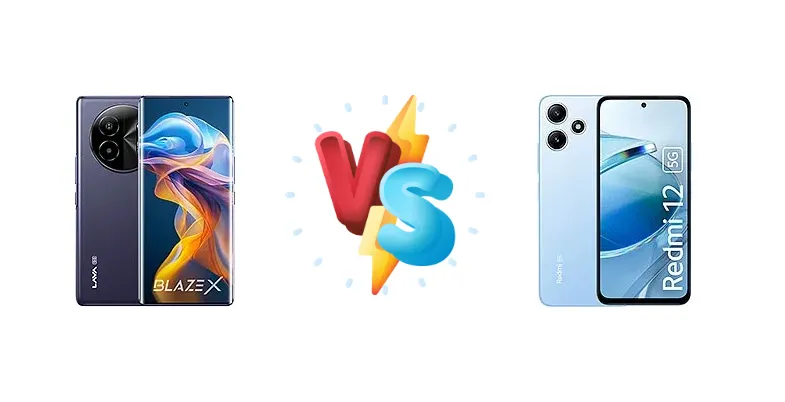
The sub-$200 5G smartphone market is heating up, with the Lava Blaze X and Xiaomi Redmi 12 5G vying for dominance. Both phones offer 5G connectivity at an accessible price point, but they take different approaches to achieving this. The Blaze X leverages MediaTek’s Dimensity 6300, while the Redmi 12 5G opts for Qualcomm’s Snapdragon 4 Gen 2. This comparison will dissect the key differences to determine which device delivers the best value.
🏆 Quick Verdict
For the average user prioritizing sustained performance and efficient power usage, the Xiaomi Redmi 12 5G emerges as the stronger contender. Its Snapdragon 4 Gen 2, built on a 4nm process, offers a noticeable advantage in thermal management and overall efficiency compared to the Lava Blaze X’s 6nm Dimensity 6300, despite a slightly lower peak CPU clock speed.
| Network |
|---|
| 2G bands | GSM 900 / 1800 | GSM 850 / 900 / 1800 / 1900 |
| 3G bands | HSDPA 850 / 900 / 1900 / 2100 | HSDPA 850 / 900 / 2100 |
| 4G bands | 1, 3, 5, 7, 8, 20, 28, 38, 40, 41 | 1, 3, 5, 8, 40, 41 |
| 5G bands | 1, 3, 5, 7, 8, 20, 28, 38, 40, 41, 66, 77, 78 SA/NSA | 1, 3, 5, 8, 28, 40, 78 SA/NSA |
| Speed | HSPA, LTE, 5G | HSPA, LTE, 5G |
| Technology | GSM / HSPA / LTE / 5G | GSM / HSPA / LTE / 5G |
| Launch |
|---|
| Announced | 2024, July 10 | 2023, August 01 |
| Status | Available. Released 2024, July 20 | Available. Released 2023, August 04 |
| Body |
|---|
| Build | - | Glass front (Gorilla Glass), plastic frame, glass back (Gorilla Glass) |
| Dimensions | 162.4 x 73.9 x 8.5 mm (6.39 x 2.91 x 0.33 in) | 168.6 x 76.3 x 8.2 mm (6.64 x 3.00 x 0.32 in) |
| SIM | Nano-SIM + Nano-SIM | Nano-SIM + Nano-SIM |
| Weight | 183 g (6.46 oz) | 199 g (7.02 oz) |
| Display |
|---|
| Protection | - | Corning Gorilla Glass |
| Resolution | 1080 x 2400 pixels, 20:9 ratio (~395 ppi density) | 1080 x 2460 pixels (~396 ppi density) |
| Size | 6.67 inches, 107.4 cm2 (~89.5% screen-to-body ratio) | 6.79 inches, 109.5 cm2 (~85.1% screen-to-body ratio) |
| Type | AMOLED, 120Hz | IPS LCD, 90Hz, 550 nits |
| Platform |
|---|
| CPU | Octa-core (2x2.4 GHz Cortex-A76 & 6x2.0 GHz Cortex-A55) | Octa-core (2x2.2 GHz Cortex-A78 & 6x1.95 GHz Cortex-A55) |
| Chipset | Mediatek Dimensity 6300 (6 nm) | Qualcomm SM4450 Snapdragon 4 Gen 2 (4 nm) |
| GPU | Mali-G57 MC2 | Adreno 613 |
| OS | Android 14, planned upgrade to Android 15 | Android 13, upgradable to Android 15, HyperOS 2 |
| Memory |
|---|
| Card slot | microSDXC | microSDXC (uses shared SIM slot) |
| Internal | 64GB 4GB RAM, 128GB 4GB RAM, 128GB 6GB RAM, 128GB 8GB RAM | 128GB 4GB RAM, 128GB 6GB RAM, 128GB 8GB RAM, 256GB 8GB RAM |
| Main Camera |
|---|
| Dual | 64 MP, (wide), AF, OIS
2 MP (macro) | 50 MP, f/1.8, (wide), PDAF
Auxiliary lens |
| Features | LED flash, HDR, panorama | LED flash, HDR |
| Video | 1080p@30fps | 1080p@30fps |
| Selfie camera |
|---|
| Features | - | HDR |
| Single | 16 MP | 8 MP, f/2.0, (wide), 1.12µm |
| Video | 1080p@30fps | 1080p@30fps |
| Sound |
|---|
| 35mm jack | No | Yes |
| Loudspeaker | Yes | Yes |
| Comms |
|---|
| Bluetooth | 5.2, A2DP, LE | 5.3, A2DP, LE |
| Infrared port | - | Yes |
| NFC | No | Unspecified |
| Positioning | GPS | GPS, GLONASS, GALILEO, BDS |
| Radio | Unspecified | No |
| USB | USB Type-C 2.0, OTG | USB Type-C |
| WLAN | Wi-Fi 802.11 b/g/n/ac | Wi-Fi 802.11 a/b/g/n/ac, dual-band |
| Features |
|---|
| Sensors | Fingerprint (under display, optical), accelerometer, gyro, proximity, compass | Fingerprint (side-mounted), accelerometer, compass |
| Battery |
|---|
| Charging | 33W wired | 18W wired, PD |
| Type | Li-Po 5000 mAh | Li-Po 5000 mAh |
| Misc |
|---|
| Colors | Starlight Purple, Titanium Grey | Jade Black, Pastel Blue, Moonstone Silver |
| Models | - | 23076RN4BI, 23076RN8DY, 2AFZZRN8DY |
| Price | About 190 EUR | € 104.09 / ₹ 15,999 |
| SAR | - | 1.09 W/kg (head) 0.88 W/kg (body) |
| SAR EU | - | 0.98 W/kg (head) 1.00 W/kg (body) |
Lava Blaze X
- Faster 33W wired charging
- Potentially higher peak CPU clock speeds
- Competitive price point
- Less efficient 6nm chipset
- Potential for more thermal throttling
- Likely less optimized software
Xiaomi Redmi 12 5G
- More efficient 4nm Snapdragon 4 Gen 2
- Better thermal management
- Qualcomm’s software optimization
- Slower 18W charging
- Slightly lower peak CPU clock speeds
- May be slightly more expensive
Display Comparison
Neither device boasts a standout display. Details are missing, so we must assume both utilize standard LCD panels common in this price bracket. The focus here will be on performance, not visual fidelity. Bezels are likely comparable, and color accuracy will be adequate for everyday use, but not professional work. The absence of high refresh rates is expected.
Camera Comparison
Without detailed camera specs, a direct comparison is difficult. However, the market segment suggests both phones will rely heavily on software processing. The primary sensor quality will be the most significant differentiator. We can assume both will include standard features like HDR and portrait modes. The absence of Optical Image Stabilization (OIS) is likely on both devices. The Redmi 12 5G may benefit from Qualcomm’s image signal processor (ISP) which is known for its strong image processing capabilities.
Performance
The core difference lies in the chipsets. The Redmi 12 5G’s Snapdragon 4 Gen 2 (4nm) benefits from a more modern fabrication process than the Lava Blaze X’s Dimensity 6300 (6nm). While the Blaze X has slightly higher clocked Cortex-A76 cores (2.4 GHz vs 2.2 GHz), the Snapdragon’s architecture and process node provide better power efficiency and sustained performance. The Snapdragon 4 Gen 2’s Cortex-A78 cores, while also dual-core, are generally more efficient than the A76. This translates to less throttling during extended gaming sessions or demanding tasks. The 4nm process also means less heat generation, further aiding sustained performance. Both phones feature 6x Cortex-A55 cores for efficiency tasks.
Battery Life
The battery capacity is not specified, but both phones likely feature batteries in the 5000mAh range, typical for this price point. The key difference is charging speed. The Lava Blaze X’s 33W wired charging is significantly faster than the Redmi 12 5G’s 18W charging, potentially reducing charge times by 30-45 minutes. The Redmi 12 5G does support Power Delivery (PD), offering wider charger compatibility, but the slower wattage limits its overall charging speed. The Snapdragon 4 Gen 2’s efficiency may offset the slower charging, providing comparable real-world battery life despite the wattage difference.
Buying Guide
Buy the Lava Blaze X if you prioritize faster wired charging and are willing to potentially trade off some sustained performance under heavy load. Its 33W charging is a significant advantage. Buy the Xiaomi Redmi 12 5G if you value a more efficient chipset, potentially better long-term performance due to superior thermal management, and the benefits of Qualcomm’s software optimization, even if it means slower 18W charging.
Frequently Asked Questions
❓ Will the Dimensity 6300 in the Lava Blaze X struggle with graphically intensive games like Genshin Impact?
The Dimensity 6300 is capable of running Genshin Impact, but you’ll likely need to lower the graphics settings to medium or low to maintain a stable frame rate. The 6nm process and potential for thermal throttling may limit sustained performance during extended gaming sessions compared to the Redmi 12 5G.
❓ Does the Redmi 12 5G support carrier aggregation, and will that impact 5G speeds?
While not explicitly stated, Qualcomm chipsets generally offer good carrier aggregation support. This means the Redmi 12 5G is more likely to combine multiple 5G bands for faster and more reliable 5G speeds, assuming your carrier supports it. Check your carrier’s compatibility list for specific band support.
❓ Is the 18W charging on the Redmi 12 5G really that slow in practical use?
While 18W is slower than 33W, the Snapdragon 4 Gen 2’s efficiency means the battery drains slower. A full charge will take longer, likely around 2-2.5 hours, but the overall impact on daily use may be minimal, especially if you charge overnight. The PD support also offers flexibility with chargers.