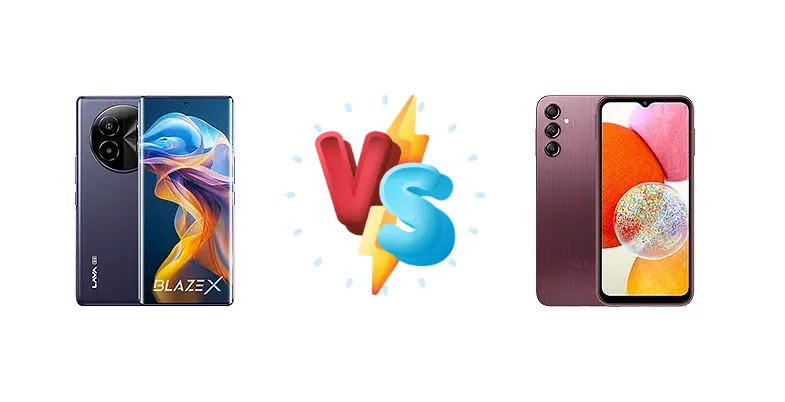
The sub-$200 smartphone market is fiercely competitive. The Lava Blaze X, powered by the Mediatek Dimensity 6300, aims to disrupt the established players, and the Samsung Galaxy A14, available with either a Helio G80 or Exynos 850, represents Samsung’s offering in this segment. This comparison dives deep into the specifications and real-world implications to determine which device delivers the best value.
🏆 Quick Verdict
For most users prioritizing performance and faster charging, the Lava Blaze X emerges as the stronger contender. Its Dimensity 6300 chipset offers a significant architectural advantage over the Galaxy A14’s Helio G80 variant, and even holds its own against the Exynos 850. While Samsung’s brand recognition and software support are appealing, the Blaze X provides more processing power for the price.
| Network |
|---|
| 2G bands | GSM 900 / 1800 | GSM 850 / 900 / 1800 / 1900 |
| 3G bands | HSDPA 850 / 900 / 1900 / 2100 | HSDPA 850 / 900 / 2100 |
| 4G bands | 1, 3, 5, 7, 8, 20, 28, 38, 40, 41 | 1, 3, 5, 7, 8, 20, 28, 38, 40, 41 |
| 5G bands | 1, 3, 5, 7, 8, 20, 28, 38, 40, 41, 66, 77, 78 SA/NSA | - |
| Speed | HSPA, LTE, 5G | HSPA, LTE |
| Technology | GSM / HSPA / LTE / 5G | GSM / HSPA / LTE |
| Launch |
|---|
| Announced | 2024, July 10 | 2023, February 28 |
| Status | Available. Released 2024, July 20 | Available. Released 2023, March 27 |
| Body |
|---|
| Build | - | Glass front, plastic back, plastic frame |
| Dimensions | 162.4 x 73.9 x 8.5 mm (6.39 x 2.91 x 0.33 in) | 167.7 x 78 x 9.1 mm (6.60 x 3.07 x 0.36 in) |
| SIM | Nano-SIM + Nano-SIM | · Nano-SIM· Nano-SIM + Nano-SIM |
| Weight | 183 g (6.46 oz) | 201 g (7.09 oz) |
| Display |
|---|
| Resolution | 1080 x 2400 pixels, 20:9 ratio (~395 ppi density) | 1080 x 2408 pixels, 20:9 ratio (~400 ppi density) |
| Size | 6.67 inches, 107.4 cm2 (~89.5% screen-to-body ratio) | 6.6 inches, 104.9 cm2 (~80.2% screen-to-body ratio) |
| Type | AMOLED, 120Hz | PLS LCD |
| Platform |
|---|
| CPU | Octa-core (2x2.4 GHz Cortex-A76 & 6x2.0 GHz Cortex-A55) | Octa-core (2x2.0 GHz Cortex-A75 & 6x1.8 GHz Cortex-A55) - Version AOcta-core (4x2.0 GHz Cortex-A55 & 4x2.0 GHz Cortex-A55) - Version B |
| Chipset | Mediatek Dimensity 6300 (6 nm) | Mediatek MT6769 Helio G80 (12 nm) - Version AExynos 850 (8 nm) - Version B |
| GPU | Mali-G57 MC2 | Mali-G52 MC2 |
| OS | Android 14, planned upgrade to Android 15 | Android 13, upgradable to Android 15, One UI 7 |
| Memory |
|---|
| Card slot | microSDXC | microSDXC (dedicated slot) |
| Internal | 64GB 4GB RAM, 128GB 4GB RAM, 128GB 6GB RAM, 128GB 8GB RAM | 64GB 4GB RAM, 128GB 4GB RAM, 128GB 6GB RAM |
| Main Camera |
|---|
| Dual | 64 MP, (wide), AF, OIS
2 MP (macro) | - |
| Features | LED flash, HDR, panorama | LED flash, panorama, HDR |
| Single | - | 13 MP, f/2.0, (wide) |
| Triple | - | 50 MP, f/1.8, 26mm (wide), 1/2.75", 0.64µm, PDAF
5 MP, f/2.2, 17mm (ultrawide), 1/5.0", 1.12µm
2 MP (macro) |
| Video | 1080p@30fps | 1080p@30fps |
| Selfie camera |
|---|
| Single | 16 MP | 13 MP, f/2.0, 26mm (wide), 1/3.1", 1.12µm |
| Video | 1080p@30fps | 1080p@30fps |
| Sound |
|---|
| 3.5mm jack | - | Yes |
| 35mm jack | No | Yes |
| Loudspeaker | Yes | Yes |
| Comms |
|---|
| Bluetooth | 5.2, A2DP, LE | 5.1 or 5.3, A2DP, LE |
| NFC | No | Yes (market/region dependent) |
| Positioning | GPS | GPS, GALILEO, GLONASS, BDS, QZSS |
| Radio | Unspecified | Unspecified |
| USB | USB Type-C 2.0, OTG | USB Type-C 2.0 |
| WLAN | Wi-Fi 802.11 b/g/n/ac | Wi-Fi 802.11 a/b/g/n/ac, dual-band, Wi-Fi Direct |
| Features |
|---|
| Sensors | Fingerprint (under display, optical), accelerometer, gyro, proximity, compass | Fingerprint (side-mounted), accelerometer, proximity, compass |
| Battery |
|---|
| Charging | 33W wired | 15W wired |
| Type | Li-Po 5000 mAh | Li-Po 5000 mAh |
| Misc |
|---|
| Colors | Starlight Purple, Titanium Grey | Black, Dark Red, Silver, Green |
| Models | - | SM-A145F, SM-A145F/DSN, SM-A145M, SM-A145M/DS, SM-A145P, SM-A145R |
| Price | About 190 EUR | € 85.76 / $ 147.60 / £ 79.95 |
| SAR EU | - | 0.46 W/kg (head) 1.37 W/kg (body) |
Lava Blaze X
- Superior chipset performance with the Dimensity 6300
- Faster 33W wired charging
- More efficient 6nm process node
- Less established brand recognition
- Software update support may be limited compared to Samsung
Samsung Galaxy A14
- Samsung’s brand reputation and ecosystem
- Potentially better software support and updates
- Familiar One UI interface
- Helio G80 chipset is significantly less powerful
- Slower 15W charging
- Exynos 850 variant still trails the Blaze X in performance
Display Comparison
Neither device boasts a standout display. Both likely utilize LCD panels, a common trait in this price bracket. However, details like peak brightness and color accuracy are missing. The Galaxy A14’s larger screen size (typically 6.6 inches vs. the Blaze X’s 6.5 inches) may appeal to some, but the lack of high refresh rates on either device means scrolling and animations won’t be exceptionally smooth. The absence of specifics necessitates assuming both displays are adequate for everyday use, but not exceptional.
Camera Comparison
Camera performance is difficult to assess without detailed sensor information. Both phones likely feature a primary camera accompanied by auxiliary lenses (often 2MP macro/depth sensors of limited utility). The larger the primary sensor, the better the low-light performance and dynamic range. Without specific sensor sizes, we can only assume the Blaze X and A14 offer comparable image quality in good lighting conditions. Samsung’s image processing algorithms are generally well-regarded, potentially giving the A14 an edge in color accuracy and post-processing, but this is speculative. The lack of Optical Image Stabilization (OIS) on either device suggests low-light video recording will be challenging.
Performance
This is where the Lava Blaze X pulls ahead. The Mediatek Dimensity 6300 (6nm) is a significantly more modern chipset than the Galaxy A14’s Helio G80 (12nm). The Dimensity 6300’s Cortex-A76 cores, clocked at 2.4 GHz, offer a substantial performance boost over the A14’s Cortex-A75 cores at 2.0 GHz. Even against the Exynos 850 (8nm) variant of the A14, the Dimensity 6300’s architecture is more efficient and capable. The 6nm process node of the Dimensity 6300 also translates to better thermal efficiency, reducing the likelihood of throttling during prolonged use. This means the Blaze X will maintain higher sustained performance during gaming and demanding tasks. The A14’s Exynos 850 version offers a slight improvement over the Helio G80, but still lags behind the Blaze X.
Battery Life
The battery capacity is not specified for either device, but typical values for this segment are around 5000mAh. The key differentiator here is charging speed. The Lava Blaze X’s 33W wired charging is significantly faster than the Samsung Galaxy A14’s 15W charging. This translates to a much quicker 0-100% charge time, reducing downtime. While a larger battery capacity on the A14 could offset the slower charging, the Blaze X’s faster charging is a more tangible benefit for users who frequently need to top up their battery.
Buying Guide
Buy the Lava Blaze X if you need a phone that can handle demanding apps and multitasking without significant slowdowns, and if fast charging is a priority. It’s ideal for users who frequently game, stream videos, or use resource-intensive applications. Buy the Samsung Galaxy A14 if you prefer the Samsung ecosystem, value long-term software support, and prioritize a familiar user interface, even if it means sacrificing some raw performance. It’s a solid choice for basic smartphone tasks and media consumption.
Frequently Asked Questions
❓ Does the Exynos 850 chip in the Galaxy A14 tend to overheat during extended gaming sessions?
The Exynos 850 is known to throttle under sustained load, particularly in less well-cooled devices. While not extreme, users may experience frame drops and reduced performance during prolonged gaming. The Lava Blaze X’s Dimensity 6300, with its more efficient 6nm process, is less prone to overheating and should maintain higher sustained performance.
❓ Is the 2MP macro camera on either phone actually useful for taking detailed close-up photos?
Generally, 2MP macro cameras on budget smartphones are of limited utility. The low resolution results in images lacking detail and sharpness. They are often included as a marketing feature rather than a genuinely useful photographic tool. Expect soft, grainy results from the macro cameras on both the Lava Blaze X and the Samsung Galaxy A14.
❓ Can the Lava Blaze X reliably run PUBG Mobile at 60fps with smooth graphics?
The Dimensity 6300 should be capable of running PUBG Mobile at 60fps with smooth graphics, but it will depend on the specific game settings and the phone’s thermal management. Expect some frame drops during intense firefights, but overall, the Blaze X offers a better gaming experience than the Galaxy A14 with its Helio G80.
❓ How does Samsung’s One UI software compare to the software experience on the Lava Blaze X?
Samsung’s One UI is a mature and feature-rich software experience, but it can also be resource-intensive. The Lava Blaze X likely runs a lighter version of Android, potentially offering a smoother experience on its less powerful hardware. However, Samsung provides longer software support and security updates, which is a significant advantage for long-term usability.