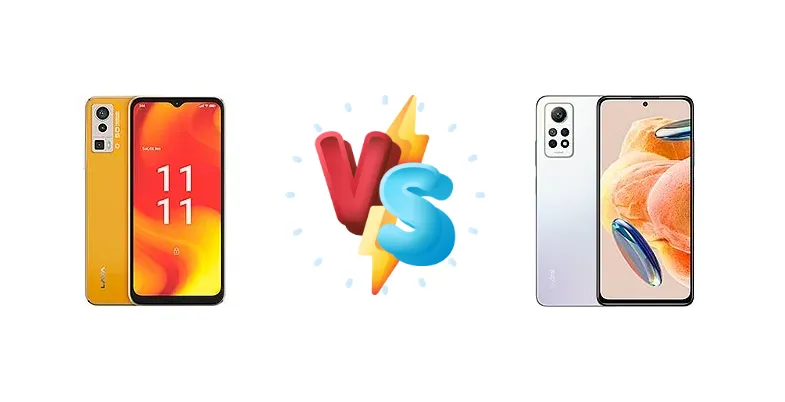
The sub-$200 smartphone market is fiercely competitive. The Lava Blaze Pro and Xiaomi Redmi Note 12 Pro 4G both aim to deliver a compelling experience without breaking the bank, but they take drastically different approaches to achieving that goal. This comparison dissects their core components to reveal which phone offers the best value for your money.
🏆 Quick Verdict
For the average user prioritizing performance and convenience, the Xiaomi Redmi Note 12 Pro 4G is the clear winner. Its Snapdragon 732G chipset and, crucially, its 67W fast charging significantly outperform the Lava Blaze Pro’s Helio G37 and 10W charging, making it a more practical daily driver.
| Network |
|---|
| 2G bands | GSM 900 / 1800 | GSM 850 / 900 / 1800 / 1900 |
| 3G bands | HSDPA 900 / 2100 | HSDPA 850 / 900 / 1700(AWS) / 1900 / 2100 |
| 4G bands | 1, 3, 5, 8, 40, 41 | 1, 2, 3, 4, 5, 7, 8, 20, 28, 38, 40, 41, 66 |
| Speed | HSPA 42.2/5.76 Mbps, LTE Cat4 150/50 Mbps | HSPA, LTE |
| Technology | GSM / HSPA / LTE | GSM / HSPA / LTE |
| Launch |
|---|
| Announced | 2022, September 20 | 2023, March 03 |
| Status | Available. Released 2022, September 20 | Available. Released 2023, April 11 |
| Body |
|---|
| Dimensions | 164.8 x 76.3 x 8.9 mm (6.49 x 3.00 x 0.35 in) | 164.2 x 76.1 x 8.1 mm (6.46 x 3.00 x 0.32 in) |
| SIM | Nano-SIM + Nano-SIM | Nano-SIM + Nano-SIM |
| Weight | 187 g (6.60 oz) | 201.8 g (7.13 oz) |
| Display |
|---|
| Resolution | 720 x 1600 pixels, 20:9 ratio (~269 ppi density) | 1080 x 2400 pixels, 20:9 ratio (~395 ppi density) |
| Size | 6.52 inches, 102.6 cm2 (~81.6% screen-to-body ratio) | 6.67 inches, 107.4 cm2 (~86.0% screen-to-body ratio) |
| Type | IPS LCD, 90Hz | AMOLED, 120Hz, Dolby Vision, 700 nits (HBM), 1100 nits (peak) |
| Platform |
|---|
| CPU | Octa-core (4x2.3 GHz Cortex-A53 & 4x1.8 GHz Cortex-A53) | Octa-core (2x2.2 GHz Kryo 470 Gold & 6x1.8 GHz Kryo 470 Silver) |
| Chipset | Mediatek MT6765V/CB Helio G37 (12 nm) | Qualcomm SM7150 Snapdragon 732G (8 nm) |
| GPU | PowerVR GE8320 | Adreno 618 |
| OS | Android 12 | Android 11, MIUI 13 |
| Memory |
|---|
| Card slot | microSDXC (dedicated slot) | microSDXC (uses shared SIM slot) |
| Internal | 64GB 4GB RAM | 128GB 6GB RAM, 128GB 8GB RAM, 256GB 8GB RAM |
| | eMMC 5.1 | UFS 2.2 |
| Main Camera |
|---|
| Features | LED flash | LED flash, HDR, panorama |
| Quad | - | 108 MP, f/1.9, (wide), 1/1.52", 0.7µm, PDAF
8 MP, 120˚, (ultrawide)
2 MP (macro)
Auxiliary lens |
| Single | 8 MP, f/2.0, (wide) | - |
| Triple | 50 MP, (wide), 0.64µm, AF
2 MP (macro)
VGA | - |
| Video | 1080p@30fps | 4K@30fps, 1080p@30/60fps |
| Selfie camera |
|---|
| Single | 8 MP, f/2.0, (wide) | 16 MP, f/2.4, (wide) |
| Video | Yes | 1080p@30fps |
| Sound |
|---|
| 3.5mm jack | Yes | Yes |
| 35mm jack | Yes | Yes |
| Loudspeaker | Yes | Yes, with stereo speakers |
| Comms |
|---|
| Bluetooth | 5.0, A2DP, LE | 5.0, A2DP, LE |
| Infrared port | - | Yes |
| NFC | No | Yes (market/region dependent) |
| Positioning | GPS | GPS, GLONASS, GALILEO, BDS |
| Radio | FM radio | Unspecified |
| USB | USB Type-C 2.0, OTG | USB Type-C 2.0, OTG |
| WLAN | Wi-Fi 802.11 b/g/n/ac | Wi-Fi 802.11 a/b/g/n/ac, dual-band |
| Features |
|---|
| Sensors | Fingerprint (side-mounted), accelerometer, proximity | Fingerprint (side-mounted), accelerometer, gyro, compass |
| Battery |
|---|
| Charging | 10W wired | 67W wired |
| Type | Li-Po 5000 mAh | Li-Po 5000 mAh |
| Misc |
|---|
| Colors | Gold, Green, Blue, Orange | Star Blue, Graphite Gray, Polar White, Ice blue |
| Models | LZX404 | 2209116AG, 2209116AG |
| Price | About 130 EUR | About 150 EUR |
Lava Blaze Pro
- Potentially lower price point
- Simple and straightforward user experience
- May offer longer battery life due to less powerful chipset (depending on battery capacity)
- Significantly slower performance
- Extremely slow 10W charging
- Inferior camera capabilities
Xiaomi Redmi Note 12 Pro 4G
- Faster and more efficient Snapdragon 732G chipset
- Blazing-fast 67W wired charging
- Likely superior camera performance
- Potentially higher price
- Xiaomi’s MIUI software can be resource-intensive
- May have more bloatware
Display Comparison
Neither device’s display specifications are provided, so we must infer. Given the price point, both likely utilize IPS LCD panels. However, the Redmi Note 12 Pro 4G, being a Xiaomi device, likely benefits from better color calibration and potentially higher peak brightness. The absence of information on refresh rates suggests both are likely capped at 60Hz. Bezels are expected to be comparable, typical of this segment.
Camera Comparison
Without detailed camera specs, a direct comparison is difficult. However, Xiaomi generally focuses on camera capabilities in its Redmi Note series. The Redmi Note 12 Pro 4G likely features a more sophisticated image processing pipeline and potentially a larger primary sensor than the Lava Blaze Pro. The Helio G37’s ISP is less capable than the Snapdragon 732G’s, limiting the Blaze Pro’s potential for image quality. We can assume both phones will include standard features like HDR and portrait modes, but the Redmi Note 12 Pro 4G is expected to deliver superior results in challenging lighting conditions.
Performance
The core difference lies in the chipsets. The Xiaomi Redmi Note 12 Pro 4G’s Qualcomm Snapdragon 732G, built on an 8nm process, offers a substantial advantage over the Lava Blaze Pro’s MediaTek Helio G37 (12nm). The Snapdragon 732G’s Kryo 470 Gold cores, clocked at 2.2 GHz, provide a noticeable performance boost over the Helio G37’s Cortex-A53 cores at 2.3 GHz. While the clock speed is higher on the Helio G37, the architectural efficiency of the Snapdragon 732G, coupled with the smaller fabrication node, translates to better sustained performance and thermal management. This means the Redmi Note 12 Pro 4G will handle demanding apps and games with greater ease and less throttling.
Battery Life
The battery capacity isn’t specified for either device, but the charging speeds tell a significant story. The Redmi Note 12 Pro 4G’s 67W wired charging is a game-changer, capable of fully charging the phone in under an hour. In contrast, the Lava Blaze Pro’s 10W charging is painfully slow, requiring several hours for a full charge. Even if the Blaze Pro has a slightly larger battery capacity, the convenience and speed of the Redmi Note 12 Pro 4G’s charging system are invaluable for most users.
Buying Guide
Buy the Lava Blaze Pro if you prioritize a simple, no-frills experience and are willing to accept slower performance and charging speeds. It’s a good option for basic communication and light tasks. Buy the Xiaomi Redmi Note 12 Pro 4G if you value faster processing, smoother multitasking, and the convenience of incredibly rapid charging – essential for users who are always on the go and demand more from their smartphone.
Frequently Asked Questions
❓ How much faster is the Snapdragon 732G in the Redmi Note 12 Pro 4G compared to the Helio G37 in the Lava Blaze Pro for gaming?
The Snapdragon 732G offers a significant performance uplift for gaming. Its more efficient architecture and higher clock speeds on the performance cores allow for smoother frame rates and better sustained performance in demanding titles. While the Helio G37 can handle casual games, the Snapdragon 732G is better suited for more graphically intensive games like PUBG Mobile or Call of Duty: Mobile.
❓ Is the 67W charging on the Redmi Note 12 Pro 4G safe for the battery's long-term health?
Yes, modern smartphones employ sophisticated charging management systems that protect the battery from overcharging and overheating, even with fast charging technologies like 67W. Xiaomi incorporates multiple layers of safety features to ensure the battery remains healthy over its lifespan. While fast charging *can* generate more heat, the Redmi Note 12 Pro 4G’s thermal management system is designed to mitigate this.
❓ Will the Lava Blaze Pro struggle with multitasking or running multiple apps simultaneously?
Yes, the Lava Blaze Pro’s Helio G37 chipset and limited RAM (spec not provided, but likely 3-4GB) will likely struggle with heavy multitasking. Switching between apps may be slow, and running demanding apps in the background could lead to performance slowdowns or app crashes. The Redmi Note 12 Pro 4G, with its Snapdragon 732G, will handle multitasking much more efficiently.