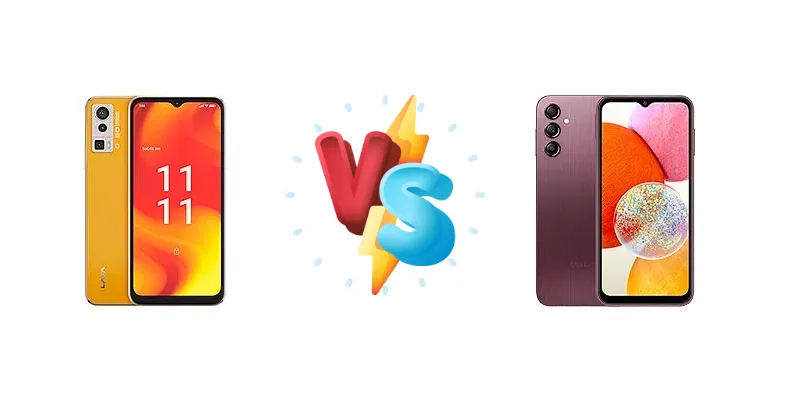
The sub-$150 smartphone market is fiercely competitive. The Lava Blaze Pro and Samsung Galaxy A14 both aim to deliver essential smartphone functionality at an accessible price point. However, they take different approaches to achieving this, with variations in chipset choice and feature sets. This comparison will dissect their strengths and weaknesses to determine which device offers the best overall experience.
🏆 Quick Verdict
For the average user prioritizing a slightly smoother experience and potential for future software updates, the Samsung Galaxy A14 is the better choice. Its Helio G80 chipset, while not a massive leap, offers a noticeable performance advantage over the Blaze Pro’s Helio G37. However, the Lava Blaze Pro remains a viable option for those on a very tight budget.
| Network |
|---|
| 2G bands | GSM 900 / 1800 | GSM 850 / 900 / 1800 / 1900 |
| 3G bands | HSDPA 900 / 2100 | HSDPA 850 / 900 / 2100 |
| 4G bands | 1, 3, 5, 8, 40, 41 | 1, 3, 5, 7, 8, 20, 28, 38, 40, 41 |
| Speed | HSPA 42.2/5.76 Mbps, LTE Cat4 150/50 Mbps | HSPA, LTE |
| Technology | GSM / HSPA / LTE | GSM / HSPA / LTE |
| Launch |
|---|
| Announced | 2022, September 20 | 2023, February 28 |
| Status | Available. Released 2022, September 20 | Available. Released 2023, March 27 |
| Body |
|---|
| Build | - | Glass front, plastic back, plastic frame |
| Dimensions | 164.8 x 76.3 x 8.9 mm (6.49 x 3.00 x 0.35 in) | 167.7 x 78 x 9.1 mm (6.60 x 3.07 x 0.36 in) |
| SIM | Nano-SIM + Nano-SIM | · Nano-SIM· Nano-SIM + Nano-SIM |
| Weight | 187 g (6.60 oz) | 201 g (7.09 oz) |
| Display |
|---|
| Resolution | 720 x 1600 pixels, 20:9 ratio (~269 ppi density) | 1080 x 2408 pixels, 20:9 ratio (~400 ppi density) |
| Size | 6.52 inches, 102.6 cm2 (~81.6% screen-to-body ratio) | 6.6 inches, 104.9 cm2 (~80.2% screen-to-body ratio) |
| Type | IPS LCD, 90Hz | PLS LCD |
| Platform |
|---|
| CPU | Octa-core (4x2.3 GHz Cortex-A53 & 4x1.8 GHz Cortex-A53) | Octa-core (2x2.0 GHz Cortex-A75 & 6x1.8 GHz Cortex-A55) - Version AOcta-core (4x2.0 GHz Cortex-A55 & 4x2.0 GHz Cortex-A55) - Version B |
| Chipset | Mediatek MT6765V/CB Helio G37 (12 nm) | Mediatek MT6769 Helio G80 (12 nm) - Version AExynos 850 (8 nm) - Version B |
| GPU | PowerVR GE8320 | Mali-G52 MC2 |
| OS | Android 12 | Android 13, upgradable to Android 15, One UI 7 |
| Memory |
|---|
| Card slot | microSDXC (dedicated slot) | microSDXC (dedicated slot) |
| Internal | 64GB 4GB RAM | 64GB 4GB RAM, 128GB 4GB RAM, 128GB 6GB RAM |
| | eMMC 5.1 | - |
| Main Camera |
|---|
| Features | LED flash | LED flash, panorama, HDR |
| Single | 8 MP, f/2.0, (wide) | 13 MP, f/2.0, (wide) |
| Triple | 50 MP, (wide), 0.64µm, AF
2 MP (macro)
VGA | 50 MP, f/1.8, 26mm (wide), 1/2.75", 0.64µm, PDAF
5 MP, f/2.2, 17mm (ultrawide), 1/5.0", 1.12µm
2 MP (macro) |
| Video | 1080p@30fps | 1080p@30fps |
| Selfie camera |
|---|
| Single | 8 MP, f/2.0, (wide) | 13 MP, f/2.0, 26mm (wide), 1/3.1", 1.12µm |
| Video | Yes | 1080p@30fps |
| Sound |
|---|
| 3.5mm jack | Yes | Yes |
| 35mm jack | Yes | Yes |
| Loudspeaker | Yes | Yes |
| Comms |
|---|
| Bluetooth | 5.0, A2DP, LE | 5.1 or 5.3, A2DP, LE |
| NFC | No | Yes (market/region dependent) |
| Positioning | GPS | GPS, GALILEO, GLONASS, BDS, QZSS |
| Radio | FM radio | Unspecified |
| USB | USB Type-C 2.0, OTG | USB Type-C 2.0 |
| WLAN | Wi-Fi 802.11 b/g/n/ac | Wi-Fi 802.11 a/b/g/n/ac, dual-band, Wi-Fi Direct |
| Features |
|---|
| Sensors | Fingerprint (side-mounted), accelerometer, proximity | Fingerprint (side-mounted), accelerometer, proximity, compass |
| Battery |
|---|
| Charging | 10W wired | 15W wired |
| Type | Li-Po 5000 mAh | Li-Po 5000 mAh |
| Misc |
|---|
| Colors | Gold, Green, Blue, Orange | Black, Dark Red, Silver, Green |
| Models | LZX404 | SM-A145F, SM-A145F/DSN, SM-A145M, SM-A145M/DS, SM-A145P, SM-A145R |
| Price | About 130 EUR | € 85.76 / $ 147.60 / £ 79.95 |
| SAR EU | - | 0.46 W/kg (head) 1.37 W/kg (body) |
Lava Blaze Pro
- Lower price point
- Functional for basic tasks
- Potentially longer battery life (depending on actual capacity)
- Inferior chipset performance
- Limited multitasking capabilities
- Likely slower software updates
Samsung Galaxy A14
- More powerful Helio G80 (or Exynos 850) chipset
- Larger 5000mAh battery
- Samsung brand recognition and potential for better software support
- Higher price
- 15W charging is still relatively slow
- Camera performance may not be significantly better
Display Comparison
Neither device boasts a particularly impressive display. Both are likely utilizing LCD panels, a common cost-saving measure in this segment. While specific details like peak brightness and color gamut coverage are unavailable, the A14’s larger screen size (6.6 inches vs. the Blaze Pro’s 6.5 inches) offers a more immersive viewing experience. Bezels are expected to be relatively thick on both, and neither is likely to feature high refresh rate technology. The A14's larger size may be preferable for media consumption, but the difference is marginal.
Camera Comparison
Camera performance is likely to be similar in real-world usage, with both phones relying on budget sensors. The A14’s camera specifications are not detailed enough to provide a definitive advantage, but Samsung’s image processing algorithms are generally more refined than those found on lesser-known brands. The inclusion of a 2MP macro camera on both devices is largely a marketing gimmick, offering limited practical benefit. Focusing on the main sensor, the A14 likely has a larger sensor size, resulting in better low-light performance. The lack of OIS on either device means image stabilization will rely solely on software, which may produce blurry results in challenging conditions.
Performance
The core difference lies in the chipsets. The Samsung Galaxy A14, in its primary configuration, features the Mediatek Helio G80 (12nm). This chipset utilizes a more modern CPU architecture – Cortex-A75 cores – compared to the Lava Blaze Pro’s Helio G37 (12nm) and its Cortex-A53 cores. The A75 cores provide a significant boost in single-core performance, translating to snappier app launches and smoother multitasking. The A14 also has a version with the Exynos 850 (8nm), which offers even better efficiency and performance due to the smaller manufacturing process. The Blaze Pro’s G37 is adequate for basic tasks, but will struggle with demanding applications. The A14’s potential for gaming is also higher, though still limited to lighter titles. The A14’s RAM configuration (likely LPDDR4X) is also likely superior to the Blaze Pro’s, further contributing to its performance advantage.
Battery Life
The Lava Blaze Pro’s battery capacity is unknown, but the Samsung Galaxy A14 packs a substantial 5000mAh battery. While the Blaze Pro’s 10W charging is slow, the A14’s 15W charging offers a modest improvement. However, the Exynos 850 version of the A14, being more efficient, will likely deliver longer battery life overall. The A14’s larger battery capacity, combined with the potentially more efficient chipset, gives it a clear advantage in endurance. Expect the A14 to comfortably last a full day of moderate use, while the Blaze Pro may require a top-up before the end of the day.
Buying Guide
Buy the Lava Blaze Pro if you need a functional smartphone for basic tasks like calling, texting, and light social media use, and your budget is extremely limited. You're willing to accept compromises in performance and future software support. Buy the Samsung Galaxy A14 if you prefer a more responsive user experience, occasional gaming, and the peace of mind that comes with Samsung’s brand recognition and potentially longer software update commitment. You're willing to spend a bit more for these benefits.
Frequently Asked Questions
❓ Does the Exynos 850 version of the Galaxy A14 noticeably outperform the Helio G80 version?
Yes, the Exynos 850, built on an 8nm process, offers improved power efficiency and a slight performance boost over the Helio G80. This translates to better sustained performance during gaming and potentially longer battery life. However, the difference isn't massive, and the Helio G80 version is still a capable performer for everyday tasks.
❓ Is the 2MP macro camera on either phone worth using?
Generally, no. 2MP macro cameras on budget phones typically lack the resolution and detail to produce truly impressive macro shots. They often result in blurry, noisy images. You're better off using the main camera and cropping in if you need a close-up shot.
❓ Can the Samsung Galaxy A14 handle popular games like PUBG Mobile?
The Galaxy A14 with the Helio G80 can run PUBG Mobile, but you'll likely need to lower the graphics settings to medium or low to achieve a playable frame rate. The Exynos 850 version will offer a slightly smoother experience. Don't expect to max out the settings and maintain a consistent 60fps.
❓ How long will software updates be supported on the Lava Blaze Pro?
Lava's software update commitment is less established than Samsung's. Expect limited software updates, potentially only one major Android version upgrade, if any. This is a significant consideration if you plan to use the phone for several years.