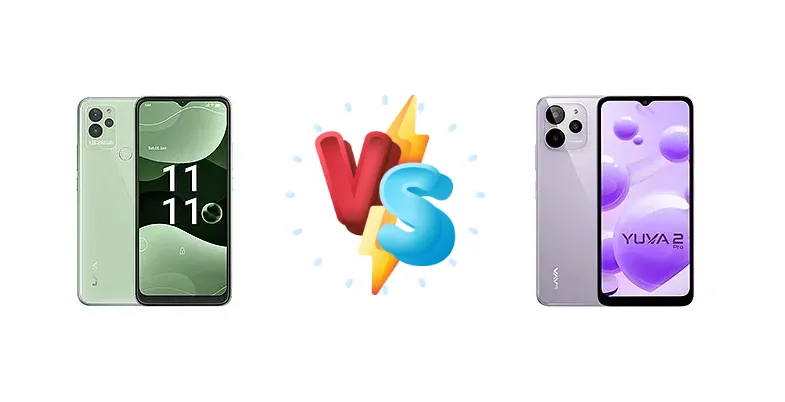
Lava has positioned both the Blaze Nxt and Yuva 2 Pro as affordable entry-level smartphones. However, a look at the core specifications reveals a startling similarity: both devices are powered by the same MediaTek Helio G37 chipset and utilize the same 10W charging standard. This comparison aims to dissect whether any meaningful differences exist beyond branding and potential software optimizations, helping you determine which, if either, offers the best value.
🏆 Quick Verdict
For the average user, the choice between the Lava Blaze Nxt and Yuva 2 Pro is largely inconsequential. They offer identical performance and charging speeds. The decision will likely come down to price, software preferences, and any unique features offered by each device beyond the core specifications provided.
| Network |
|---|
| 2G bands | GSM 900 / 1800 | GSM 900 / 1800 |
| 3G bands | HSDPA 900 / 2100 | HSDPA 900 / 2100 |
| 4G bands | 1, 3, 5, 8, 40, 41 | 1, 3, 5, 8, 40, 41 |
| Speed | HSPA, LTE | HSPA, LTE |
| Technology | GSM / HSPA / LTE | GSM / HSPA / LTE |
| Launch |
|---|
| Announced | 2022, November 25 | 2023, February 22 |
| Status | Available. Released 2022, December 02 | Available. Released 2023, February 22 |
| Body |
|---|
| Dimensions | 164.8 x 76.3 x 8.9 mm (6.49 x 3.00 x 0.35 in) | 164.5 x 76 x 9 mm (6.48 x 2.99 x 0.35 in) |
| SIM | Nano-SIM + Nano-SIM | Nano-SIM + Nano-SIM |
| Weight | 203.5 g (7.20 oz) | 204 g (7.20 oz) |
| Display |
|---|
| Resolution | 720 x 1600 pixels, 20:9 ratio (~269 ppi density) | 720 x 1600 pixels, 20:9 ratio (~269 ppi density) |
| Size | 6.52 inches, 102.6 cm2 (~81.6% screen-to-body ratio) | 6.52 inches, 102.6 cm2 (~82.1% screen-to-body ratio) |
| Type | IPS LCD | IPS LCD |
| Platform |
|---|
| CPU | Octa-core (4x2.3 GHz Cortex-A53 & 4x1.8 GHz Cortex-A53) | Octa-core (4x2.3 GHz Cortex-A53 & 4x1.8 GHz Cortex-A53) |
| Chipset | Mediatek MT6765 Helio G37 (12 nm) | Mediatek MT6765 Helio G37 (12 nm) |
| GPU | PowerVR GE8320 | PowerVR GE8320 |
| OS | Android 12 | Android 12 |
| Memory |
|---|
| Card slot | microSDXC (dedicated slot) | microSDXC (dedicated slot) |
| Internal | 64GB 4GB RAM | 64GB 4GB RAM |
| | - | eMMC 5.1 |
| Main Camera |
|---|
| Features | LED flash | LED flash |
| Single | - | 5 MP |
| Triple | 13 MP, (wide), AF
2 MP
VGA | 13 MP, (wide), AF
VGA
VGA |
| Video | 1080p@30fps | 1080p@30fps |
| Selfie camera |
|---|
| Single | 8 MP | 5 MP |
| Video | Yes | Yes |
| Sound |
|---|
| 3.5mm jack | Yes | Yes |
| 35mm jack | Yes | Yes |
| Loudspeaker | Yes | Yes |
| Comms |
|---|
| Bluetooth | 5.0, A2DP, LE | 5.1, A2DP, LE |
| NFC | No | No |
| Positioning | GPS | GPS |
| Radio | FM radio | FM radio |
| USB | USB Type-C 2.0, OTG | USB Type-C 2.0, OTG |
| WLAN | Wi-Fi 802.11 b/g/n/ac | Wi-Fi 802.11 b/g/n/ac |
| Features |
|---|
| Sensors | Fingerprint (rear-mounted), accelerometer, proximity | Fingerprint (side-mounted), accelerometer, proximity |
| Battery |
|---|
| Charging | 10W wired | 10W wired |
| Type | Li-Ion 5000 mAh | Li-Po 5000 mAh |
| Misc |
|---|
| Colors | Glass Blue, Glass Red, Glass Green | Glass Lavender, Glass Green, Glass White |
| Models | - | LZX408 |
| Price | About 110 EUR | About 90 EUR |
Lava Blaze Nxt
- Identical performance to Yuva 2 Pro
- Potential for established software support
- May be available at a lower price
- Slow 10W charging
- Likely basic camera system
Lava Yuva 2 Pro
- Identical performance to Blaze Nxt
- Potentially more modern design
- May offer unique bundled accessories
- Slow 10W charging
- Likely basic camera system
Display Comparison
Both the Lava Blaze Nxt and Yuva 2 Pro are expected to feature LCD panels, typical for this price segment. Without specific details on screen size, resolution, or peak brightness, it's safe to assume a similar viewing experience. The absence of higher refresh rates or advanced panel technologies like LTPO suggests a focus on cost optimization rather than visual fidelity. Color accuracy is likely to be standard for budget devices, prioritizing power efficiency over precise color reproduction.
Camera Comparison
Camera performance is difficult to assess without detailed sensor information. However, given the target market, both devices likely employ similar camera setups. The absence of OIS (Optical Image Stabilization) suggests reliance on software stabilization. Lens apertures are likely to be modest, impacting low-light performance. While both phones may feature multiple rear cameras, the image processing algorithms and overall image quality are expected to be comparable, given the shared chipset and likely similar sensor choices.
Performance
The heart of both devices is the MediaTek Helio G37 (12 nm) chipset, featuring an octa-core CPU configuration with 4x2.3 GHz Cortex-A53 and 4x1.8 GHz Cortex-A53 cores. This means identical CPU performance for everyday tasks like browsing, social media, and light gaming. The GPU performance will also be the same. The lack of information regarding RAM type (LPDDR4X vs LPDDR5) and storage speed (eMMC vs UFS) prevents a deeper analysis, but these are likely to be similar, further minimizing performance differences. Thermal management will be adequate for the intended use case, but sustained heavy workloads may lead to throttling.
Battery Life
Both the Lava Blaze Nxt and Yuva 2 Pro utilize 10W wired charging, indicating a similar charging time from 0-100%. The actual battery capacity isn't specified, but it's reasonable to expect a capacity around 5000mAh in this segment. The 10W charging rate will result in relatively slow charging times, requiring several hours for a full charge. Battery life will depend on usage patterns, but both devices should comfortably last a full day with moderate use.
Buying Guide
Buy the Lava Blaze Nxt if you prioritize a potentially more established software experience within Lava's ecosystem, or if it's available at a significantly lower price point. Buy the Lava Yuva 2 Pro if you prefer its design aesthetic or if it comes bundled with specific accessories or promotions that add value. Given the identical core hardware, focusing on these secondary factors is crucial.
Frequently Asked Questions
❓ Will I notice a difference in gaming performance between the Blaze Nxt and Yuva 2 Pro?
No, you shouldn't expect any noticeable difference in gaming performance. Both phones utilize the same MediaTek Helio G37 chipset and GPU, meaning they will deliver the same frame rates and graphical fidelity in games. However, demanding titles may still require reduced settings for smooth gameplay.
❓ Is the 10W charging speed acceptable for daily use?
While 10W charging is functional, it's relatively slow compared to modern fast-charging standards. Expect a full charge to take several hours. This is typical for phones in this price range, and it's best to charge the device overnight to ensure it's ready for the next day.
❓ What kind of software experience can I expect on these phones?
Both devices likely run a lightweight version of Android, potentially Android Go Edition, to optimize performance on the Helio G37 chipset. Lava's software customizations may differ between the two models, but the core Android experience should be similar. Expect a focus on essential apps and features, with minimal bloatware.