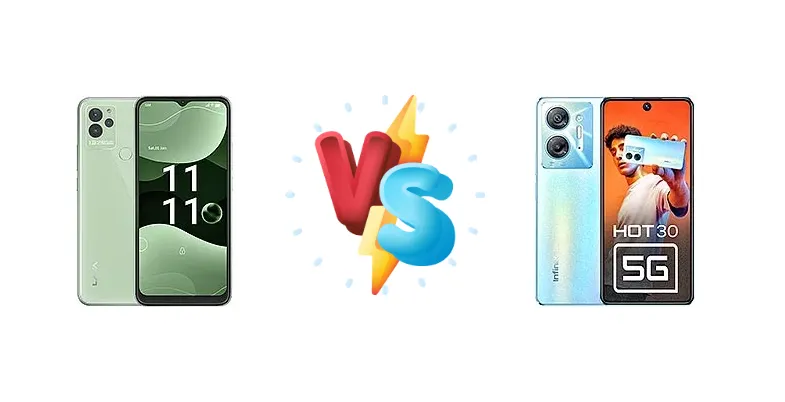
The sub-$200 smartphone market is fiercely competitive, and the Lava Blaze Nxt and Infinix Hot 30 5G represent compelling options. The Blaze Nxt focuses on providing a reliable experience at an extremely accessible price point, while the Hot 30 5G aims to deliver 5G connectivity and a more powerful processor without breaking the bank. This comparison dives deep into the specifications to determine which device offers the best overall package.
🏆 Quick Verdict
For most users, the Infinix Hot 30 5G is the superior choice. Its Mediatek Dimensity 6020 chipset, built on a more efficient 7nm process, provides a significant performance uplift over the Lava Blaze Nxt’s Helio G37. The faster 18W charging also addresses a key pain point in this price segment, making it a more convenient daily driver.
| Network |
|---|
| 2G bands | GSM 900 / 1800 | GSM 850 / 900 / 1800 / 1900 |
| 3G bands | HSDPA 900 / 2100 | HSDPA 850 / 900 / 1700(AWS) / 1900 / 2100 |
| 4G bands | 1, 3, 5, 8, 40, 41 | LTE |
| 5G bands | - | 1, 3, 5, 8, 28, 38, 40, 41, 77, 78 SA/NSA |
| Speed | HSPA, LTE | HSPA, LTE, 5G |
| Technology | GSM / HSPA / LTE | GSM / HSPA / LTE / 5G |
| Launch |
|---|
| Announced | 2022, November 25 | 2023, July 14 |
| Status | Available. Released 2022, December 02 | Available. Released 2023, July 18 |
| Body |
|---|
| Build | - | Glass front, plastic frame, plastic back |
| Dimensions | 164.8 x 76.3 x 8.9 mm (6.49 x 3.00 x 0.35 in) | 168.5 x 76.5 x 9.2 mm (6.63 x 3.01 x 0.36 in) |
| SIM | Nano-SIM + Nano-SIM | Nano-SIM + Nano-SIM |
| Weight | 203.5 g (7.20 oz) | 215 g (7.58 oz) |
| Display |
|---|
| Resolution | 720 x 1600 pixels, 20:9 ratio (~269 ppi density) | 1080 x 2460 pixels (~396 ppi density) |
| Size | 6.52 inches, 102.6 cm2 (~81.6% screen-to-body ratio) | 6.78 inches, 109.2 cm2 (~84.7% screen-to-body ratio) |
| Type | IPS LCD | IPS LCD, 120Hz, 580 nits (peak) |
| Platform |
|---|
| CPU | Octa-core (4x2.3 GHz Cortex-A53 & 4x1.8 GHz Cortex-A53) | Octa-core (2x2.2 GHz Cortex-A76 & 6x2.0 GHz Cortex-A55) |
| Chipset | Mediatek MT6765 Helio G37 (12 nm) | Mediatek Dimensity 6020 (7 nm) |
| GPU | PowerVR GE8320 | Mali-G57 MC2 |
| OS | Android 12 | Android 13, XOS 13 |
| Memory |
|---|
| Card slot | microSDXC (dedicated slot) | microSDXC (dedicated slot) |
| Internal | 64GB 4GB RAM | 128GB 4GB RAM, 128GB 8GB RAM |
| Main Camera |
|---|
| Features | LED flash | Quad-LED flash, HDR, panorama |
| Single | - | 50 MP, f/1.6, (wide), 1/2.55", AF
Auxiliary lens |
| Triple | 13 MP, (wide), AF
2 MP
VGA | - |
| Video | 1080p@30fps | 1440p@30fps, 1080p@30fps |
| Selfie camera |
|---|
| Features | - | Dual-LED flash |
| Single | 8 MP | 8 MP, f/2.0, (wide) |
| Video | Yes | 1080p@30fps |
| Sound |
|---|
| 3.5mm jack | Yes | - |
| 35mm jack | Yes | Yes |
| Loudspeaker | Yes | Yes, with stereo speakers |
| Comms |
|---|
| Bluetooth | 5.0, A2DP, LE | 5.1, A2DP, LE |
| NFC | No | No |
| Positioning | GPS | GPS, GLONASS, GALILEO, BDS |
| Radio | FM radio | FM radio |
| USB | USB Type-C 2.0, OTG | USB Type-C 2.0 |
| WLAN | Wi-Fi 802.11 b/g/n/ac | Wi-Fi 802.11 a/b/g/n/ac, dual-band |
| Features |
|---|
| Sensors | Fingerprint (rear-mounted), accelerometer, proximity | Fingerprint (side-mounted), accelerometer, proximity, compass |
| Battery |
|---|
| Charging | 10W wired | 18W wired |
| Type | Li-Ion 5000 mAh | 5000 mAh |
| Misc |
|---|
| Colors | Glass Blue, Glass Red, Glass Green | Knight Black, Aurora Blue |
| Models | - | X6832 |
| Price | About 110 EUR | About 140 EUR |
Lava Blaze Nxt
- Extremely affordable price point
- Reliable and simple user experience
- Suitable for basic smartphone tasks
- Outdated and less powerful chipset
- Slow 10W charging
- Limited performance for demanding apps
Infinix Hot 30 5G
- Faster and more efficient Dimensity 6020 chipset
- 18W fast charging for quicker top-ups
- 5G connectivity for future-proofed data speeds
- Slightly higher price compared to Lava Blaze Nxt
- May still exhibit some thermal throttling under heavy load
- Camera performance likely similar to Lava Blaze Nxt
Display Comparison
Neither device boasts a standout display. Given the provided data, a direct comparison is limited. However, the market positioning suggests the Infinix Hot 30 5G likely features a higher resolution and potentially a higher refresh rate panel, contributing to a sharper and smoother visual experience. The Lava Blaze Nxt will likely prioritize cost savings, potentially resulting in a lower resolution and 60Hz refresh rate. Bezels are expected to be similar on both, reflecting their budget nature.
Camera Comparison
Without detailed camera specifications, a precise comparison is difficult. However, given the price points, both devices likely employ similar sensor configurations, with a primary sensor and potentially a depth or macro lens. The Infinix Hot 30 5G may benefit from Mediatek’s image signal processor (ISP) within the Dimensity 6020, potentially offering improved image processing capabilities and better low-light performance. The Lava Blaze Nxt will likely rely on software optimization to enhance image quality. The presence of a 2MP macro camera on either device is largely a marketing feature with limited practical utility.
Performance
The core difference lies in the chipsets. The Infinix Hot 30 5G’s Mediatek Dimensity 6020 (7nm) is a clear upgrade over the Lava Blaze Nxt’s Helio G37 (12nm). The 7nm process allows for greater transistor density and improved power efficiency, translating to better sustained performance and reduced thermal throttling. The Dimensity 6020’s CPU configuration – 2x2.2 GHz Cortex-A76 & 6x2.0 GHz Cortex-A55 – is architecturally superior to the Helio G37’s 4x2.3 GHz Cortex-A53 & 4x1.8 GHz Cortex-A53. The Cortex-A76 cores offer significantly higher single-core performance, crucial for app launch speeds and responsiveness. While both are octa-core, the architectural differences will be noticeable in real-world usage, particularly in demanding tasks.
Battery Life
While battery capacity isn’t specified, the charging wattage provides a clear advantage to the Infinix Hot 30 5G. Its 18W wired charging is significantly faster than the Lava Blaze Nxt’s 10W charging. This translates to a quicker top-up time, reducing downtime and improving convenience. Even with a similar battery capacity, the 18W charging will allow the Hot 30 5G to reach a full charge much faster. The Dimensity 6020’s improved power efficiency may also contribute to slightly better battery life in real-world scenarios.
Buying Guide
Buy the Lava Blaze Nxt if you prioritize extreme affordability and a simple, no-frills smartphone experience. It’s ideal for first-time smartphone users or those needing a reliable backup device. Buy the Infinix Hot 30 5G if you value 5G connectivity, smoother multitasking, and faster charging speeds, even if it means spending slightly more. It’s the better option for users who consume media, play mobile games, or require a more responsive device.
Frequently Asked Questions
❓ Will the Mediatek Dimensity 6020 in the Infinix Hot 30 5G overheat during prolonged gaming sessions?
While the Dimensity 6020 is a capable chipset, it's still a budget-focused processor. Some thermal throttling is possible during extended gaming, but the 7nm process and likely optimized cooling solutions in the Hot 30 5G should mitigate this better than the Helio G37 in the Lava Blaze Nxt. Expect playable frame rates, but not necessarily sustained peak performance.
❓ Is the 10W charging on the Lava Blaze Nxt realistically usable for daily charging?
10W charging is quite slow by modern standards. Expect a full charge to take well over 3 hours, potentially closer to 4-5 hours depending on battery capacity. This is best suited for overnight charging or topping up when the device isn't actively in use. The Infinix Hot 30 5G’s 18W charging offers a significantly more convenient charging experience.
❓ Does the Infinix Hot 30 5G support carrier aggregation for improved 5G speeds?
While not explicitly stated, the Dimensity 6020 chipset *typically* supports carrier aggregation, which combines multiple 5G bands for faster and more stable connections. However, actual 5G performance will depend on your carrier's network and support for specific bands.