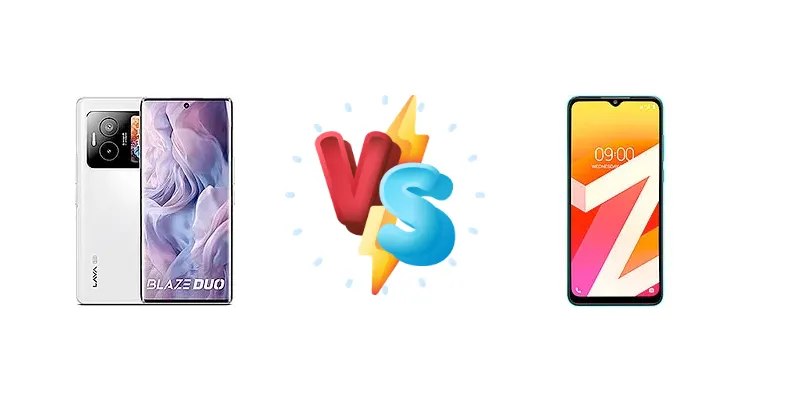
Lava is targeting different segments with the Blaze Duo and Z6. The Blaze Duo aims for a balance of performance and features with its newer Dimensity 7025 chipset, while the Z6 focuses on affordability with the Helio G35. This comparison dissects the key differences to help you determine which device best suits your needs.
🏆 Quick Verdict
For most users, the Lava Blaze Duo is the superior choice. Its Mediatek Dimensity 7025 chipset delivers significantly better performance and future-proofing than the Z6’s Helio G35. While the Z6 offers a lower entry price, the performance trade-offs are substantial.
| Network |
|---|
| 2G bands | GSM 850 / 900 / 1800 / 1900 | GSM 900 / 1800 |
| 3G bands | HSDPA 850 / 900 / 1900 / 2100 | HSDPA 900 / 2100 |
| 4G bands | 1, 3, 5, 7, 8, 20, 28, 38, 40, 41 | 1, 3, 5, 8, 40, 41 |
| 5G bands | 1, 3, 5, 7, 8, 20, 28, 38, 40, 41, 66, 77, 78 SA/NSA | - |
| Speed | HSPA, LTE, 5G | HSPA 42.2/5.76 Mbps, LTE Cat4 150/50 Mbps |
| Technology | GSM / HSPA / LTE / 5G | GSM / HSPA / LTE |
| Launch |
|---|
| Announced | 2024, December 10 | 2021, January 07 |
| Status | Available. Released 2024, December 20 | Available. Released 2021, January 11 |
| Body |
|---|
| Build | - | Glass front, plastic back, plastic frame |
| Dimensions | 162.4 x 73.9 x 8.5 mm (6.39 x 2.91 x 0.33 in) | 164.5 x 75.8 x 9 mm (6.48 x 2.98 x 0.35 in) |
| SIM | Nano-SIM + Nano-SIM | Nano-SIM + Nano-SIM |
| Weight | 186 g (6.56 oz) | 190 g (6.70 oz) |
| Display |
|---|
| Protection | - | Corning Gorilla Glass 3 |
| Resolution | 1080 x 2400 pixels, 20:9 ratio (~395 ppi density) | 720 x 1600 pixels, 20:9 ratio (~270 ppi density) |
| Size | 6.67 inches, 107.4 cm2 (~89.5% screen-to-body ratio) | 6.51 inches, 102.3 cm2 (~82.1% screen-to-body ratio) |
| Type | AMOLED, 120Hz | IPS LCD |
| Platform |
|---|
| CPU | Octa-core (2x2.5 GHz Cortex-A78 & 6x2.0 GHz Cortex-A55) | Octa-core (4x2.3 GHz Cortex-A53 & 4x1.8 GHz Cortex-A53) |
| Chipset | Mediatek Dimensity 7025 (6 nm) | Mediatek MT6765G Helio G35 (12 nm) |
| GPU | IMG BXM-8-256 | PowerVR GE8320 |
| OS | Android 14, planned upgrade to Android 15 | Android 10 |
| Memory |
|---|
| Card slot | No | microSDXC (dedicated slot) |
| Internal | 128GB 6GB RAM, 128GB 8GB RAM | 64GB 6GB RAM |
| | - | eMMC 5.1 |
| Main Camera |
|---|
| Dual | 64 MP, (wide), PDAF
2 MP (macro) | - |
| Features | LED flash | LED flash |
| Triple | - | 13 MP, f/1.9, (wide), 1/3.0", 1.12µm, AF
5 MP, (ultrawide)
Auxiliary lens |
| Video | Yes | 1080p@30fps |
| Selfie camera |
|---|
| Features | - | LED flash |
| Single | 16 MP, (wide) | 16 MP, f/2.0, (wide), 1/3.06" 1.0µm |
| Video | 1080p@30fps | 1080p@30fps |
| Sound |
|---|
| 3.5mm jack | - | Yes |
| 35mm jack | No | Yes |
| Loudspeaker | Yes | Yes |
| Comms |
|---|
| Bluetooth | 5.2, A2DP, LE | 5.0, A2DP, LE |
| NFC | No | No |
| Positioning | GPS | GPS |
| Radio | Unspecified | FM radio |
| USB | USB Type-C 2.0, OTG | USB Type-C |
| WLAN | Wi-Fi 802.11 b/g/n/ac, dual-band | Wi-Fi 802.11 b/g/n, Wi-Fi Direct |
| Features |
|---|
| Sensors | Fingerprint (under display, optical), accelerometer, gyro, proximity, compass | Fingerprint (rear-mounted), accelerometer, proximity |
| Battery |
|---|
| Charging | 33W wired | - |
| Type | Li-Po 5000 mAh | Li-Po 5000 mAh |
| Misc |
|---|
| Colors | Arctic White, Celestial Blue | Blue, Red |
| Models | - | LMX06 |
| Price | ₹ 14,299 | About 110 EUR |
Lava Blaze Duo
- Significantly faster processor for smoother performance
- More efficient chipset for better battery life and less heat
- Faster 33W charging for quicker top-ups
- Likely higher price point
- May not have expandable storage (unconfirmed)
Lava Z6
- Lower price point for budget-conscious buyers
- Potentially longer battery life during very light usage
- Simple and easy-to-use interface
- Substantially slower processor for sluggish performance
- Less efficient chipset leading to more heat and shorter battery life under load
- Limited gaming capabilities
Display Comparison
Display specifications are not provided, so a direct comparison is limited. However, given the price difference, the Z6 likely utilizes a lower-quality panel with lower brightness and color accuracy. The Blaze Duo, benefiting from its higher price point, likely features a more vibrant and sharper display, potentially with a higher refresh rate (though unconfirmed).
Camera Comparison
Camera details are absent beyond the device names. However, the Blaze Duo’s more powerful chipset likely enables more sophisticated image processing algorithms, potentially resulting in better dynamic range and low-light performance. It’s reasonable to assume the Blaze Duo features a higher-resolution main sensor and potentially additional camera features not found on the Z6. The Z6 will likely rely on simpler image processing, resulting in less detailed and vibrant photos.
Performance
The core difference lies in the chipsets. The Lava Blaze Duo’s Mediatek Dimensity 7025, built on a 6nm process, represents a significant leap over the Lava Z6’s 12nm Mediatek Helio G35. The Dimensity 7025’s octa-core configuration, featuring 2x2.5 GHz Cortex-A78 cores and 6x2.0 GHz Cortex-A55 cores, provides substantially more processing power than the Z6’s 4x2.3 GHz Cortex-A53 and 4x1.8 GHz Cortex-A53 setup. The Cortex-A78 cores in the Blaze Duo are architecturally superior, offering better single-core performance crucial for app responsiveness. The 6nm process also translates to improved thermal efficiency, reducing throttling during sustained workloads. The Z6’s Helio G35 is geared towards basic tasks and will struggle with demanding games or heavy multitasking.
Battery Life
Battery capacity is not specified. However, the Blaze Duo’s 33W wired charging is a clear advantage over the Z6, which likely supports slower charging speeds. Even if the Z6 has a slightly larger battery, the faster charging of the Blaze Duo will result in less downtime. The Dimensity 7025’s 6nm efficiency also contributes to potentially better battery life under load compared to the Z6’s less efficient Helio G35.
Buying Guide
Buy the Lava Blaze Duo if you prioritize smooth multitasking, demanding app usage, and a more responsive overall experience. It’s ideal for users who enjoy mobile gaming beyond casual titles and want a phone that will remain usable for longer. Buy the Lava Z6 if your primary needs are basic communication, light social media use, and you are on a very tight budget where every dollar counts, accepting significant performance limitations.
Frequently Asked Questions
❓ Will the Lava Z6 be able to run popular games like Call of Duty: Mobile or PUBG?
While the Z6 can *launch* these games, the Helio G35 chipset will struggle to deliver a smooth and enjoyable experience. Expect low frame rates, significant lag, and potentially frequent crashes, even on low graphics settings. The Blaze Duo, with its Dimensity 7025, is far better suited for mobile gaming.
❓ Is the difference in processor performance noticeable for everyday tasks like browsing and social media?
Yes, the difference is quite noticeable. The Dimensity 7025 in the Blaze Duo will make everyday tasks feel snappier and more responsive. Apps will launch faster, multitasking will be smoother, and scrolling through web pages will be less laggy compared to the Z6’s Helio G35.
❓ Does the Lava Blaze Duo support 5G connectivity?
While not explicitly stated, the Dimensity 7025 chipset is capable of supporting 5G connectivity. However, whether Lava has enabled this feature in the Blaze Duo depends on the specific model and regional availability. Check the product specifications carefully before purchasing if 5G is a priority.
❓ How much faster is the 33W charging on the Blaze Duo compared to the Z6?
Without knowing the Z6’s charging wattage, a precise comparison is difficult. However, 33W charging is significantly faster than the typical 10-15W charging found on budget phones like the Z6. Expect the Blaze Duo to charge from 0-100% in approximately 60-90 minutes, while the Z6 could take over 2 hours.