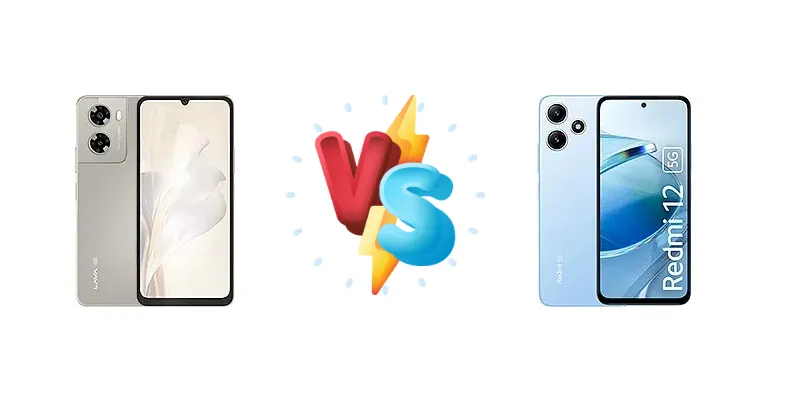
The Lava Blaze Dragon and Xiaomi Redmi 12 5G represent a growing trend: affordable 5G smartphones powered by Qualcomm's Snapdragon 4 Gen 2 chipset. With identical core hardware, the differences lie in the finer details – charging implementation, software experience, and brand reputation. This comparison dissects these nuances to determine which device offers the best value.
🏆 Quick Verdict
For the average user prioritizing a well-rounded experience and potentially faster charging speeds due to Power Delivery support, the Xiaomi Redmi 12 5G edges out the Lava Blaze Dragon. However, Lava's focus on localized support and potentially cleaner software could appeal to specific buyers.
| Network |
|---|
| 2G bands | GSM 850 / 900 / 1800 / 1900 | GSM 850 / 900 / 1800 / 1900 |
| 3G bands | HSDPA 850 / 900 / 1900 / 2100 | HSDPA 850 / 900 / 2100 |
| 4G bands | 1, 3, 5, 8, 28, 40, 41 | 1, 3, 5, 8, 40, 41 |
| 5G bands | 1, 3, 5, 8, 28, 40, 41, 77, 78 SA/NSA | 1, 3, 5, 8, 28, 40, 78 SA/NSA |
| Speed | HSPA, LTE, 5G | HSPA, LTE, 5G |
| Technology | GSM / HSPA / LTE / 5G | GSM / HSPA / LTE / 5G |
| Launch |
|---|
| Announced | 2025, July 25 | 2023, August 01 |
| Status | Available. Released 2025, August 01 | Available. Released 2023, August 04 |
| Body |
|---|
| Build | - | Glass front (Gorilla Glass), plastic frame, glass back (Gorilla Glass) |
| Dimensions | 168.2 x 77.8 x 9.1 mm (6.62 x 3.06 x 0.36 in) | 168.6 x 76.3 x 8.2 mm (6.64 x 3.00 x 0.32 in) |
| SIM | Nano-SIM + Nano-SIM | Nano-SIM + Nano-SIM |
| Weight | 210 g (7.41 oz) | 199 g (7.02 oz) |
| Display |
|---|
| Protection | - | Corning Gorilla Glass |
| Resolution | 900 x 1600 pixels, 16:9 ratio (~260 ppi density) | 1080 x 2460 pixels (~396 ppi density) |
| Size | 6.75 inches, 137.5 cm2 (~105.0% screen-to-body ratio) | 6.79 inches, 109.5 cm2 (~85.1% screen-to-body ratio) |
| Type | LCD, 120Hz, 450 nits | IPS LCD, 90Hz, 550 nits |
| Platform |
|---|
| CPU | Octa-core (2x2.2 GHz Cortex-A78 & 6x1.95 GHz Cortex-A55) | Octa-core (2x2.2 GHz Cortex-A78 & 6x1.95 GHz Cortex-A55) |
| Chipset | Qualcomm SM4450 Snapdragon 4 Gen 2 (4 nm) | Qualcomm SM4450 Snapdragon 4 Gen 2 (4 nm) |
| GPU | Adreno 613 | Adreno 613 |
| OS | Android 15, up to 1 major Android upgrade | Android 13, upgradable to Android 15, HyperOS 2 |
| Memory |
|---|
| Card slot | microSDXC (uses shared SIM slot) | microSDXC (uses shared SIM slot) |
| Internal | 128GB 4GB RAM, 128GB 6GB RAM | 128GB 4GB RAM, 128GB 6GB RAM, 128GB 8GB RAM, 256GB 8GB RAM |
| Main Camera |
|---|
| Dual | 50 MP, (wide), 1/2.8"
2 MP | 50 MP, f/1.8, (wide), PDAF
Auxiliary lens |
| Features | LED flash, HDR, panorama | LED flash, HDR |
| Video | 1080p@30/60fps | 1080p@30fps |
| Selfie camera |
|---|
| Features | - | HDR |
| Single | 8 MP | 8 MP, f/2.0, (wide), 1.12µm |
| Video | Yes | 1080p@30fps |
| Sound |
|---|
| 35mm jack | Yes | Yes |
| Loudspeaker | Yes | Yes |
| Comms |
|---|
| Bluetooth | 5.1, A2DP, LE | 5.3, A2DP, LE |
| Infrared port | - | Yes |
| NFC | No | Unspecified |
| Positioning | GPS, GALILEO, GLONASS, BDS, QZSS | GPS, GLONASS, GALILEO, BDS |
| Radio | Unspecified | No |
| USB | USB Type-C 2.0, OTG | USB Type-C |
| WLAN | Wi-Fi 802.11 a/b/g/n/ac, dual-band | Wi-Fi 802.11 a/b/g/n/ac, dual-band |
| Features |
|---|
| Sensors | Fingerprint (side-mounted), accelerometer, proximity, compass | Fingerprint (side-mounted), accelerometer, compass |
| Battery |
|---|
| Charging | 18W wired | 18W wired, PD |
| Type | Li-Po 5000 mAh | Li-Po 5000 mAh |
| Misc |
|---|
| Colors | Golden Mist, Midnight Mist | Jade Black, Pastel Blue, Moonstone Silver |
| Models | - | 23076RN4BI, 23076RN8DY, 2AFZZRN8DY |
| Price | ₹ 9,998 | € 104.09 / ₹ 15,999 |
| SAR | - | 1.09 W/kg (head) 0.88 W/kg (body) |
| SAR EU | - | 0.98 W/kg (head) 1.00 W/kg (body) |
Lava Blaze Dragon
- Potentially cleaner software experience with less bloatware.
- Growing brand presence in the Indian market.
- Competitive pricing.
- Charging lacks Power Delivery (PD) support.
- Less established brand reputation for software updates.
Xiaomi Redmi 12 5G
- Power Delivery (PD) support for potentially faster charging.
- Established brand with a wider ecosystem of products.
- Refined image processing software (potentially).
- Xiaomi's MIUI software can be resource-intensive and include bloatware.
- May be slightly more expensive than the Lava Blaze Dragon.
Display Comparison
Both devices are expected to feature LCD panels, typical for this price segment. Without specific display specs like peak brightness or color gamut coverage, it's difficult to differentiate. However, the Redmi 12 5G's potential for a higher quality panel, given Xiaomi's broader portfolio, is a possibility. Bezels are likely comparable, and both will likely target a 60Hz refresh rate to maximize battery life.
Camera Comparison
Without detailed camera specifications beyond the chipset, a direct comparison is challenging. Both phones will likely feature a multi-camera setup, but the quality will heavily depend on the sensor size and image processing algorithms. It's reasonable to expect a primary sensor around 50MP on both, but the Redmi 12 5G might benefit from Xiaomi's more refined image processing software. The inclusion of a 2MP macro camera on both is largely a marketing feature with limited practical utility.
Performance
The core performance is identical: both the Lava Blaze Dragon and Xiaomi Redmi 12 5G are powered by the Qualcomm SM4450 Snapdragon 4 Gen 2 (4 nm) chipset, featuring an octa-core CPU configuration with 2x2.2 GHz Cortex-A78 and 6x1.95 GHz Cortex-A55 cores. This means similar CPU and GPU performance for everyday tasks and light gaming. Thermal management will likely be comparable, relying on passive cooling due to the budget nature of the devices. The 4nm process node ensures relatively efficient power consumption, minimizing throttling during sustained workloads.
Battery Life
Both devices feature 18W wired charging, but the Redmi 12 5G adds Power Delivery (PD) support. This is a significant advantage, as PD allows for negotiation of optimal charging voltages and currents, potentially leading to faster charging times with compatible chargers. While both will likely have battery capacities around 5000mAh, the Redmi 12 5G's PD support could translate to a noticeable difference in 0-100% charging time, especially when using a higher-wattage PD charger.
Buying Guide
Buy the Lava Blaze Dragon if you prioritize a brand with a growing presence in the Indian market and potentially prefer a less cluttered software experience. Buy the Xiaomi Redmi 12 5G if you value the broader ecosystem of Xiaomi products, the potential for faster charging with PD support, and a more established brand reputation for software updates and features.
Frequently Asked Questions
❓ Does the Snapdragon 4 Gen 2 in either phone struggle with demanding games like Genshin Impact?
While the Snapdragon 4 Gen 2 is a capable chipset for its class, Genshin Impact will likely require significant graphics settings reductions to achieve playable frame rates on both the Lava Blaze Dragon and Xiaomi Redmi 12 5G. Expect to play at low settings and potentially with frame rate caps to avoid overheating and stuttering.
❓ Is the 18W charging speed on the Redmi 12 5G significantly faster than the Lava Blaze Dragon due to Power Delivery?
Yes, the inclusion of Power Delivery (PD) on the Redmi 12 5G allows it to negotiate higher voltages and currents with compatible chargers, potentially reducing charging times by 15-30% compared to the Lava Blaze Dragon, especially when using a charger rated above 18W that supports PD.
❓ Which phone is likely to receive more software updates and security patches?
Xiaomi generally has a better track record for providing software updates and security patches compared to newer brands like Lava. While Lava is improving, Xiaomi's established software infrastructure and larger user base give it an advantage in this area.