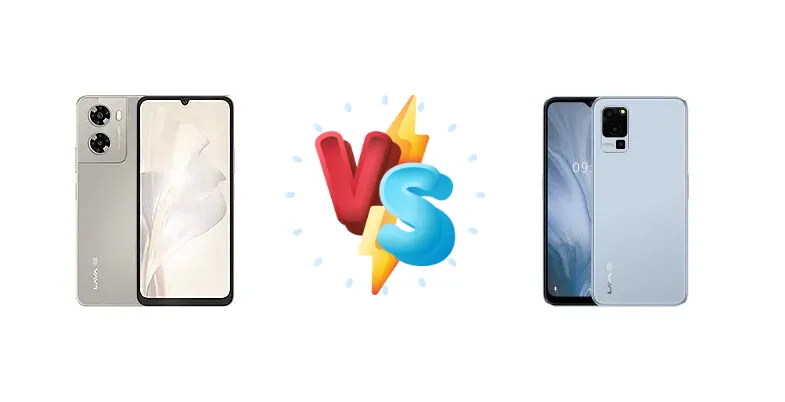
Lava has been aggressively targeting the budget 5G segment with the Blaze series. The Blaze Dragon and Blaze 5G represent two distinct approaches: the Dragon leverages Qualcomm's newer, more efficient Snapdragon 4 Gen 2, while the Blaze 5G relies on the established MediaTek Dimensity 700. This comparison dissects the key differences to help you choose the right phone for your needs.
🏆 Quick Verdict
For most users, the Lava Blaze Dragon emerges as the better choice. Its Snapdragon 4 Gen 2 chipset, built on a 4nm process, offers superior efficiency and potentially better sustained performance compared to the 7nm Dimensity 700 in the Blaze 5G. While the Blaze 5G has 5G connectivity, the Dragon's overall package is more compelling.
| Network |
|---|
| 2G bands | GSM 850 / 900 / 1800 / 1900 | GSM 900 / 1800 |
| 3G bands | HSDPA 850 / 900 / 1900 / 2100 | HSDPA 900 / 2100 |
| 4G bands | 1, 3, 5, 8, 28, 40, 41 | 1, 3, 5, 8, 40, 41 |
| 5G bands | 1, 3, 5, 8, 28, 40, 41, 77, 78 SA/NSA | SA/NSA |
| Speed | HSPA, LTE, 5G | HSPA, LTE, 5G |
| Technology | GSM / HSPA / LTE / 5G | GSM / HSPA / LTE / 5G |
| Launch |
|---|
| Announced | 2025, July 25 | 2022, October 3 |
| Status | Available. Released 2025, August 01 | Available. Released 2022, October 24 |
| Body |
|---|
| Dimensions | 168.2 x 77.8 x 9.1 mm (6.62 x 3.06 x 0.36 in) | 165.3 x 76.4 x 8.9 mm (6.51 x 3.01 x 0.35 in) |
| SIM | Nano-SIM + Nano-SIM | Nano-SIM + Nano-SIM |
| Weight | 210 g (7.41 oz) | 207 g (7.30 oz) |
| Display |
|---|
| Resolution | 900 x 1600 pixels, 16:9 ratio (~260 ppi density) | 720 x 1600 pixels, 20:9 ratio (~269 ppi density) |
| Size | 6.75 inches, 137.5 cm2 (~105.0% screen-to-body ratio) | 6.52 inches, 102.6 cm2 (~81.3% screen-to-body ratio) |
| Type | LCD, 120Hz, 450 nits | IPS LCD, 90Hz |
| Platform |
|---|
| CPU | Octa-core (2x2.2 GHz Cortex-A78 & 6x1.95 GHz Cortex-A55) | Octa-core (2x2.2 GHz Cortex-A76 & 6x2.0 GHz Cortex-A55) |
| Chipset | Qualcomm SM4450 Snapdragon 4 Gen 2 (4 nm) | Mediatek Dimensity 700 (7 nm) |
| GPU | Adreno 613 | Mali-G57 MC2 |
| OS | Android 15, up to 1 major Android upgrade | Android 12 |
| Memory |
|---|
| Card slot | microSDXC (uses shared SIM slot) | microSDXC (uses shared SIM slot) |
| Internal | 128GB 4GB RAM, 128GB 6GB RAM | 128GB 4GB RAM, 128GB 6GB RAM |
| | - | eMMC 5.1 |
| Main Camera |
|---|
| Dual | 50 MP, (wide), 1/2.8"
2 MP | - |
| Features | LED flash, HDR, panorama | LED flash, HDR, panorama |
| Single | - | 8 MP, f/2.0, (wide) |
| Triple | - | 50 MP, (wide), 0.64µm, AF
2 MP (macro)
0.3 MP |
| Video | 1080p@30/60fps | 1080p@30fps |
| Selfie camera |
|---|
| Single | 8 MP | 8 MP, f/2.0, (wide) |
| Video | Yes | Yes |
| Sound |
|---|
| 3.5mm jack | - | Yes |
| 35mm jack | Yes | Yes |
| Loudspeaker | Yes | Yes |
| Comms |
|---|
| Bluetooth | 5.1, A2DP, LE | 5.0, A2DP, LE |
| NFC | No | No |
| Positioning | GPS, GALILEO, GLONASS, BDS, QZSS | GPS |
| Radio | Unspecified | FM radio |
| USB | USB Type-C 2.0, OTG | USB Type-C 2.0, OTG |
| WLAN | Wi-Fi 802.11 a/b/g/n/ac, dual-band | Wi-Fi 802.11 b/g/n/ac |
| Features |
|---|
| Sensors | Fingerprint (side-mounted), accelerometer, proximity, compass | Fingerprint (side-mounted), accelerometer, proximity |
| Battery |
|---|
| Charging | 18W wired | 10W wired |
| Type | Li-Po 5000 mAh | Li-Po 5000 mAh |
| Misc |
|---|
| Colors | Golden Mist, Midnight Mist | Green, Blue |
| Models | - | LXX503 |
| Price | ₹ 9,998 | About 130 EUR |
Lava Blaze Dragon
- More efficient 4nm Snapdragon 4 Gen 2 chipset
- Faster 18W charging
- Potentially better sustained performance
- Lacks 5G connectivity
- Camera specs unknown
Lava Blaze 5G
- 5G connectivity
- Established Dimensity 700 platform
- Potentially lower price
- Less efficient 7nm chipset
- Slower 10W charging
- Likely more thermal throttling
Display Comparison
Both phones likely feature similar LCD panels, given their price points. However, the core difference lies in the processing power driving them. Display specs beyond resolution and size are not provided, so we can only assume similar quality. The focus here is on the chipset's ability to render graphics smoothly, which favors the Dragon.
Camera Comparison
Without detailed camera specifications, a direct comparison is difficult. However, the chipset plays a crucial role in image processing. The Snapdragon 4 Gen 2’s ISP (Image Signal Processor) is likely more advanced, potentially leading to better image quality, especially in challenging lighting conditions. The absence of information regarding sensor size and lens apertures makes a definitive statement impossible, but the Dragon’s superior processing power gives it an edge.
Performance
The Lava Blaze Dragon’s Qualcomm Snapdragon 4 Gen 2 (4nm) is a significant advantage over the Blaze 5G’s MediaTek Dimensity 700 (7nm). The 4nm fabrication process inherently provides better power efficiency and thermal characteristics. While both CPUs feature a 2x2.2 GHz core configuration, the Snapdragon 4 Gen 2 utilizes Cortex-A78 cores, which offer a performance uplift over the Dimensity 700’s Cortex-A76 cores. This translates to snappier app launches, smoother multitasking, and potentially better gaming performance on the Dragon. The Dimensity 700, while capable, will likely exhibit more throttling under sustained load.
Battery Life
The Lava Blaze Dragon’s 18W charging is faster than the Blaze 5G’s 10W charging. While battery capacity isn't specified, the Snapdragon 4 Gen 2’s superior efficiency means the Dragon will likely offer longer battery life despite potentially having a similar or even smaller battery. The 18W charging will also allow for quicker top-ups, reducing downtime.
Buying Guide
Buy the Lava Blaze Dragon if you prioritize long-term performance, efficient power usage, and a smoother overall experience, even if 5G isn't a critical requirement. Buy the Lava Blaze 5G if 5G connectivity is absolutely essential and you're willing to trade some processing power and efficiency for it. The Blaze 5G is a viable option for users in areas with strong 5G coverage who primarily use their phone for basic tasks.
Frequently Asked Questions
❓ Will the Dimensity 700 in the Lava Blaze 5G overheat during extended gaming sessions?
The Dimensity 700, being a 7nm chip, is more prone to thermal throttling than the 4nm Snapdragon 4 Gen 2. While it can handle casual gaming, demanding titles played for extended periods may result in noticeable performance drops as the chip heats up.
❓ Is the 5G connectivity on the Lava Blaze 5G worth the trade-off in processing power?
That depends on your location and usage. If you live in an area with robust 5G coverage and frequently use data-intensive applications, the 5G connectivity could be beneficial. However, if 5G isn't readily available or you primarily use Wi-Fi, the Snapdragon 4 Gen 2's superior performance in the Blaze Dragon is likely a better investment.
❓ How much faster is the 18W charging on the Lava Blaze Dragon compared to the 10W charging on the Blaze 5G?
18W charging will significantly reduce charging times. While exact 0-100% times aren't available, expect the Blaze Dragon to charge considerably faster, potentially shaving off 30-60 minutes compared to the Blaze 5G.