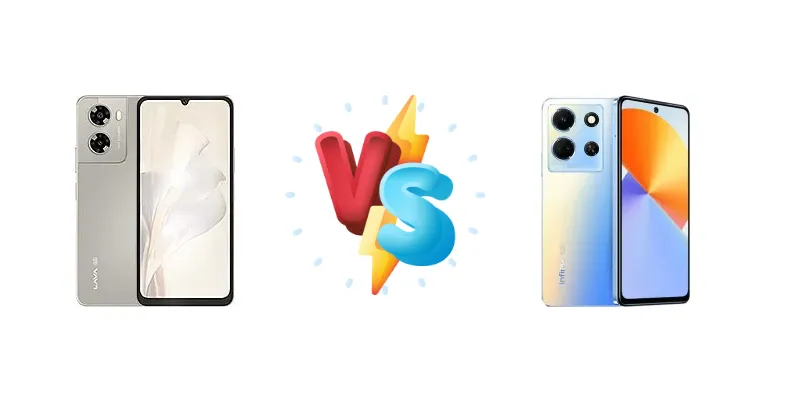
The sub-$200 5G smartphone market is heating up, and the Lava Blaze Dragon and Infinix Note 30 5G are two contenders vying for your attention. The Blaze Dragon leverages Qualcomm's efficient Snapdragon 4 Gen 2, while the Note 30 5G opts for MediaTek's Dimensity 6080. This comparison will dissect their strengths and weaknesses to determine which device delivers the best value.
🏆 Quick Verdict
For the average user prioritizing fast charging and a brighter display, the Infinix Note 30 5G emerges as the winner. Its 45W charging and 607 nits of brightness offer a more convenient and visually appealing experience. However, the Lava Blaze Dragon’s 4nm Snapdragon chip provides a compelling alternative for those focused on efficiency.
| Network |
|---|
| 2G bands | GSM 850 / 900 / 1800 / 1900 | GSM 850 / 900 / 1800 / 1900 |
| 3G bands | HSDPA 850 / 900 / 1900 / 2100 | HSDPA 850 / 900 / 1700(AWS) / 1900 / 2100 |
| 4G bands | 1, 3, 5, 8, 28, 40, 41 | 1, 2, 3, 4, 5, 7, 8, 12, 17, 20, 28, 38, 40, 41, 66 |
| 5G bands | 1, 3, 5, 8, 28, 40, 41, 77, 78 SA/NSA | 1, 3, 5, 7, 8, 12, 22, 28, 38, 40, 41, 66, 77, 78 |
| Speed | HSPA, LTE, 5G | HSPA, LTE, 5G |
| Technology | GSM / HSPA / LTE / 5G | GSM / HSPA / LTE / 5G |
| Launch |
|---|
| Announced | 2025, July 25 | 2023, May 22 |
| Status | Available. Released 2025, August 01 | Available. Released 2023, May 22 |
| Body |
|---|
| Build | - | Glass front, plastic frame, glass or leather back |
| Dimensions | 168.2 x 77.8 x 9.1 mm (6.62 x 3.06 x 0.36 in) | 168.5 x 76.5 x 8.5 mm (6.63 x 3.01 x 0.33 in) |
| SIM | Nano-SIM + Nano-SIM | Nano-SIM + Nano-SIM |
| Weight | 210 g (7.41 oz) | 205 g (7.23 oz) |
| Display |
|---|
| Resolution | 900 x 1600 pixels, 16:9 ratio (~260 ppi density) | 1080 x 2460 pixels (~396 ppi density) |
| Size | 6.75 inches, 137.5 cm2 (~105.0% screen-to-body ratio) | 6.78 inches, 109.2 cm2 (~84.7% screen-to-body ratio) |
| Type | LCD, 120Hz, 450 nits | IPS LCD, 120Hz, 580 nits (peak) |
| Platform |
|---|
| CPU | Octa-core (2x2.2 GHz Cortex-A78 & 6x1.95 GHz Cortex-A55) | Octa-core (2x2.4 GHz Cortex-A76 & 6x2.0 GHz Cortex-A55) |
| Chipset | Qualcomm SM4450 Snapdragon 4 Gen 2 (4 nm) | Mediatek Dimensity 6080 (6 nm) |
| GPU | Adreno 613 | Mali-G57 MC2 |
| OS | Android 15, up to 1 major Android upgrade | Android 13 |
| Memory |
|---|
| Card slot | microSDXC (uses shared SIM slot) | microSDXC (dedicated slot) |
| Internal | 128GB 4GB RAM, 128GB 6GB RAM | 128GB 4GB RAM, 256GB 8GB RAM |
| Main Camera |
|---|
| Dual | 50 MP, (wide), 1/2.8"
2 MP | - |
| Features | LED flash, HDR, panorama | Quad-LED flash, HDR, panorama |
| Triple | - | 108 MP, f/1.75, 26mm (wide), 1/1.67", 0.64µm, PDAF
Auxiliary lenses |
| Video | 1080p@30/60fps | 1440p@30fps, 1080p@30/60fps |
| Selfie camera |
|---|
| Features | - | Dual-LED flash, HDR |
| Single | 8 MP | 16 MP, f/2.0, (wide) |
| Video | Yes | 1080p@30fps |
| Sound |
|---|
| 35mm jack | Yes | Yes |
| Loudspeaker | Yes | Yes, with dual speakers |
| Comms |
|---|
| Bluetooth | 5.1, A2DP, LE | Yes |
| NFC | No | Yes |
| Positioning | GPS, GALILEO, GLONASS, BDS, QZSS | GPS |
| Radio | Unspecified | FM radio |
| USB | USB Type-C 2.0, OTG | USB Type-C 2.0, OTG |
| WLAN | Wi-Fi 802.11 a/b/g/n/ac, dual-band | Wi-Fi 802.11 a/b/g/n/ac, dual-band, Wi-Fi Direct |
| Features |
|---|
| Sensors | Fingerprint (side-mounted), accelerometer, proximity, compass | Fingerprint (side-mounted), accelerometer, gyro, proximity, compass |
| Battery |
|---|
| Charging | 18W wired | 45W wired, bypass charging |
| Type | Li-Po 5000 mAh | 5000 mAh |
| Misc |
|---|
| Colors | Golden Mist, Midnight Mist | Magic Black, Interstellar Blue, Sunset Gold |
| Models | - | X6711 |
| Price | ₹ 9,998 | - |
Lava Blaze Dragon
- More power-efficient 4nm Snapdragon 4 Gen 2 chipset
- Potentially better sustained performance due to thermal efficiency
- Competitive price point
- Slower 18W charging
- Display brightness likely lower than the competition
Infinix Note 30 5G
- Significantly faster 45W charging with bypass charging
- Brighter 607 nits display for better outdoor visibility
- Higher CPU clock speeds for potentially snappier performance
- Less power-efficient 6nm Dimensity 6080 chipset
- Potential for more thermal throttling under heavy load
Display Comparison
The Infinix Note 30 5G boasts a significantly brighter display, reaching a measured 607 nits, compared to the Lava Blaze Dragon’s unspecified brightness. This difference is crucial for outdoor visibility. While the Blaze Dragon’s panel specifications are unknown, the Note 30 5G’s 1521:1 contrast ratio suggests deeper blacks and more vibrant colors. The absence of high refresh rate panels on both devices suggests a focus on battery life over fluid scrolling.
Camera Comparison
Without detailed camera specifications for either device, a direct comparison is difficult. However, given the price point, both are likely to feature primary sensors around the 50MP mark. The absence of information regarding Optical Image Stabilization (OIS) suggests neither phone will excel in low-light photography. The usefulness of any included 2MP macro lenses on either device is questionable, offering limited practical benefit over the main sensor.
Performance
The Infinix Note 30 5G’s MediaTek Dimensity 6080 (6nm) features a CPU with 2x2.4 GHz Cortex-A76 cores, offering a clock speed advantage over the Lava Blaze Dragon’s Snapdragon 4 Gen 2 (4nm) which has 2x2.2 GHz Cortex-A78 cores. While the A76 is an older architecture, the higher clock speed may translate to snappier performance in some tasks. However, the Snapdragon 4 Gen 2’s 4nm process node provides superior power efficiency, potentially leading to longer battery life and less thermal throttling during prolonged use. The 6nm Dimensity 6080 will likely run warmer under sustained load.
Battery Life
The Infinix Note 30 5G’s 45W wired charging is a clear advantage over the Lava Blaze Dragon’s 18W charging. 45W charging allows for significantly faster top-ups, potentially going from 0-100% in under an hour, while the Blaze Dragon will likely take over two hours. While battery capacity isn’t specified for either device, the faster charging speed of the Note 30 5G mitigates the impact of a potentially smaller battery.
Buying Guide
Buy the Lava Blaze Dragon if you need a phone with a focus on power efficiency and a slightly more refined CPU architecture for sustained tasks. It’s ideal for users who prioritize longer battery life and don’t heavily rely on extremely fast charging. Buy the Infinix Note 30 5G if you prefer a brighter, more vibrant display and significantly faster 45W charging, making it perfect for media consumption and users who need to quickly top up their battery throughout the day.
Frequently Asked Questions
❓ Does the Dimensity 6080 in the Infinix Note 30 5G tend to overheat during extended gaming sessions?
The Dimensity 6080, being a 6nm chip, is more prone to thermal throttling than the Lava Blaze Dragon’s 4nm Snapdragon 4 Gen 2. While it can handle moderate gaming, prolonged sessions with demanding titles may lead to noticeable performance drops as the chip heats up. The Infinix Note 30 5G’s thermal management will be a key factor in mitigating this.
❓ How much faster is the 45W charging on the Infinix Note 30 5G compared to the 18W charging on the Lava Blaze Dragon in real-world use?
The 45W charging on the Infinix Note 30 5G can realistically cut charging times in half. While the Lava Blaze Dragon might take over 2 hours for a full charge, the Note 30 5G could achieve 0-100% in under an hour, offering a significant convenience factor for users who frequently need to top up their battery.
❓ Is the difference in CPU architecture (Cortex-A78 vs Cortex-A76) noticeable in everyday tasks?
While the Cortex-A78 cores in the Snapdragon 4 Gen 2 are newer and generally more efficient, the higher clock speed of the Cortex-A76 cores in the Dimensity 6080 may result in a similar experience for most everyday tasks like browsing, social media, and light app usage. The difference will be more apparent in CPU-intensive applications.