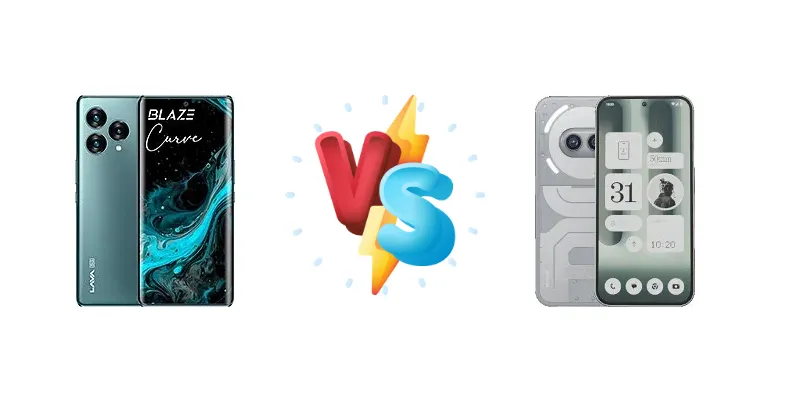
The Lava Blaze Curve and Nothing Phone (2a) Plus both target the competitive mid-range smartphone market, but approach it from different angles. The Lava focuses on delivering a compelling feature set at an aggressive price point, while the Nothing Phone (2a) Plus aims for a more refined experience with a focus on design and software. This comparison will dissect their key specifications to determine which device best suits your needs.
🏆 Quick Verdict
For the average user prioritizing a balanced experience with a brighter display and faster charging, the Nothing Phone (2a) Plus is the superior choice. However, the Lava Blaze Curve offers a strong value proposition for those on a tighter budget who don't mind compromising on certain features.
| Network |
|---|
| 2G bands | GSM 850 / 900 / 1800 / 1900 | GSM 850 / 900 / 1800 / 1900 |
| 3G bands | HSDPA 850 / 900 / 1900 / 2100 | HSDPA 800 / 850 / 900 / 1700(AWS) / 1900 / 2100 |
| 4G bands | 1, 3, 5, 7, 8, 20, 28, 38, 40, 41 | 1, 3, 4, 5, 7, 8, 18, 19, 20, 26, 28, 38, 39, 40, 41, 42, 66 |
| 5G bands | 1, 3, 5, 8, 28, 41, 77, 78 SA/NSA | 1, 3, 5, 7, 8, 20, 28, 38, 40, 41, 66, 77, 78 SA/NSA |
| Speed | HSPA, LTE, 5G | HSPA, LTE, 5G |
| Technology | GSM / HSPA / LTE / 5G | GSM / HSPA / LTE / 5G |
| Launch |
|---|
| Announced | 2024, March 05 | 2024, July 31 |
| Status | Available. Released 2024, March 11 | Available. Released 2024, August 03 |
| Body |
|---|
| Build | Glass front (Dragontrail Star 2), glass back (Gorilla Glass 3) | Glass front (Gorilla Glass 5), plastic frame, plastic back |
| Dimensions | 161.8 x 74 x 8.8 mm (6.37 x 2.91 x 0.35 in) | 161.7 x 76.3 x 8.5 mm (6.37 x 3.00 x 0.33 in) |
| SIM | Nano-SIM + Nano-SIM | Nano-SIM + Nano-SIM |
| Weight | 189 g (6.67 oz) | 190 g (6.70 oz) |
| Display |
|---|
| Protection | Dragontrail Star 2 | Corning Gorilla Glass 5 |
| Resolution | 1080 x 2400 pixels, 20:9 ratio (~395 ppi density) | 1080 x 2412 pixels, 20:9 ratio (~395 ppi density) |
| Size | 6.67 inches, 107.4 cm2 (~89.7% screen-to-body ratio) | 6.7 inches, 107.5 cm2 (~87.1% screen-to-body ratio) |
| Type | AMOLED, 120Hz, HDR10+, 500 nits (typ), 800 nits (peak) | AMOLED, 1B colors, 120Hz, 2160Hz PWM, HDR10+, 700 nits (typ), 1100 nits (HBM), 1300 nits (peak) |
| Platform |
|---|
| CPU | Octa-core (2x2.6 GHz Cortex-A78 & 6x2.0 GHz Cortex-A55) | Octa-core (2x3.0 GHz Cortex-A715 & 6x 2.0 GHz Cortex-A510) |
| Chipset | Mediatek Dimensity 7050 (6 nm) | Mediatek Dimensity 7350 Pro (4 nm) |
| GPU | Mali-G68 MC4 | Mali-G610 MC4 |
| OS | Android 13, planned upgrade to Android 14 | Android 14, up to 3 major Android upgrades, Nothing OS 3.0 |
| Memory |
|---|
| Card slot | No | No |
| Internal | 128GB 8GB RAM, 256GB 8GB RAM | 256GB 8GB RAM, 256GB 12GB RAM |
| Main Camera |
|---|
| Dual | 64 MP, (wide), PDAF
8 MP, (ultrawide)
2 MP (macro) | 50 MP, f/1.9, 24mm (wide), 1/1.57", 1.0µm, PDAF, OIS
50 MP, f/2.2, 114˚ (ultrawide), 1/2.76", 0.64µm |
| Features | LED flash, panorama, HDR | LED flash, panorama, HDR |
| Video | 4K@30fps, 1080p@30fps | 4K@30fps, 1080p@60/120fps, gyro-EIS |
| Selfie camera |
|---|
| Features | - | HDR |
| Single | 32 MP | 50 MP, f/2.2, (wide), 1/2.76" |
| Video | 1080p@30fps | 4K@30fps |
| Sound |
|---|
| 35mm jack | No | No |
| Loudspeaker | Yes, with stereo speakers | Yes, with stereo speakers |
| Comms |
|---|
| Bluetooth | 5.2, A2DP, LE | 5.3, A2DP, LE |
| Infrared port | Yes | - |
| NFC | No | Yes, 360˚ |
| Positioning | GPS, GLONASS | GPS, GALILEO, GLONASS, BDS, QZSS |
| Radio | FM radio | No |
| USB | USB Type-C 2.0, OTG | USB Type-C 2.0, OTG |
| WLAN | Wi-Fi 802.11 a/b/g/n/ac/6, dual-band | Wi-Fi 802.11 a/b/g/n/ac/6, dual-band, Wi-Fi Direct |
| Features |
|---|
| Sensors | Fingerprint (under display, optical), accelerometer, gyro, proximity, compass | Fingerprint (under display, optical), accelerometer, gyro, proximity, compass |
| Battery |
|---|
| Charging | 33W wired, 50% in 30 min | 50W wired, 50% in 21 min, 100% in 56 min |
| Type | Li-Po 5000 mAh | 5000 mAh |
| Misc |
|---|
| Colors | Iron Glass, Viridian Glass | Black, Grey |
| Models | - | A142P |
| Price | About 200 EUR | € 269.90 / ₹ 22,599 |
Lava Blaze Curve
- Aggressive pricing offers excellent value.
- Decent performance for everyday tasks.
- Likely offers a large storage capacity for the price.
- Less powerful chipset compared to the competition.
- Slower charging speed.
- Display likely lacks the brightness and vibrancy of the Nothing Phone (2a) Plus.
Nothing Phone (2a) Plus
- Brighter, more vibrant display for better outdoor visibility.
- Faster and more efficient Dimensity 7350 Pro chipset.
- Significantly faster charging speeds.
- Higher price point.
- May not offer the same storage capacity as the Lava Blaze Curve at the same price.
- Software experience may not appeal to all users.
Display Comparison
The Nothing Phone (2a) Plus boasts a significantly brighter display, reaching a measured peak of 1097 nits. This is a substantial advantage over what we'd expect from the Lava Blaze Curve, making the Nothing Phone (2a) Plus far more usable outdoors in direct sunlight. While the Lava's panel specifications aren't available, the brightness difference suggests a lower peak output. The Nothing Phone (2a) Plus's brightness also contributes to better HDR content viewing. We can assume both phones utilize AMOLED panels given the market segment, but the Nothing Phone (2a) Plus's superior brightness is a clear win.
Camera Comparison
Without detailed camera specifications for the Lava Blaze Curve, a direct comparison is challenging. However, the Nothing Phone (2a) Plus likely benefits from a more sophisticated image signal processor (ISP) integrated within the Dimensity 7350 Pro. The ISP handles noise reduction, dynamic range, and overall image quality. While megapixel counts aren't provided, the Nothing Phone (2a) Plus's chipset suggests superior image processing capabilities. We can expect better low-light performance and more accurate color reproduction from the Nothing Phone (2a) Plus. The Lava Blaze Curve will likely offer a serviceable camera experience, but won't match the refinement of the Nothing Phone (2a) Plus.
Performance
The Nothing Phone (2a) Plus is equipped with the Mediatek Dimensity 7350 Pro (4nm), a more advanced chipset than the Lava Blaze Curve’s Dimensity 7050 (6nm). The 4nm process node of the 7350 Pro translates to improved power efficiency and potentially better sustained performance under load, reducing thermal throttling during extended gaming sessions. The CPU configuration also favors the Nothing Phone (2a) Plus, with 2x3.0 GHz Cortex-A715 cores compared to the Lava’s 2x2.6 GHz Cortex-A78 cores. While both utilize 6x2.0 GHz efficiency cores (A510 vs A55), the A715 architecture offers a performance uplift. This means the Nothing Phone (2a) Plus will handle demanding apps and multitasking more smoothly.
Battery Life
The Nothing Phone (2a) Plus demonstrates a clear advantage in battery performance, achieving an active use score of 16:34 hours. While the Lava Blaze Curve’s battery capacity isn’t specified, the Nothing Phone (2a) Plus’s longevity is further bolstered by its faster 50W wired charging, reaching 50% charge in just 21 minutes and a full charge in 56 minutes. The Lava Blaze Curve’s 33W charging, while respectable, takes 30 minutes to reach 50% charge, indicating a slower overall charging speed. The combination of efficient chipset and faster charging gives the Nothing Phone (2a) Plus a significant edge in usability.
Buying Guide
Buy the Lava Blaze Curve if you need a phone with a decent chipset for everyday tasks and light gaming, and your primary concern is maximizing value for money. Buy the Nothing Phone (2a) Plus if you prefer a brighter, more vibrant display, significantly faster charging, and a longer-lasting battery, and are willing to pay a premium for a more polished user experience.
Frequently Asked Questions
❓ Does the Dimensity 7350 Pro in the Nothing Phone (2a) Plus get noticeably warmer during prolonged gaming sessions compared to the Dimensity 7050 in the Lava Blaze Curve?
While both chipsets are capable, the Dimensity 7350 Pro's 4nm process node is inherently more thermally efficient. This means it's likely to generate less heat under sustained load, resulting in less throttling and more consistent performance during extended gaming. However, thermal performance also depends on the phone's cooling system, which isn't specified for either device.
❓ How much of a real-world difference will the faster charging of the Nothing Phone (2a) Plus make in daily use?
The 50W charging on the Nothing Phone (2a) Plus is a significant advantage. Reaching 50% charge in 21 minutes means you can quickly top up your battery during a short break, minimizing downtime. The Lava Blaze Curve’s 33W charging, taking 30 minutes for 50%, is slower and less convenient for users who frequently need a quick boost.
❓ Is the difference in CPU architecture (Cortex-A715 vs A78) noticeable in everyday tasks like browsing and social media?
For basic tasks like browsing and social media, the difference may be subtle. However, the Cortex-A715 cores in the Nothing Phone (2a) Plus are newer and more efficient, leading to slightly smoother animations and faster app loading times. The difference becomes more apparent with demanding applications and multitasking.