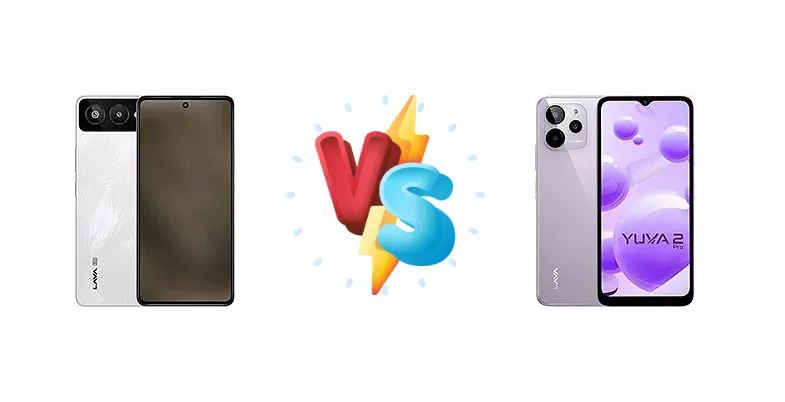
Lava is aggressively targeting the budget smartphone market with the Blaze Amoled 2 and Yuva 2 Pro. While both aim to deliver value, they diverge significantly in their core components. The Blaze Amoled 2 prioritizes performance with a modern chipset and AMOLED display, while the Yuva 2 Pro focuses on affordability, making this a crucial comparison for budget-conscious buyers.
🏆 Quick Verdict
For the average user prioritizing responsiveness and a vibrant display, the Lava Blaze Amoled 2 is the clear winner. Its Mediatek Dimensity 7060 chipset provides a substantial performance uplift over the Yuva 2 Pro’s Helio G37, and the AMOLED screen offers a superior viewing experience. The Yuva 2 Pro remains a viable option for basic tasks, but struggles to keep pace.
| Network |
|---|
| 2G bands | GSM 900 / 1800 | GSM 900 / 1800 |
| 3G bands | HSDPA 850 / 900 / 1900 / 2100 | HSDPA 900 / 2100 |
| 4G bands | 1, 3, 5, 8, 28, 40, 41 | 1, 3, 5, 8, 40, 41 |
| 5G bands | 1, 3, 5, 8, 28, 40, 41, 77, 78 SA/NSA | - |
| Speed | HSPA, LTE, 5G | HSPA, LTE |
| Technology | GSM / HSPA / LTE / 5G | GSM / HSPA / LTE |
| Launch |
|---|
| Announced | 2025, August 07 | 2023, February 22 |
| Status | Available. Released 2025, August 16 | Available. Released 2023, February 22 |
| Body |
|---|
| Dimensions | 163.2 x 76.1 x 7.6 mm (6.43 x 3.00 x 0.30 in) | 164.5 x 76 x 9 mm (6.48 x 2.99 x 0.35 in) |
| SIM | Nano-SIM + Nano-SIM | Nano-SIM + Nano-SIM |
| Weight | 174 g (6.14 oz) | 204 g (7.20 oz) |
| Display |
|---|
| Resolution | 1080 x 2400 pixels, 20:9 ratio (~395 ppi density) | 720 x 1600 pixels, 20:9 ratio (~269 ppi density) |
| Size | 6.67 inches, 107.4 cm2 (~86.5% screen-to-body ratio) | 6.52 inches, 102.6 cm2 (~82.1% screen-to-body ratio) |
| Type | AMOLED, 1B colors, 120Hz, 800 nits (HBM) | IPS LCD |
| Platform |
|---|
| CPU | Octa-core (2x2.6 GHz Cortex-A78 & 6x2.0 GHz Cortex-A55) | Octa-core (4x2.3 GHz Cortex-A53 & 4x1.8 GHz Cortex-A53) |
| Chipset | Mediatek Dimensity 7060 (6 nm) | Mediatek MT6765 Helio G37 (12 nm) |
| GPU | IMG BXM-8-256 | PowerVR GE8320 |
| OS | Android 15, up to 1 major Android upgrade | Android 12 |
| Memory |
|---|
| Card slot | microSDXC (uses shared SIM slot) | microSDXC (dedicated slot) |
| Internal | 128GB 6GB RAM | 64GB 4GB RAM |
| | - | eMMC 5.1 |
| Main Camera |
|---|
| Features | LED flash, HDR, panorama | LED flash |
| Single | 50 MP, (wide), AF
Auxiliary lens | 5 MP |
| Triple | - | 13 MP, (wide), AF
VGA
VGA |
| Video | 1440p@30fps, 1080p@30fps | 1080p@30fps |
| Selfie camera |
|---|
| Single | 8 MP | 5 MP |
| Video | 1440p@30fps, 1080p@30fps | Yes |
| Sound |
|---|
| 3.5mm jack | - | Yes |
| 35mm jack | No | Yes |
| Loudspeaker | Yes, with stereo speakers | Yes |
| Comms |
|---|
| Bluetooth | 5.2, A2DP, LE | 5.1, A2DP, LE |
| Infrared port | Yes | - |
| NFC | No | No |
| Positioning | GPS, GALILEO, GLONASS, BDS, QZSS | GPS |
| Radio | Unspecified | FM radio |
| USB | USB Type-C 2.0, OTG | USB Type-C 2.0, OTG |
| WLAN | Wi-Fi 802.11 a/b/g/n/ac | Wi-Fi 802.11 b/g/n/ac |
| Features |
|---|
| Sensors | Fingerprint (under display, optical), accelerometer, gyro, proximity, compass | Fingerprint (side-mounted), accelerometer, proximity |
| Battery |
|---|
| Charging | 33W wired | 10W wired |
| Type | Li-Po 5000 mAh | Li-Po 5000 mAh |
| Misc |
|---|
| Colors | Midnight Black, White Feather | Glass Lavender, Glass Green, Glass White |
| Models | - | LZX408 |
| Price | ₹ 12,499 | About 90 EUR |
Lava Blaze Amoled 2
- Significantly faster processor for smoother performance
- Vibrant AMOLED display for an immersive viewing experience
- 33W fast charging for quick power-ups
- May be slightly more expensive than the Yuva 2 Pro
- Potential for more heat generation under heavy load (though 6nm helps)
Lava Yuva 2 Pro
- More affordable price point
- Decent battery life for basic usage
- Functional for essential smartphone tasks
- Slow Helio G37 processor struggles with demanding apps
- Likely LCD display offers inferior image quality
- Extremely slow 10W charging
Display Comparison
The Lava Blaze Amoled 2 boasts an AMOLED panel, a significant advantage over the Yuva 2 Pro’s likely LCD (spec not provided, but standard for this price point). AMOLED technology delivers superior contrast, deeper blacks, and more vibrant colors. While specific brightness nits aren’t provided, AMOLED inherently offers better viewing angles and power efficiency when displaying dark content. The Yuva 2 Pro, lacking AMOLED, will likely struggle in direct sunlight and offer a less immersive visual experience. Bezels are also likely wider on the Yuva 2 Pro due to the less advanced display technology.
Camera Comparison
Without detailed camera specifications beyond the chipsets, a direct comparison is limited. However, the Dimensity 7060 in the Blaze Amoled 2 typically supports more advanced image signal processors (ISPs), enabling better image processing and potentially superior low-light performance. The Yuva 2 Pro’s Helio G37 is a more basic chipset, likely resulting in less refined image quality. It’s reasonable to assume the Blaze Amoled 2 will offer a more versatile and capable camera system, even if the sensor sizes are similar. We can expect the Yuva 2 Pro to struggle with dynamic range and detail in challenging lighting conditions.
Performance
The performance gap between these two devices is substantial. The Lava Blaze Amoled 2’s Mediatek Dimensity 7060 (6nm) features a more modern CPU architecture – Cortex-A78 cores – compared to the Yuva 2 Pro’s Helio G37 (12nm) which relies on older Cortex-A53 cores. The 6nm process node of the Dimensity 7060 also translates to better power efficiency and reduced thermal throttling. The Dimensity 7060’s octa-core configuration (2x2.6 GHz + 6x2.0 GHz) is significantly faster than the Helio G37’s (4x2.3 GHz + 4x1.8 GHz). This difference will be noticeable in app launch times, multitasking, and gaming performance. The Yuva 2 Pro will likely exhibit lag and stuttering with demanding applications.
Battery Life
The Lava Blaze Amoled 2’s 33W wired charging is a major advantage over the Yuva 2 Pro’s 10W charging. This translates to significantly faster charging times – potentially a full charge in under an hour for the Blaze Amoled 2, compared to several hours for the Yuva 2 Pro. While battery capacity isn’t specified, the more efficient Dimensity 7060 in the Blaze Amoled 2 will likely offset any potential capacity difference, providing comparable or even better real-world battery life despite the faster charging.
Buying Guide
Buy the Lava Blaze Amoled 2 if you need a phone capable of handling demanding apps, moderate gaming, and appreciate a vibrant AMOLED display. This phone is ideal for users who multitask frequently and value a smooth user experience. Buy the Lava Yuva 2 Pro if you primarily need a phone for calls, texts, and light social media use, and your budget is extremely limited. It’s a functional device for basic communication, but compromises heavily on performance and display quality.
Frequently Asked Questions
❓ Will the Helio G37 in the Lava Yuva 2 Pro struggle with popular games like Call of Duty: Mobile?
Yes, the Helio G37 is a relatively weak chipset and will likely struggle to run demanding games like Call of Duty: Mobile at high settings. You'll likely need to lower the graphics settings significantly and may still experience frame drops and lag. It's better suited for less graphically intensive games.
❓ How much faster is the 33W charging on the Lava Blaze Amoled 2 compared to the 10W charging on the Yuva 2 Pro?
The 33W charging on the Blaze Amoled 2 is considerably faster. While exact times depend on battery capacity, you can expect a full charge in approximately 60-90 minutes. The Yuva 2 Pro’s 10W charging will likely take 3-4 hours or more to fully charge the battery.
❓ Is the difference in CPU architecture (Cortex-A78 vs Cortex-A53) noticeable in everyday tasks?
Absolutely. The Cortex-A78 cores in the Dimensity 7060 are significantly more powerful and efficient than the Cortex-A53 cores in the Helio G37. This translates to faster app launch times, smoother multitasking, and a more responsive user experience in everyday tasks like browsing, social media, and email.
❓ Does the Lava Blaze Amoled 2 support higher refresh rates (90Hz or 120Hz) on its AMOLED display?
The provided specifications do not mention the refresh rate. However, given the inclusion of an AMOLED panel and the chipset's capabilities, it's highly probable that the Lava Blaze Amoled 2 supports a 90Hz refresh rate, offering smoother scrolling and animations. This is a common feature in phones with AMOLED displays in this price range.