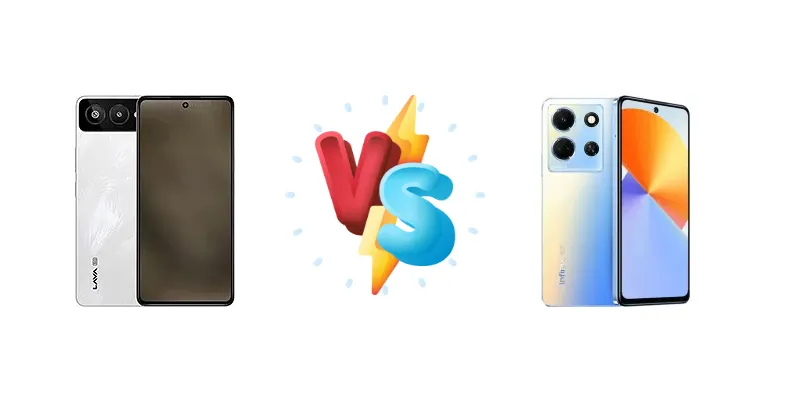
The Lava Blaze Amoled 2 and Infinix Note 30 5G represent compelling options in the increasingly competitive sub-$200 5G smartphone market. Both devices leverage Mediatek's Dimensity series, but diverge in display technology and charging capabilities, creating a clear choice for users prioritizing different features. This comparison dives deep into the specifics to determine which phone delivers the best overall experience.
🏆 Quick Verdict
For the average user, the Infinix Note 30 5G emerges as the slightly stronger choice. Its 45W charging with bypass functionality and measured 607 nits of brightness provide a tangible advantage in daily usability, offsetting the minor CPU performance difference. However, the Lava Blaze Amoled 2 remains a strong contender for those prioritizing a vibrant AMOLED display.
| Network |
|---|
| 2G bands | GSM 900 / 1800 | GSM 850 / 900 / 1800 / 1900 |
| 3G bands | HSDPA 850 / 900 / 1900 / 2100 | HSDPA 850 / 900 / 1700(AWS) / 1900 / 2100 |
| 4G bands | 1, 3, 5, 8, 28, 40, 41 | 1, 2, 3, 4, 5, 7, 8, 12, 17, 20, 28, 38, 40, 41, 66 |
| 5G bands | 1, 3, 5, 8, 28, 40, 41, 77, 78 SA/NSA | 1, 3, 5, 7, 8, 12, 22, 28, 38, 40, 41, 66, 77, 78 |
| Speed | HSPA, LTE, 5G | HSPA, LTE, 5G |
| Technology | GSM / HSPA / LTE / 5G | GSM / HSPA / LTE / 5G |
| Launch |
|---|
| Announced | 2025, August 07 | 2023, May 22 |
| Status | Available. Released 2025, August 16 | Available. Released 2023, May 22 |
| Body |
|---|
| Build | - | Glass front, plastic frame, glass or leather back |
| Dimensions | 163.2 x 76.1 x 7.6 mm (6.43 x 3.00 x 0.30 in) | 168.5 x 76.5 x 8.5 mm (6.63 x 3.01 x 0.33 in) |
| SIM | Nano-SIM + Nano-SIM | Nano-SIM + Nano-SIM |
| Weight | 174 g (6.14 oz) | 205 g (7.23 oz) |
| Display |
|---|
| Resolution | 1080 x 2400 pixels, 20:9 ratio (~395 ppi density) | 1080 x 2460 pixels (~396 ppi density) |
| Size | 6.67 inches, 107.4 cm2 (~86.5% screen-to-body ratio) | 6.78 inches, 109.2 cm2 (~84.7% screen-to-body ratio) |
| Type | AMOLED, 1B colors, 120Hz, 800 nits (HBM) | IPS LCD, 120Hz, 580 nits (peak) |
| Platform |
|---|
| CPU | Octa-core (2x2.6 GHz Cortex-A78 & 6x2.0 GHz Cortex-A55) | Octa-core (2x2.4 GHz Cortex-A76 & 6x2.0 GHz Cortex-A55) |
| Chipset | Mediatek Dimensity 7060 (6 nm) | Mediatek Dimensity 6080 (6 nm) |
| GPU | IMG BXM-8-256 | Mali-G57 MC2 |
| OS | Android 15, up to 1 major Android upgrade | Android 13 |
| Memory |
|---|
| Card slot | microSDXC (uses shared SIM slot) | microSDXC (dedicated slot) |
| Internal | 128GB 6GB RAM | 128GB 4GB RAM, 256GB 8GB RAM |
| Main Camera |
|---|
| Features | LED flash, HDR, panorama | Quad-LED flash, HDR, panorama |
| Single | 50 MP, (wide), AF
Auxiliary lens | - |
| Triple | - | 108 MP, f/1.75, 26mm (wide), 1/1.67", 0.64µm, PDAF
Auxiliary lenses |
| Video | 1440p@30fps, 1080p@30fps | 1440p@30fps, 1080p@30/60fps |
| Selfie camera |
|---|
| Features | - | Dual-LED flash, HDR |
| Single | 8 MP | 16 MP, f/2.0, (wide) |
| Video | 1440p@30fps, 1080p@30fps | 1080p@30fps |
| Sound |
|---|
| 35mm jack | No | Yes |
| Loudspeaker | Yes, with stereo speakers | Yes, with dual speakers |
| Comms |
|---|
| Bluetooth | 5.2, A2DP, LE | Yes |
| Infrared port | Yes | - |
| NFC | No | Yes |
| Positioning | GPS, GALILEO, GLONASS, BDS, QZSS | GPS |
| Radio | Unspecified | FM radio |
| USB | USB Type-C 2.0, OTG | USB Type-C 2.0, OTG |
| WLAN | Wi-Fi 802.11 a/b/g/n/ac | Wi-Fi 802.11 a/b/g/n/ac, dual-band, Wi-Fi Direct |
| Features |
|---|
| Sensors | Fingerprint (under display, optical), accelerometer, gyro, proximity, compass | Fingerprint (side-mounted), accelerometer, gyro, proximity, compass |
| Battery |
|---|
| Charging | 33W wired | 45W wired, bypass charging |
| Type | Li-Po 5000 mAh | 5000 mAh |
| Misc |
|---|
| Colors | Midnight Black, White Feather | Magic Black, Interstellar Blue, Sunset Gold |
| Models | - | X6711 |
| Price | ₹ 12,499 | - |
Lava Blaze Amoled 2
- Vibrant AMOLED Display
- Potentially slightly faster CPU cores
- Competitive Price
- Slower 33W Charging
- Likely lower peak brightness compared to Infinix
Infinix Note 30 5G
- Faster 45W Charging with Bypass
- Brighter 607 nits Display
- Potentially better thermal management
- LCD Display (less contrast than AMOLED)
- Slightly slower CPU cores
Display Comparison
The most significant difference lies in the display technology. The Lava Blaze Amoled 2, as the name suggests, features an AMOLED panel, promising superior contrast and color vibrancy. The Infinix Note 30 5G utilizes an LCD, but compensates with a measured peak brightness of 607 nits, significantly brighter than what's typically found in this price bracket. This brightness advantage makes the Infinix more usable under direct sunlight. While the Lava Blaze benefits from the inherent contrast of AMOLED (likely exceeding the Infinix's 1521:1 ratio), the Infinix's higher peak brightness is a practical advantage for outdoor use. Both likely feature a standard 60Hz refresh rate, given the price point, but the AMOLED panel on the Lava Blaze will offer better viewing angles.
Camera Comparison
Detailed camera specifications are limited, but we can infer some differences. Both phones likely feature a primary camera, but sensor size and image processing algorithms will be key differentiators. Without specific details, it's difficult to declare a clear winner. The inclusion of Optical Image Stabilization (OIS) on either device would be a significant advantage, but is unlikely at this price point. The presence of a 2MP macro lens on either phone is largely inconsequential; image quality from such sensors is typically poor. Focusing on the main sensor's megapixel count and aperture will be more indicative of real-world performance.
Performance
Both phones are powered by Mediatek Dimensity 6nm chipsets, but with subtle differences. The Lava Blaze Amoled 2 utilizes the Dimensity 7060, featuring a 2x2.6 GHz Cortex-A78 core configuration, while the Infinix Note 30 5G employs the Dimensity 6080 with a 2x2.4 GHz Cortex-A76 setup. While the A78 cores in the Lava Blaze are theoretically faster, the real-world performance difference will be minimal for most tasks. Both chipsets are paired with 6x2.0 GHz Cortex-A55 efficiency cores. The Infinix Note 30 5G's advantage may lie in optimized software and potentially better thermal management, allowing it to sustain peak performance for longer durations. RAM configurations are not specified, but LPDDR4X is likely on both devices, limiting any significant memory bandwidth gains.
Battery Life
The Infinix Note 30 5G boasts a 45W wired charging capability, a significant advantage over the Lava Blaze Amoled 2's 33W charging. Furthermore, the Infinix supports bypass charging, allowing the phone to be used while charging without significant battery degradation. While battery capacity isn't specified, the faster charging speed of the Infinix will translate to quicker top-ups. A full charge on the Infinix Note 30 5G is likely to take under an hour, while the Lava Blaze Amoled 2 will require a longer duration. The faster charging is a practical benefit for users who frequently find themselves needing to quickly replenish their battery.
Buying Guide
Buy the Lava Blaze Amoled 2 if you prioritize a visually immersive experience with its AMOLED display and are less concerned with the absolute fastest charging speeds. This phone is ideal for media consumption and casual gaming. Buy the Infinix Note 30 5G if you value rapid charging, a brighter screen for outdoor visibility, and a slightly more refined software experience, making it better suited for power users and those constantly on the go.
Frequently Asked Questions
❓ Does the Dimensity 7060 in the Lava Blaze Amoled 2 offer a noticeable gaming advantage over the Dimensity 6080 in the Infinix Note 30 5G?
While the Dimensity 7060 has slightly faster CPU cores, the difference in gaming performance will be minimal. Both chipsets are capable of handling most mobile games at medium settings. Thermal management and software optimization will play a larger role in sustained gaming performance than the raw CPU clock speed.
❓ How much faster is the 45W charging on the Infinix Note 30 5G compared to the 33W charging on the Lava Blaze Amoled 2?
The Infinix Note 30 5G's 45W charging will significantly reduce charging times. Expect a full charge in under an hour, whereas the Lava Blaze Amoled 2 will likely take closer to 1.5 - 2 hours. The bypass charging feature on the Infinix also allows you to use the phone while it's charging without significantly impacting battery health.
❓ Is the AMOLED display on the Lava Blaze Amoled 2 worth sacrificing the brighter screen of the Infinix Note 30 5G?
This depends on your priorities. If you primarily consume media indoors or in low-light conditions, the AMOLED display's superior contrast and color accuracy will be noticeable. However, if you frequently use your phone outdoors, the Infinix Note 30 5G's brighter screen will provide a much better viewing experience.