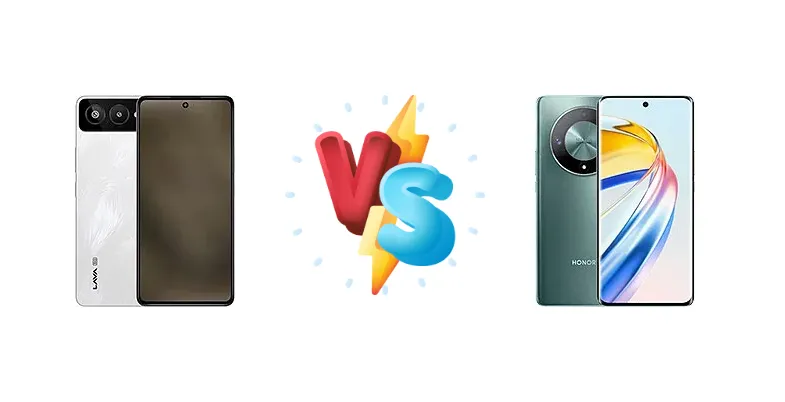
The Lava Blaze Amoled 2 and Honor X9b represent compelling options in the increasingly competitive sub-$250 smartphone market. The Blaze Amoled 2 leverages Mediatek's Dimensity 7060, while the Honor X9b opts for Qualcomm's Snapdragon 6 Gen 1. This comparison dissects their core differences, focusing on performance, charging, and overall user experience to determine which device offers the most bang for your buck.
🏆 Quick Verdict
For the average user prioritizing consistent performance and slightly faster charging, the Honor X9b emerges as the winner. Its Snapdragon 6 Gen 1, built on a more efficient 4nm process, provides a smoother experience, especially during sustained tasks. However, the Lava Blaze Amoled 2 offers a strong value proposition with its AMOLED display.
| Network |
|---|
| 2G bands | GSM 900 / 1800 | GSM 850 / 900 / 1800 / 1900 |
| 3G bands | HSDPA 850 / 900 / 1900 / 2100 | HSDPA 850 / 900 / 1900 / 2100 |
| 4G bands | 1, 3, 5, 8, 28, 40, 41 | 1, 2, 3, 4, 5, 7, 8, 20, 28, 32, 38, 40, 41 |
| 5G bands | 1, 3, 5, 8, 28, 40, 41, 77, 78 SA/NSA | 1, 3, 7, 8, 20, 28, 38, 40, 41, 77, 78 SA/NSA |
| Speed | HSPA, LTE, 5G | HSPA, LTE, 5G |
| Technology | GSM / HSPA / LTE / 5G | GSM / HSPA / LTE / 5G |
| Launch |
|---|
| Announced | 2025, August 07 | 2023, October 18 |
| Status | Available. Released 2025, August 16 | Available. Released 2023, October |
| Body |
|---|
| Dimensions | 163.2 x 76.1 x 7.6 mm (6.43 x 3.00 x 0.30 in) | 163.6 x 75.5 x 8 mm (6.44 x 2.97 x 0.31 in) |
| SIM | Nano-SIM + Nano-SIM | Nano-SIM + Nano-SIM |
| Weight | 174 g (6.14 oz) | 185 g (6.53 oz) |
| Display |
|---|
| Resolution | 1080 x 2400 pixels, 20:9 ratio (~395 ppi density) | 1220 x 2652 pixels, 19.5:9 ratio (~431 ppi density) |
| Size | 6.67 inches, 107.4 cm2 (~86.5% screen-to-body ratio) | 6.78 inches, 112.6 cm2 (~91.2% screen-to-body ratio) |
| Type | AMOLED, 1B colors, 120Hz, 800 nits (HBM) | AMOLED, 1B colors, 120Hz, 1200 nits (peak) |
| Platform |
|---|
| CPU | Octa-core (2x2.6 GHz Cortex-A78 & 6x2.0 GHz Cortex-A55) | Octa-core (4x2.2 GHz Cortex-A78 & 4x1.8 GHz Cortex-A55) |
| Chipset | Mediatek Dimensity 7060 (6 nm) | Qualcomm SM6450 Snapdragon 6 Gen 1 (4 nm) |
| GPU | IMG BXM-8-256 | Adreno 710 |
| OS | Android 15, up to 1 major Android upgrade | Android 13, Magic OS 7.2 |
| Memory |
|---|
| Card slot | microSDXC (uses shared SIM slot) | No |
| Internal | 128GB 6GB RAM | 256GB 8GB RAM, 256GB 12GB RAM, 512GB 8GB RAM, 512GB 12GB RAM |
| Main Camera |
|---|
| Features | LED flash, HDR, panorama | LED flash, panorama, HDR |
| Single | 50 MP, (wide), AF
Auxiliary lens | - |
| Triple | - | 108 MP, f/1.8, (wide), 1/1.67", PDAF
5 MP, f/2.2, (ultrawide)
2 MP (macro) |
| Video | 1440p@30fps, 1080p@30fps | 4K@30fps, 1080p@30fps |
| Selfie camera |
|---|
| Single | 8 MP | 16 MP, f/2.5, (wide) |
| Video | 1440p@30fps, 1080p@30fps | 1080p@30fps |
| Sound |
|---|
| 35mm jack | No | No |
| Loudspeaker | Yes, with stereo speakers | Yes |
| Comms |
|---|
| Bluetooth | 5.2, A2DP, LE | 5.1, A2DP, LE |
| Infrared port | Yes | Yes |
| NFC | No | Yes (market/region dependent) |
| Positioning | GPS, GALILEO, GLONASS, BDS, QZSS | GPS, GLONASS, GALILEO, BDS |
| Radio | Unspecified | No |
| USB | USB Type-C 2.0, OTG | USB Type-C 2.0, OTG |
| WLAN | Wi-Fi 802.11 a/b/g/n/ac | Wi-Fi 802.11 a/b/g/n/ac, dual-band, Wi-Fi Direct |
| Features |
|---|
| Sensors | Fingerprint (under display, optical), accelerometer, gyro, proximity, compass | Fingerprint (under display, optical), accelerometer, gyro, proximity, compass |
| Battery |
|---|
| Charging | 33W wired | 35W wired
Reverse wired |
| Type | Li-Po 5000 mAh | Li-Po 5800 mAh |
| Misc |
|---|
| Colors | Midnight Black, White Feather | Sunrise Orange, Midnight Black, Emerald Green |
| Models | - | ALI-NX1 |
| Price | ₹ 12,499 | About 970 EUR |
Lava Blaze Amoled 2
- Vibrant AMOLED Display
- Competitive Price
- Decent Charging Speed (33W)
- Less Efficient Chipset (6nm)
- Potential for Thermal Throttling
Honor X9b
- More Efficient Chipset (4nm)
- Faster Charging (35W) with Reverse Wired Charging
- Potentially Better Sustained Performance
- Likely LCD Display (inferior to AMOLED)
- May be slightly more expensive
Display Comparison
Neither device boasts a flagship-level display, but both target a vibrant viewing experience. The Lava Blaze Amoled 2, as its name suggests, features an AMOLED panel, promising superior contrast and color accuracy compared to the likely LCD panel on the Honor X9b (panel type not specified in provided data). While the Honor X9b's display specs are unknown, the Lava Blaze Amoled 2's AMOLED technology will provide deeper blacks and a more immersive experience. Bezels and resolution are assumed to be similar given the price bracket, but the AMOLED panel gives Lava a clear advantage for media consumption.
Camera Comparison
Without detailed camera specifications, a direct comparison is difficult. However, the market segment suggests both phones will rely on software processing to enhance image quality. The presence or absence of Optical Image Stabilization (OIS) on either device is unknown, but its inclusion would significantly benefit low-light photography. We can assume both phones will feature a primary camera, ultrawide, and potentially a macro lens, but the sensor sizes and lens apertures will be the determining factors in image quality. Focusing on the main sensor resolution and aperture would be key to differentiating the camera performance.
Performance
The core of the difference lies in the chipsets. The Lava Blaze Amoled 2’s Mediatek Dimensity 7060 (6nm) features a 2x2.6 GHz Cortex-A78 and 6x2.0 GHz Cortex-A55 configuration. The Honor X9b’s Qualcomm Snapdragon 6 Gen 1 (4nm) uses a 4x2.2 GHz Cortex-A78 and 4x1.8 GHz Cortex-A55 setup. The Snapdragon 6 Gen 1’s 4nm fabrication process is a significant advantage, offering improved power efficiency and potentially better sustained performance compared to the Dimensity 7060’s 6nm node. While the Dimensity 7060 has slightly higher clocked A78 cores, the architectural efficiency of the Snapdragon 6 Gen 1 will likely translate to smoother multitasking and less thermal throttling. Both devices likely utilize LPDDR4X RAM, limiting overall memory bandwidth.
Battery Life
Both devices offer relatively fast charging, with the Honor X9b edging out the Lava Blaze Amoled 2 with 35W wired charging versus 33W. The Honor X9b also boasts reverse wired charging, a convenient feature for topping up accessories. While battery capacity isn’t specified, the Snapdragon 6 Gen 1’s superior power efficiency suggests the Honor X9b may offer slightly longer battery life despite potentially having a similar capacity. The 2W difference in charging wattage translates to a potentially faster 0-100% charge time on the Honor X9b.
Buying Guide
Buy the Lava Blaze Amoled 2 if you prioritize a vibrant AMOLED display and are primarily focused on everyday tasks like social media, browsing, and casual gaming. Buy the Honor X9b if you need a phone that can handle more demanding applications, multitasking, and offers slightly better long-term performance due to its more efficient chipset.
Frequently Asked Questions
❓ Will the Dimensity 7060 in the Lava Blaze Amoled 2 struggle with graphically intensive games like Genshin Impact?
The Dimensity 7060 is capable of running Genshin Impact, but you'll likely need to lower the graphics settings to medium or low to maintain a stable frame rate. The 6nm process and potential for thermal throttling may limit sustained performance during extended gaming sessions. The Snapdragon 6 Gen 1 in the Honor X9b, with its 4nm process, will likely offer a smoother experience at similar settings.
❓ Does the Honor X9b support 5G connectivity, and if so, on which bands?
While the provided data doesn't specify 5G band support, the Snapdragon 6 Gen 1 typically includes 5G modem capabilities. However, the specific bands supported will vary depending on the region and carrier. It's crucial to check the Honor X9b's specifications for your region to confirm 5G compatibility.
❓ How does the charging speed of the Honor X9b compare to real-world usage? Will 35W significantly reduce charging times?
35W charging is relatively fast for this price segment. Expect a full charge from 0-100% in approximately 60-75 minutes, depending on battery capacity. While not as rapid as some flagship phones with 65W or 120W charging, it's a noticeable improvement over slower charging speeds and will provide a substantial charge in a short amount of time.