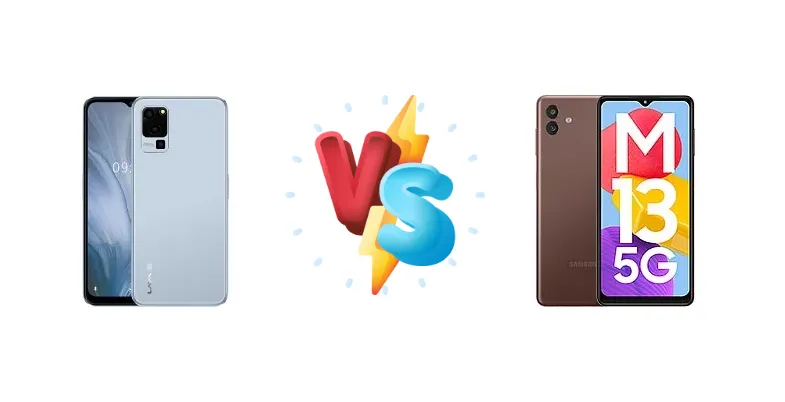
The 5G landscape is becoming increasingly accessible, with budget-friendly options like the Lava Blaze 5G and Samsung Galaxy M13 5G. Both offer 5G connectivity at an attractive price point, but which one delivers the better overall experience? Let's dive into a comprehensive comparison.
🏆 Quick Verdict
The Samsung Galaxy M13 5G edges out the Lava Blaze 5G primarily due to its faster charging and generally more polished Samsung software experience. While both share the same Dimensity 700 chipset, Samsung's brand recognition and slightly better features make it the preferred choice for most users.
| Network |
|---|
| 2G bands | GSM 900 / 1800 | GSM 850 / 900 / 1800 / 1900 |
| 3G bands | HSDPA 900 / 2100 | HSDPA 850 / 900 / 1900 / 2100 |
| 4G bands | 1, 3, 5, 8, 40, 41 | 1, 2, 3, 4, 5, 7, 8, 12, 17, 20, 26, 28, 38, 40, 41, 66 |
| 5G bands | SA/NSA | 1, 3, 5, 7, 8, 20, 28, 38, 40, 41, 78 SA/NSA/Sub6 |
| Speed | HSPA, LTE, 5G | HSPA, LTE, 5G |
| Technology | GSM / HSPA / LTE / 5G | GSM / HSPA / LTE / 5G |
| Launch |
|---|
| Announced | 2022, October 3 | 2022, July 14 |
| Status | Available. Released 2022, October 24 | Available. Released 2022, July 23 |
| Body |
|---|
| Build | - | Glass front (Gorilla Glass 3), plastic back, plastic frame |
| Dimensions | 165.3 x 76.4 x 8.9 mm (6.51 x 3.01 x 0.35 in) | 164.5 x 76.5 x 8.8 mm (6.48 x 3.01 x 0.35 in) |
| SIM | Nano-SIM + Nano-SIM | Nano-SIM + Nano-SIM |
| Weight | 207 g (7.30 oz) | 195 g (6.88 oz) |
| Display |
|---|
| Protection | - | Corning Gorilla Glass 3 |
| Resolution | 720 x 1600 pixels, 20:9 ratio (~269 ppi density) | 720 x 1600 pixels, 20:9 ratio (~270 ppi density) |
| Size | 6.52 inches, 102.6 cm2 (~81.3% screen-to-body ratio) | 6.5 inches, 102.0 cm2 (~81.1% screen-to-body ratio) |
| Type | IPS LCD, 90Hz | PLS LCD, 90Hz, 400 nits (typ) |
| Platform |
|---|
| CPU | Octa-core (2x2.2 GHz Cortex-A76 & 6x2.0 GHz Cortex-A55) | Octa-core (2x2.2 GHz Cortex-A76 & 6x2.0 GHz Cortex-A55) |
| Chipset | Mediatek Dimensity 700 (7 nm) | Mediatek Dimensity 700 (7 nm) |
| GPU | Mali-G57 MC2 | Mali-G57 MC2 |
| OS | Android 12 | Android 12, One UI Core 4 |
| Memory |
|---|
| Card slot | microSDXC (uses shared SIM slot) | microSDXC (dedicated slot) |
| Internal | 128GB 4GB RAM, 128GB 6GB RAM | 64GB 4GB RAM, 128GB 6GB RAM |
| | eMMC 5.1 | - |
| Main Camera |
|---|
| Dual | - | 50 MP, f/1.8, (wide), PDAF
Auxiliary lens |
| Features | LED flash, HDR, panorama | LED flash, panorama, HDR |
| Single | 8 MP, f/2.0, (wide) | - |
| Triple | 50 MP, (wide), 0.64µm, AF
2 MP (macro)
0.3 MP | - |
| Video | 1080p@30fps | 1080p@30fps |
| Selfie camera |
|---|
| Features | - | HDR |
| Single | 8 MP, f/2.0, (wide) | 5 MP, f/2.0, (wide) |
| Video | Yes | - |
| Sound |
|---|
| 3.5mm jack | Yes | Yes |
| 35mm jack | Yes | Yes |
| Loudspeaker | Yes | Yes |
| Comms |
|---|
| Bluetooth | 5.0, A2DP, LE | 5.0, A2DP, LE |
| NFC | No | No |
| Positioning | GPS | GPS, GLONASS, BDS, GALILEO, QZSS |
| Radio | FM radio | Unspecified |
| USB | USB Type-C 2.0, OTG | USB Type-C 2.0 |
| WLAN | Wi-Fi 802.11 b/g/n/ac | Wi-Fi 802.11 a/b/g/n/ac, dual-band |
| Features |
|---|
| Sensors | Fingerprint (side-mounted), accelerometer, proximity | Fingerprint (side-mounted), accelerometer, gyro, compass |
| | - | Virtual proximity sensing |
| Battery |
|---|
| Charging | 10W wired | 15W wired |
| Type | Li-Po 5000 mAh | Li-Po 5000 mAh |
| Misc |
|---|
| Colors | Green, Blue | Midnight Blue, Aqua Green, Stardust Brown |
| Models | LXX503 | SM-M136B, SM-M136B/DS |
| Price | About 130 EUR | About 180 EUR |
| SAR | - | 0.73 W/kg (head) |
| SAR EU | - | 0.84 W/kg (head) 1.33 W/kg (body) |
Lava Blaze 5G
- Very affordable
- 5G connectivity
- Decent performance for the price
- Slow charging (10W)
- Less established brand
- Potentially less refined software
Samsung Galaxy M13 5G
- Faster charging (15W)
- Reputable brand
- Likely better camera quality
- Smoother software experience
- Slightly more expensive
- May not have the highest refresh rate
Display Comparison
Both phones feature a 6.5-inch display, likely with an FHD+ resolution. However, Samsung typically offers better display calibration and potentially brighter panels, resulting in a more vibrant and enjoyable viewing experience. The Lava Blaze 5G might have a slightly higher refresh rate (90Hz vs 60Hz) but this is unconfirmed.
Camera Comparison
The Samsung Galaxy M13 5G likely boasts a more versatile camera system, potentially with a higher resolution main sensor and improved image processing. While the Lava Blaze 5G may have a decent camera, Samsung's experience in mobile photography usually translates to better image quality, especially in challenging lighting conditions. Expect Samsung to have better video recording capabilities.
Performance
Powered by the same Mediatek Dimensity 700 chipset, both phones offer similar performance for everyday tasks and moderate gaming. Differences will likely be found in software optimization; Samsung's One UI is generally more refined and efficient than Lava's custom skin. Expect similar benchmark scores.
Battery Life
Both phones likely have a 5000mAh battery, providing all-day battery life. However, the Samsung Galaxy M13 5G's 15W charging is significantly faster than the Lava Blaze 5G's 10W charging, reducing charging times considerably.
Buying Guide
The Lava Blaze 5G is a good option for users prioritizing a very budget-friendly 5G phone and are comfortable with a less established brand. The Samsung Galaxy M13 5G is ideal for those seeking a reliable, well-supported device with a smoother user experience and faster charging, even if it comes at a slightly higher price.
Frequently Asked Questions
❓ Is the Lava Blaze 5G worth buying?
If you're on a very tight budget and need 5G, the Lava Blaze 5G is a viable option. However, consider the Samsung Galaxy M13 5G for a better overall experience.
❓ Which phone has better software support?
Samsung generally provides longer software update support and more frequent security patches compared to Lava.
❓ Can both phones handle gaming?
Yes, both phones can handle casual gaming. However, demanding games may require lower graphics settings for smooth performance.