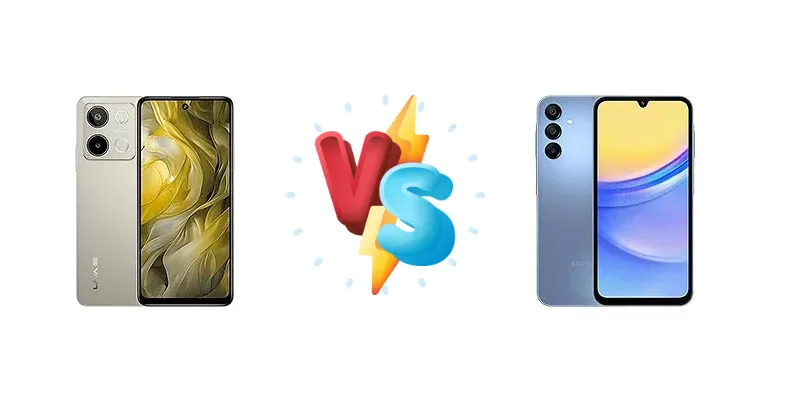
The sub-$200 5G smartphone market is heating up, with the Lava Blaze 3 5G and Samsung Galaxy A15 5G vying for dominance. Both devices aim to deliver 5G connectivity and a modern smartphone experience without breaking the bank. This comparison dives deep into their specifications to determine which phone offers the best value for your money, focusing on performance, display quality, and battery endurance.
🏆 Quick Verdict
For the average user prioritizing display quality and established brand reliability, the Samsung Galaxy A15 5G is the better choice. Its brighter 786 nit display and 25W charging provide a more polished experience. However, the Lava Blaze 3 5G offers a compelling alternative with a slightly faster processor for those focused on raw performance.
| Network |
|---|
| 2G bands | GSM 850 / 900 / 1800 / 1900 | GSM 850 / 900 / 1800 / 1900 |
| 3G bands | HSDPA 900 / 2100 | HSDPA 850 / 900 / 1700(AWS) / 1900 / 2100 |
| 4G bands | 1, 3, 5, 8, 28, 40, 41 | 1, 2, 3, 4, 5, 7, 8, 12, 17, 20, 26, 28, 38, 40, 41, 66 |
| 5G bands | 1, 3, 5, 8, 28, 40, 41, 77, 88 SA/NSA | 1, 3, 5, 7, 8, 26, 28, 40, 41, 66, 77, 78 SA/NSA/Sub6 |
| Speed | HSPA, LTE, 5G | HSPA, LTE, 5G |
| Technology | GSM / HSPA / LTE / 5G | GSM / HSPA / LTE / 5G |
| Launch |
|---|
| Announced | 2024, September 16 | 2023, December 11 |
| Status | Available. Released 2024, September 18 | Available. Released 2023, December 16 |
| Body |
|---|
| Build | - | Glass front, plastic back, plastic frame |
| Dimensions | 164.3 x 76.2 x 8.6 mm (6.47 x 3.00 x 0.34 in) | 160.1 x 76.8 x 8.4 mm (6.30 x 3.02 x 0.33 in) |
| SIM | Nano-SIM + Nano-SIM | · Nano-SIM· Nano-SIM + Nano-SIM |
| Weight | 201 g (7.09 oz) | 200 g (7.05 oz) |
| Display |
|---|
| Resolution | 720 x 1600 pixels, 20:9 ratio (~267 ppi density) | 1080 x 2340 pixels, 19.5:9 ratio (~396 ppi density) |
| Size | 6.56 inches, 103.9 cm2 (~83.0% screen-to-body ratio) | 6.5 inches, 103.7 cm2 (~84.3% screen-to-body ratio) |
| Type | IPS LCD, 90Hz | Super AMOLED, 90Hz, 800 nits (HBM) |
| Platform |
|---|
| CPU | Octa-core (2x2.4 GHz Cortex-A76 & 6x2.0 GHz Cortex-A55) | Octa-core (2x2.2 GHz Cortex-A76 & 6x2.0 GHz Cortex-A55) |
| Chipset | Mediatek Dimensity 6300 (6 nm) | Mediatek Dimensity 6100+ (6 nm) |
| GPU | Mali-G57 MC2 | Mali-G57 MC2 |
| OS | Android 14, planned upgrade to Android 15 | Android 14, upgradable to Android 16, One UI 8, up to 4 major Android upgrades |
| Memory |
|---|
| Card slot | microSDXC (dedicated slot) | microSDXC (uses shared SIM slot) |
| Internal | 128GB 6GB RAM | 64GB 4GB RAM, 128GB 4GB RAM, 128GB 6GB RAM, 128GB 8GB RAM, 256GB 8GB RAM |
| Main Camera |
|---|
| Dual | 50 MP, (wide), AF
2 MP | - |
| Features | LED flash, HDR, panorama | LED flash, panorama, HDR |
| Triple | - | 50 MP, f/1.8, (wide), AF
5 MP, f/2.2, (ultrawide)
2 MP (macro) |
| Video | 1440p@30fps, 1080p@30fps | 1080p@30fps, gyro-EIS |
| Selfie camera |
|---|
| Single | 8 MP, (wide) | 13 MP, f/2.0, (wide) |
| Video | Yes | 1080p@30fps |
| Sound |
|---|
| 35mm jack | Yes | Yes |
| Loudspeaker | Yes, with stereo speakers | Yes |
| Comms |
|---|
| Bluetooth | 5.2, A2DP, LE | 5.3, A2DP, LE |
| NFC | No | Yes (market/region dependent) |
| Positioning | GPS, GLONASS | GPS, GALILEO, GLONASS, BDS, QZSS |
| Radio | FM radio | No |
| USB | USB Type-C 2.0, OTG | USB Type-C 2.0 |
| WLAN | Wi-Fi 802.11 b/g/n/ac | Wi-Fi 802.11 a/b/g/n/ac, dual-band, Wi-Fi Direct |
| Features |
|---|
| Sensors | Fingerprint (side-mounted), accelerometer, proximity, compass | Fingerprint (side-mounted), accelerometer, gyro, compass |
| Battery |
|---|
| Charging | 18W wired | 25W wired |
| Type | Li-Po 5000 mAh | 5000 mAh |
| Misc |
|---|
| Colors | Glass Blue, Glass Gold | Brave Black, Personality Yellow, Magical Blue, Optimistic Blue |
| Models | - | SM-A156B, SM-A156B/DS, SM-A156P, SM-A156P/DS, SM-A156U, SM-A156U1, SM-A156U1/DS, SM-A156W, SM-A156P/N, SM-A156P/DSN, SM-S156VL, SM-A156M, SM-A156E, SM-A156E/DSN |
| Price | About 120 EUR | € 167.00 / $ 79.97 / ₹ 17,490 |
| SAR EU | - | 0.80 W/kg (head) 1.46 W/kg (body) |
Lava Blaze 3 5G
- Potentially faster CPU performance due to higher clocked cores
- Competitive 5G connectivity
- Likely more affordable price point
- Slower 18W charging
- Unknown battery capacity
- Less established brand reputation
Samsung Galaxy A15 5G
- Brighter 786 nit display for better outdoor visibility
- Faster 25W charging
- Longer battery life (14:31h active use)
- Slightly slower CPU clock speed
- Potentially higher price
- Samsung's software bloatware
Display Comparison
The Samsung Galaxy A15 5G boasts a significantly brighter display, reaching a measured 786 nits. This is crucial for outdoor visibility, a clear advantage over the Lava Blaze 3 5G (brightness data unavailable, but likely lower based on market positioning). While both likely utilize LCD panels, the A15’s higher peak brightness translates to a more enjoyable viewing experience in bright conditions. Bezels are comparable, and without detailed color accuracy data, we assume typical budget phone performance in this area for both.
Camera Comparison
Camera details are sparse, but focusing on the main sensors is crucial. Without specific sensor sizes, it’s difficult to declare a clear winner. Both phones likely include a suite of auxiliary cameras (ultrawide, macro, depth) of limited utility. Image processing will be a key differentiator, and Samsung typically excels in this area, offering more refined and consistent results. The absence of OIS on either device suggests reliance on software stabilization, which may struggle in low-light conditions.
Performance
Both phones are powered by Mediatek Dimensity chips fabricated on a 6nm process, ensuring reasonable efficiency. However, the Lava Blaze 3 5G utilizes the Dimensity 6300, featuring a slightly higher clocked Cortex-A76 core (2.4 GHz vs 2.2 GHz on the A15’s Dimensity 6100+). This suggests a marginal performance edge in CPU-intensive tasks for the Blaze 3. However, the real-world difference will likely be minimal for everyday use. RAM configurations are not specified, but LPDDR4X is a safe assumption for both, limiting memory bandwidth. Thermal management will be key; the 6nm process should keep temperatures in check, but sustained loads could lead to throttling on both devices.
Battery Life
The Samsung Galaxy A15 5G shines with its 25W wired charging, offering a significantly faster charging experience than the Lava Blaze 3 5G’s 18W charging. The A15 also boasts an impressive 14:31h active use battery score, indicating excellent endurance. While the Blaze 3’s battery capacity is unknown, the slower charging speed suggests it may need more frequent top-ups. The A15’s faster charging is a significant convenience factor for users who are constantly on the go.
Buying Guide
Buy the Lava Blaze 3 5G if you prioritize raw processing power for multitasking and light gaming, and are comfortable with a less established brand. Buy the Samsung Galaxy A15 5G if you value a brighter, more visible display, faster charging, and the peace of mind that comes with Samsung's software support and brand recognition.
Frequently Asked Questions
❓ Does the Mediatek Dimensity 6100+ in the Galaxy A15 5G throttle under sustained gaming loads?
While the Dimensity 6100+ is a capable chip, prolonged gaming sessions on the Galaxy A15 5G may lead to some thermal throttling. The phone's plastic build doesn't offer optimal heat dissipation. Expect playable frame rates, but potentially with some dips over extended periods.
❓ Is the 18W charging on the Lava Blaze 3 5G slow compared to other phones in this price range?
Yes, 18W charging is relatively slow compared to the 25W charging offered by the Samsung Galaxy A15 5G. Expect a significantly longer time to fully charge the Lava Blaze 3 5G, potentially taking over 2 hours from 0 to 100%.
❓ How does Samsung's One UI affect the performance of the Galaxy A15 5G?
Samsung's One UI is feature-rich but can be resource-intensive. While the Dimensity 6100+ is capable, One UI may contribute to slightly slower app launch times and multitasking compared to a more streamlined Android experience. However, Samsung's optimizations generally provide a stable and user-friendly experience.