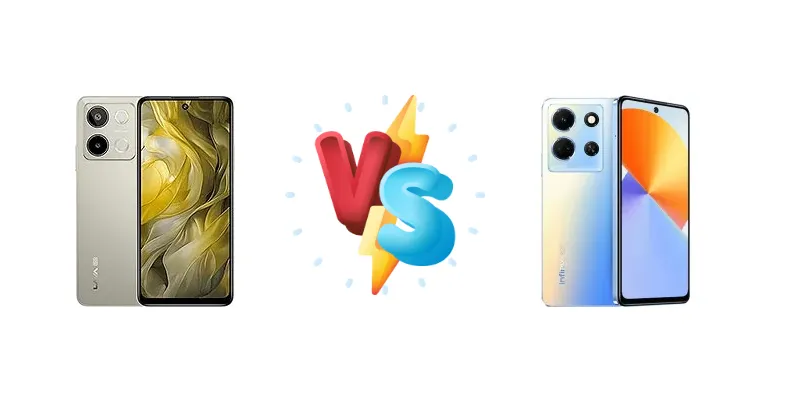
The sub-$200 5G smartphone segment is heating up, and the Lava Blaze 3 5G and Infinix Note 30 5G are two strong contenders. Both leverage Mediatek's Dimensity series to deliver 5G connectivity at an accessible price point, but key differences in charging speed and display quality separate them. This comparison dives deep into the specs to determine which phone offers the best value.
🏆 Quick Verdict
For the average user prioritizing convenience, the Infinix Note 30 5G emerges as the winner. Its significantly faster 45W charging with bypass charging capability, coupled with a brighter display, outweighs the marginal performance differences offered by the Lava Blaze 3 5G's Dimensity 6300.
| Network |
|---|
| 2G bands | GSM 850 / 900 / 1800 / 1900 | GSM 850 / 900 / 1800 / 1900 |
| 3G bands | HSDPA 900 / 2100 | HSDPA 850 / 900 / 1700(AWS) / 1900 / 2100 |
| 4G bands | 1, 3, 5, 8, 28, 40, 41 | 1, 2, 3, 4, 5, 7, 8, 12, 17, 20, 28, 38, 40, 41, 66 |
| 5G bands | 1, 3, 5, 8, 28, 40, 41, 77, 88 SA/NSA | 1, 3, 5, 7, 8, 12, 22, 28, 38, 40, 41, 66, 77, 78 |
| Speed | HSPA, LTE, 5G | HSPA, LTE, 5G |
| Technology | GSM / HSPA / LTE / 5G | GSM / HSPA / LTE / 5G |
| Launch |
|---|
| Announced | 2024, September 16 | 2023, May 22 |
| Status | Available. Released 2024, September 18 | Available. Released 2023, May 22 |
| Body |
|---|
| Build | - | Glass front, plastic frame, glass or leather back |
| Dimensions | 164.3 x 76.2 x 8.6 mm (6.47 x 3.00 x 0.34 in) | 168.5 x 76.5 x 8.5 mm (6.63 x 3.01 x 0.33 in) |
| SIM | Nano-SIM + Nano-SIM | Nano-SIM + Nano-SIM |
| Weight | 201 g (7.09 oz) | 205 g (7.23 oz) |
| Display |
|---|
| Resolution | 720 x 1600 pixels, 20:9 ratio (~267 ppi density) | 1080 x 2460 pixels (~396 ppi density) |
| Size | 6.56 inches, 103.9 cm2 (~83.0% screen-to-body ratio) | 6.78 inches, 109.2 cm2 (~84.7% screen-to-body ratio) |
| Type | IPS LCD, 90Hz | IPS LCD, 120Hz, 580 nits (peak) |
| Platform |
|---|
| CPU | Octa-core (2x2.4 GHz Cortex-A76 & 6x2.0 GHz Cortex-A55) | Octa-core (2x2.4 GHz Cortex-A76 & 6x2.0 GHz Cortex-A55) |
| Chipset | Mediatek Dimensity 6300 (6 nm) | Mediatek Dimensity 6080 (6 nm) |
| GPU | Mali-G57 MC2 | Mali-G57 MC2 |
| OS | Android 14, planned upgrade to Android 15 | Android 13 |
| Memory |
|---|
| Card slot | microSDXC (dedicated slot) | microSDXC (dedicated slot) |
| Internal | 128GB 6GB RAM | 128GB 4GB RAM, 256GB 8GB RAM |
| Main Camera |
|---|
| Dual | 50 MP, (wide), AF
2 MP | - |
| Features | LED flash, HDR, panorama | Quad-LED flash, HDR, panorama |
| Triple | - | 108 MP, f/1.75, 26mm (wide), 1/1.67", 0.64µm, PDAF
Auxiliary lenses |
| Video | 1440p@30fps, 1080p@30fps | 1440p@30fps, 1080p@30/60fps |
| Selfie camera |
|---|
| Features | - | Dual-LED flash, HDR |
| Single | 8 MP, (wide) | 16 MP, f/2.0, (wide) |
| Video | Yes | 1080p@30fps |
| Sound |
|---|
| 35mm jack | Yes | Yes |
| Loudspeaker | Yes, with stereo speakers | Yes, with dual speakers |
| Comms |
|---|
| Bluetooth | 5.2, A2DP, LE | Yes |
| NFC | No | Yes |
| Positioning | GPS, GLONASS | GPS |
| Radio | FM radio | FM radio |
| USB | USB Type-C 2.0, OTG | USB Type-C 2.0, OTG |
| WLAN | Wi-Fi 802.11 b/g/n/ac | Wi-Fi 802.11 a/b/g/n/ac, dual-band, Wi-Fi Direct |
| Features |
|---|
| Sensors | Fingerprint (side-mounted), accelerometer, proximity, compass | Fingerprint (side-mounted), accelerometer, gyro, proximity, compass |
| Battery |
|---|
| Charging | 18W wired | 45W wired, bypass charging |
| Type | Li-Po 5000 mAh | 5000 mAh |
| Misc |
|---|
| Colors | Glass Blue, Glass Gold | Magic Black, Interstellar Blue, Sunset Gold |
| Models | - | X6711 |
| Price | About 120 EUR | - |
Lava Blaze 3 5G
- Potentially slightly better CPU/GPU performance with Dimensity 6300
- Competitive price point
- 5G connectivity
- Slower 18W charging
- Likely lower display brightness
- Limited camera details available
Infinix Note 30 5G
- Faster 45W charging with bypass charging
- Brighter display (607 nits)
- Good value for money
- Potentially slightly lower CPU/GPU performance
- Camera details are limited
- No high refresh rate display
Display Comparison
The Infinix Note 30 5G boasts a clear advantage in display technology, achieving a measured peak brightness of 607 nits. While both phones lack high refresh rate panels, the Note 30’s higher brightness translates to better visibility outdoors. The 1521:1 contrast ratio further enhances image quality. The Lava Blaze 3 5G’s display specifications are currently unavailable, making a direct comparison difficult, but it’s reasonable to assume it falls behind the Note 30 in both brightness and contrast, potentially impacting outdoor usability.
Camera Comparison
Detailed camera specifications are limited for both devices. Without information on sensor size, aperture, or image stabilization (OIS), a definitive camera comparison is challenging. It’s safe to assume both phones will feature a primary camera alongside supporting lenses, potentially including a depth or macro sensor. Given the price point, image processing will likely prioritize computational photography to enhance image quality. The absence of OIS on either device suggests low-light performance may be limited. Focusing on the main sensor's megapixel count is misleading without knowing the sensor size; larger sensors capture more light and produce better images.
Performance
Both the Lava Blaze 3 5G and Infinix Note 30 5G utilize an octa-core CPU configuration with the same core arrangement: 2x2.4 GHz Cortex-A76 and 6x2.0 GHz Cortex-A55. However, the chipset differs – the Lava uses the Mediatek Dimensity 6300 (6nm), while the Infinix employs the Dimensity 6080 (6nm). While both are 6nm chips, the Dimensity 6300 generally offers a slight edge in CPU and GPU performance. However, this difference is unlikely to be noticeable in everyday tasks. The real-world performance gap will likely be minimal, with both phones handling typical Android workloads and moderate gaming adequately. RAM configurations are not specified, but LPDDR4X is a likely candidate for both, limiting memory bandwidth.
Battery Life
The Infinix Note 30 5G’s 45W wired charging is a significant advantage over the Lava Blaze 3 5G’s 18W charging. The Note 30 also features bypass charging, allowing you to use the phone while it’s charging, minimizing heat buildup and extending battery lifespan. While battery capacity isn’t specified for either device, the faster charging speed of the Infinix means less downtime tethered to a wall outlet. A full charge on the Note 30 will likely take under an hour, while the Blaze 3 5G will require considerably longer.
Buying Guide
Buy the Lava Blaze 3 5G if you prioritize a slightly more powerful processor for demanding tasks and are comfortable with slower charging speeds. Buy the Infinix Note 30 5G if you value a brighter, more usable display in sunlight and need the convenience of rapid 45W charging, especially if you frequently find yourself needing to top up your battery quickly. The Infinix is ideal for users who prioritize daily usability over raw benchmark scores.
Frequently Asked Questions
❓ Will the Infinix Note 30 5G get noticeably warmer during extended gaming sessions compared to the Lava Blaze 3 5G?
While both phones use 6nm chipsets, the slightly more powerful Dimensity 6300 in the Lava Blaze 3 5G *could* generate more heat under sustained load. However, the Infinix Note 30 5G’s bypass charging feature allows for continued use while charging, potentially mitigating thermal throttling by shifting heat dissipation to the charger.
❓ Is the 45W charging on the Infinix Note 30 5G compatible with Power Delivery (PD) chargers?
Infinix typically uses its own charging protocols. While some PD chargers *may* work at a reduced wattage, it's best to use the charger included in the box or a charger specifically designed for Infinix devices to ensure optimal charging speed and safety.
❓ How does the Dimensity 6080 in the Infinix Note 30 5G handle popular games like Call of Duty: Mobile and PUBG?
The Dimensity 6080 is capable of running Call of Duty: Mobile and PUBG at medium settings with stable frame rates. Expect some frame drops during intense action, but the experience should be generally playable. Achieving higher frame rates will likely require lowering graphics settings.
❓ Does either phone support expandable storage via microSD card?
This information is not provided in the specifications. However, given the target market and price point, it's highly probable that both the Lava Blaze 3 5G and Infinix Note 30 5G offer microSD card support for expanding storage capacity.