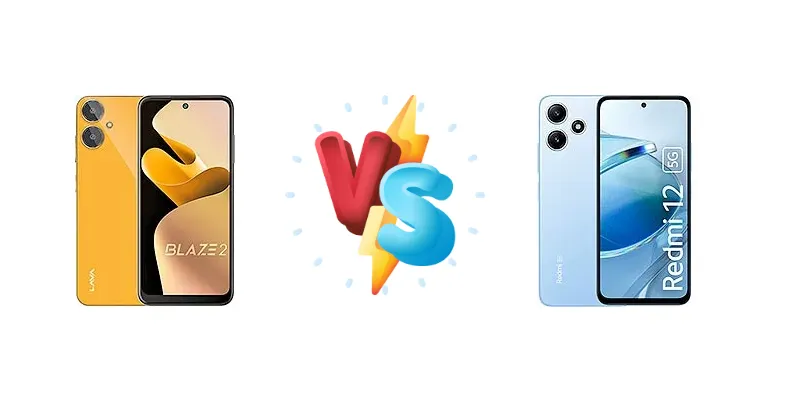
The sub-$150 smartphone market is fiercely competitive, and the Lava Blaze 2 and Xiaomi Redmi 12 5G are two contenders vying for your attention. While both offer 5G connectivity at an accessible price point, they diverge significantly in their core hardware. This comparison will dissect the key differences, focusing on performance, efficiency, and overall user experience to determine which device offers the best value.
🏆 Quick Verdict
For most users, the Xiaomi Redmi 12 5G emerges as the stronger choice. Its Snapdragon 4 Gen 2 chipset, built on a more efficient 4nm process, delivers noticeably better performance and thermal management than the Lava Blaze 2’s Unisoc Tiger T616. While both charge at 18W, the Redmi 12 5G’s support for Power Delivery offers broader compatibility.
| Network |
|---|
| 2G bands | GSM 900 / 1800 | GSM 850 / 900 / 1800 / 1900 |
| 3G bands | HSDPA 900 / 2100 | HSDPA 850 / 900 / 2100 |
| 4G bands | 1, 3, 5, 8, 40, 41 | 1, 3, 5, 8, 40, 41 |
| 5G bands | - | 1, 3, 5, 8, 28, 40, 78 SA/NSA |
| Speed | HSPA, LTE | HSPA, LTE, 5G |
| Technology | GSM / HSPA / LTE | GSM / HSPA / LTE / 5G |
| Launch |
|---|
| Announced | 2023, April 10 | 2023, August 01 |
| Status | Available. Released 2023, April 18 | Available. Released 2023, August 04 |
| Body |
|---|
| Build | - | Glass front (Gorilla Glass), plastic frame, glass back (Gorilla Glass) |
| Dimensions | 165 x 76.1 x 8.6 mm (6.50 x 3.00 x 0.34 in) | 168.6 x 76.3 x 8.2 mm (6.64 x 3.00 x 0.32 in) |
| SIM | Nano-SIM + Nano-SIM | Nano-SIM + Nano-SIM |
| Weight | 203 g (7.16 oz) | 199 g (7.02 oz) |
| Display |
|---|
| Protection | - | Corning Gorilla Glass |
| Resolution | 720 x 1600 pixels, 20:9 ratio (~270 ppi density) | 1080 x 2460 pixels (~396 ppi density) |
| Size | 6.5 inches, 102.0 cm2 (~81.2% screen-to-body ratio) | 6.79 inches, 109.5 cm2 (~85.1% screen-to-body ratio) |
| Type | IPS LCD, 90Hz | IPS LCD, 90Hz, 550 nits |
| Platform |
|---|
| CPU | Octa-core (2x2.0 GHz Cortex-A75 & 6x1.8 GHz Cortex-A55) | Octa-core (2x2.2 GHz Cortex-A78 & 6x1.95 GHz Cortex-A55) |
| Chipset | Unisoc Tiger T616 (12 nm) | Qualcomm SM4450 Snapdragon 4 Gen 2 (4 nm) |
| GPU | Mali-G57 MP1 | Adreno 613 |
| OS | Android 12 | Android 13, upgradable to Android 15, HyperOS 2 |
| Memory |
|---|
| Card slot | microSDXC (dedicated slot) | microSDXC (uses shared SIM slot) |
| Internal | 128GB 6GB RAM | 128GB 4GB RAM, 128GB 6GB RAM, 128GB 8GB RAM, 256GB 8GB RAM |
| | UFS 2.2 | - |
| Main Camera |
|---|
| Dual | 13 MP, (wide), AF
2 MP | 50 MP, f/1.8, (wide), PDAF
Auxiliary lens |
| Features | LED flash | LED flash, HDR |
| Video | 1080p@30fps | 1080p@30fps |
| Selfie camera |
|---|
| Features | - | HDR |
| Single | 8 MP, (wide) | 8 MP, f/2.0, (wide), 1.12µm |
| Video | Yes | 1080p@30fps |
| Sound |
|---|
| 3.5mm jack | Yes | - |
| 35mm jack | Yes | Yes |
| Loudspeaker | Yes | Yes |
| Comms |
|---|
| Bluetooth | 5.0, A2DP, LE | 5.3, A2DP, LE |
| Infrared port | - | Yes |
| NFC | No | Unspecified |
| Positioning | GPS | GPS, GLONASS, GALILEO, BDS |
| Radio | FM radio | No |
| USB | USB Type-C 2.0, OTG | USB Type-C |
| WLAN | Wi-Fi 802.11 b/g/n/ac | Wi-Fi 802.11 a/b/g/n/ac, dual-band |
| Features |
|---|
| Sensors | Fingerprint (side-mounted), accelerometer, proximity | Fingerprint (side-mounted), accelerometer, compass |
| Battery |
|---|
| Charging | 18W wired | 18W wired, PD |
| Type | Li-Po 5000 mAh | Li-Po 5000 mAh |
| Misc |
|---|
| Colors | Glass Blue, Glass Black, Glass Orange | Jade Black, Pastel Blue, Moonstone Silver |
| Models | LZX409 | 23076RN4BI, 23076RN8DY, 2AFZZRN8DY |
| Price | About 100 EUR | € 104.09 / ₹ 15,999 |
| SAR | - | 1.09 W/kg (head) 0.88 W/kg (body) |
| SAR EU | - | 0.98 W/kg (head) 1.00 W/kg (body) |
Lava Blaze 2
- Potentially lower price point (depending on region)
- Established brand presence in India
- Simple and straightforward user experience
- Less powerful Unisoc Tiger T616 chipset
- Less efficient 12nm process
- Likely inferior camera performance
Xiaomi Redmi 12 5G
- More powerful and efficient Snapdragon 4 Gen 2 chipset
- Power Delivery (PD) charging support
- Better long-term performance and software support
- May be slightly more expensive
- Xiaomi’s MIUI software can be polarizing
- Global brand, potentially less localized support
Display Comparison
Neither device boasts a standout display. Both likely utilize LCD panels, a common cost-saving measure in this segment. However, detailed specs like resolution and peak brightness are missing. The Redmi 12 5G’s potential advantage lies in Xiaomi’s typically more refined display calibration. The absence of high refresh rates on both suggests a focus on battery life over visual fluidity.
Camera Comparison
Without detailed camera specs, a direct comparison is difficult. However, it’s safe to assume both phones feature a primary camera and supporting lenses. The Redmi 12 5G likely benefits from Qualcomm’s image signal processor (ISP), which generally offers better image processing capabilities than Unisoc’s offerings. The absence of Optical Image Stabilization (OIS) on either device suggests a reliance on software stabilization, which may struggle in low-light conditions. Expect similar performance in good lighting, but the Redmi 12 5G will likely excel in challenging scenarios.
Performance
The core difference lies in the chipsets. The Xiaomi Redmi 12 5G’s Qualcomm Snapdragon 4 Gen 2 (4nm) is a significant upgrade over the Lava Blaze 2’s Unisoc Tiger T616 (12nm). The 4nm process node translates to superior power efficiency and reduced heat generation, crucial for sustained performance. While both are octa-core CPUs, the Redmi 12 5G utilizes Cortex-A78 cores (2x2.2 GHz) which are architecturally more advanced than the Blaze 2’s Cortex-A75 cores (2x2.0 GHz), resulting in faster single-core performance. This will be noticeable in app launch times and general responsiveness. The Redmi 12 5G is the clear winner for users who multitask or play mobile games.
Battery Life
Both phones feature 18W wired charging, but the Redmi 12 5G adds Power Delivery (PD) support, offering wider charger compatibility. Battery capacity is not specified, but given the price point, both likely house batteries in the 5000mAh range. The Snapdragon 4 Gen 2’s superior efficiency will likely translate to longer battery life on the Redmi 12 5G, even with similar capacity. The 4nm process allows for more efficient power management, extending usage between charges.
Buying Guide
Buy the Lava Blaze 2 if you prioritize a slightly more established brand within India and are primarily focused on basic smartphone tasks like calling, messaging, and light social media use. Buy the Xiaomi Redmi 12 5G if you want a more future-proof device capable of handling demanding apps, occasional gaming, and benefit from the superior efficiency of the Snapdragon 4 Gen 2 chipset, even if it means opting for a globally recognized brand.
Frequently Asked Questions
❓ Will the Redmi 12 5G’s Snapdragon 4 Gen 2 handle demanding games like PUBG Mobile?
While not a gaming powerhouse, the Snapdragon 4 Gen 2 in the Redmi 12 5G is capable of running PUBG Mobile at medium settings with reasonable frame rates. The 4nm process helps prevent excessive throttling during extended gaming sessions, providing a more consistent experience than the Lava Blaze 2.
❓ Does the Lava Blaze 2 support VoLTE on all Indian carriers?
Lava typically ensures broad carrier compatibility within India. However, it’s always recommended to check with your specific carrier to confirm VoLTE support before purchasing, as network configurations can change. The Redmi 12 5G, being a Xiaomi device, also generally offers good carrier compatibility.
❓ Is the 18W charging on either phone considered fast charging in 2024?
18W charging is relatively standard for phones in this price range. It won’t provide exceptionally fast charging speeds – expect around 2-3 hours for a full charge. The Redmi 12 5G’s Power Delivery support offers a slight advantage in charger compatibility, but the charging speed itself remains similar.