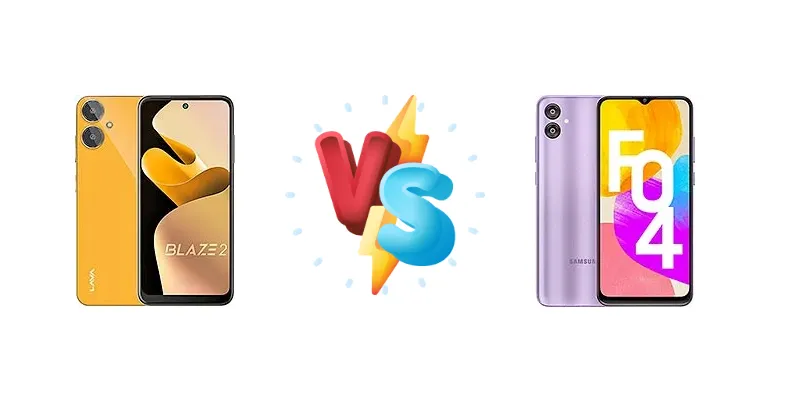
The budget smartphone market is fiercely competitive, offering incredible value for money. Today, we're pitting two contenders against each other: the Lava Blaze 2 and the Samsung Galaxy F04. Both promise affordability, but which one delivers the better overall experience?
🏆 Quick Verdict
The Lava Blaze 2 edges out the Samsung Galaxy F04 thanks to its slightly more powerful chipset and faster charging. While the Samsung offers the reliability of the Samsung brand, the Blaze 2 provides a noticeable performance boost for a similar price, making it the better choice for most users.
| Network |
|---|
| 2G bands | GSM 900 / 1800 | GSM 850 / 900 / 1800 / 1900 |
| 3G bands | HSDPA 900 / 2100 | HSDPA 850 / 900 / 2100 |
| 4G bands | 1, 3, 5, 8, 40, 41 | 1, 3, 5, 7, 8, 20, 28, 38, 40, 41 |
| Speed | HSPA, LTE | HSPA, LTE |
| Technology | GSM / HSPA / LTE | GSM / HSPA / LTE |
| Launch |
|---|
| Announced | 2023, April 10 | 2023, January 04 |
| Status | Available. Released 2023, April 18 | Available. Released 2023, January 12 |
| Body |
|---|
| Build | - | Glass front, plastic back, plastic frame |
| Dimensions | 165 x 76.1 x 8.6 mm (6.50 x 3.00 x 0.34 in) | 164.2 x 75.9 x 9.1 mm (6.46 x 2.99 x 0.36 in) |
| SIM | Nano-SIM + Nano-SIM | Nano-SIM + Nano-SIM |
| Weight | 203 g (7.16 oz) | 188 g (6.63 oz) |
| Display |
|---|
| Resolution | 720 x 1600 pixels, 20:9 ratio (~270 ppi density) | 720 x 1600 pixels, 20:9 ratio (~270 ppi density) |
| Size | 6.5 inches, 102.0 cm2 (~81.2% screen-to-body ratio) | 6.5 inches, 102.0 cm2 (~81.8% screen-to-body ratio) |
| Type | IPS LCD, 90Hz | PLS LCD |
| Platform |
|---|
| CPU | Octa-core (2x2.0 GHz Cortex-A75 & 6x1.8 GHz Cortex-A55) | Octa-core (4x2.35 GHz Cortex-A53 & 4x1.8 GHz Cortex-A53) |
| Chipset | Unisoc Tiger T616 (12 nm) | Mediatek MT6765 Helio P35 (12 nm) |
| GPU | Mali-G57 MP1 | PowerVR GE8320 |
| OS | Android 12 | Android 12, One UI |
| Memory |
|---|
| Card slot | microSDXC (dedicated slot) | microSDXC (dedicated slot) |
| Internal | 128GB 6GB RAM | 64GB 4GB RAM |
| | UFS 2.2 | - |
| Main Camera |
|---|
| Dual | 13 MP, (wide), AF
2 MP | 13 MP, f/2.2, (wide), AF
Auxiliary lens |
| Features | LED flash | LED flash |
| Video | 1080p@30fps | 1080p@30fps |
| Selfie camera |
|---|
| Single | 8 MP, (wide) | 5 MP, f/2.2 |
| Video | Yes | Yes |
| Sound |
|---|
| 3.5mm jack | Yes | Yes |
| 35mm jack | Yes | Yes |
| Loudspeaker | Yes | Yes |
| Comms |
|---|
| Bluetooth | 5.0, A2DP, LE | 5.0, A2DP, LE |
| NFC | No | No |
| Positioning | GPS | GPS, GLONASS, GALILEO, BDS |
| Radio | FM radio | Unspecified |
| USB | USB Type-C 2.0, OTG | USB Type-C 2.0 |
| WLAN | Wi-Fi 802.11 b/g/n/ac | Wi-Fi 802.11 b/g/n, Wi-Fi Direct |
| Features |
|---|
| Sensors | Fingerprint (side-mounted), accelerometer, proximity | Accelerometer, proximity |
| Battery |
|---|
| Charging | 18W wired | 15W wired |
| Type | Li-Po 5000 mAh | Li-Po 5000 mAh |
| Misc |
|---|
| Colors | Glass Blue, Glass Black, Glass Orange | Jade Purple, Opal Green |
| Models | LZX409 | SM-E045F, SM-E045F/DS |
| Price | About 100 EUR | About 90 EUR |
| SAR | - | 0.38 W/kg (head) |
Lava Blaze 2
- More powerful chipset (Unisoc T616)
- Faster 18W charging
- Potentially better camera versatility
- Competitive pricing
- Less established brand reputation
- Software support may be limited
- Display quality is average
Samsung Galaxy F04
- Samsung brand reliability
- Familiar Samsung UI
- Decent camera performance
- Long battery life
- Less powerful chipset (Helio P35)
- Slower 15W charging
- Average display quality
- Can feel underpowered with demanding apps
Display Comparison
Both phones feature similar 6.5-inch HD+ displays, offering adequate viewing for everyday use. Color accuracy and brightness are typical for this price range, with neither phone excelling in this area. The Samsung might have slightly better color calibration due to Samsung's display technology, but the difference is minimal.
Camera Comparison
The Lava Blaze 2 typically features a more versatile camera setup, often including a higher resolution main sensor and potentially additional macro or depth sensors. The Samsung Galaxy F04's camera is generally decent, but may lack the same level of detail and features. Image processing is a key differentiator, and Samsung's software often produces more pleasing results, but the Blaze 2's hardware gives it an edge.
Performance
The Lava Blaze 2's Unisoc Tiger T616 chipset holds a slight advantage over the Samsung Galaxy F04's Helio P35. The T616's Cortex-A75 cores offer better single-core performance, resulting in snappier app launches and smoother multitasking. The Galaxy F04's Helio P35 is adequate for basic tasks but may struggle with more demanding applications.
Battery Life
Both phones pack a substantial 5000mAh battery, promising all-day battery life. However, the Lava Blaze 2's 18W fast charging support provides a significant advantage over the Samsung Galaxy F04's 15W charging. This means you can top up the Blaze 2 much quicker when needed.
Buying Guide
The Lava Blaze 2 is ideal for users who prioritize performance and faster charging within a tight budget. The Samsung Galaxy F04 is a good option for those who value brand recognition and a more streamlined, Samsung-familiar experience, even if it means sacrificing a bit of performance.
Frequently Asked Questions
❓ Which phone has better gaming performance?
The Lava Blaze 2 generally offers better gaming performance due to its more powerful chipset. However, both phones are best suited for casual games rather than demanding titles.
❓ How long does the battery last on each phone?
Both phones offer excellent battery life, typically lasting a full day with moderate usage. The Lava Blaze 2's faster charging allows for quicker top-ups.