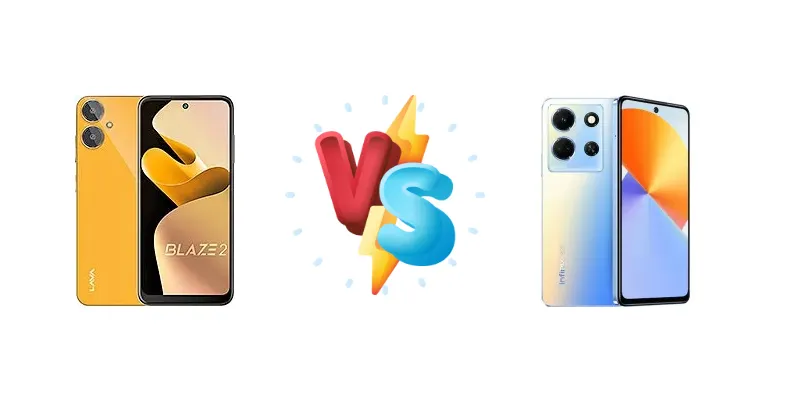
The sub-$200 smartphone market is fiercely competitive. The Lava Blaze 2 and Infinix Note 30 5G both aim to deliver 5G connectivity and essential features at an accessible price point. However, they take different approaches to achieving this, with the Infinix prioritizing performance and charging speed, while the Lava focuses on a more conservative, efficiency-focused design.
🏆 Quick Verdict
For the average user prioritizing responsiveness and future-proofing, the Infinix Note 30 5G is the better choice. Its Mediatek Dimensity 6080 chipset and 45W charging significantly outperform the Lava Blaze 2’s Unisoc T616 and 18W charging, justifying a potential price premium.
| Network |
|---|
| 2G bands | GSM 900 / 1800 | GSM 850 / 900 / 1800 / 1900 |
| 3G bands | HSDPA 900 / 2100 | HSDPA 850 / 900 / 1700(AWS) / 1900 / 2100 |
| 4G bands | 1, 3, 5, 8, 40, 41 | 1, 2, 3, 4, 5, 7, 8, 12, 17, 20, 28, 38, 40, 41, 66 |
| 5G bands | - | 1, 3, 5, 7, 8, 12, 22, 28, 38, 40, 41, 66, 77, 78 |
| Speed | HSPA, LTE | HSPA, LTE, 5G |
| Technology | GSM / HSPA / LTE | GSM / HSPA / LTE / 5G |
| Launch |
|---|
| Announced | 2023, April 10 | 2023, May 22 |
| Status | Available. Released 2023, April 18 | Available. Released 2023, May 22 |
| Body |
|---|
| Build | - | Glass front, plastic frame, glass or leather back |
| Dimensions | 165 x 76.1 x 8.6 mm (6.50 x 3.00 x 0.34 in) | 168.5 x 76.5 x 8.5 mm (6.63 x 3.01 x 0.33 in) |
| SIM | Nano-SIM + Nano-SIM | Nano-SIM + Nano-SIM |
| Weight | 203 g (7.16 oz) | 205 g (7.23 oz) |
| Display |
|---|
| Resolution | 720 x 1600 pixels, 20:9 ratio (~270 ppi density) | 1080 x 2460 pixels (~396 ppi density) |
| Size | 6.5 inches, 102.0 cm2 (~81.2% screen-to-body ratio) | 6.78 inches, 109.2 cm2 (~84.7% screen-to-body ratio) |
| Type | IPS LCD, 90Hz | IPS LCD, 120Hz, 580 nits (peak) |
| Platform |
|---|
| CPU | Octa-core (2x2.0 GHz Cortex-A75 & 6x1.8 GHz Cortex-A55) | Octa-core (2x2.4 GHz Cortex-A76 & 6x2.0 GHz Cortex-A55) |
| Chipset | Unisoc Tiger T616 (12 nm) | Mediatek Dimensity 6080 (6 nm) |
| GPU | Mali-G57 MP1 | Mali-G57 MC2 |
| OS | Android 12 | Android 13 |
| Memory |
|---|
| Card slot | microSDXC (dedicated slot) | microSDXC (dedicated slot) |
| Internal | 128GB 6GB RAM | 128GB 4GB RAM, 256GB 8GB RAM |
| | UFS 2.2 | - |
| Main Camera |
|---|
| Dual | 13 MP, (wide), AF
2 MP | - |
| Features | LED flash | Quad-LED flash, HDR, panorama |
| Triple | - | 108 MP, f/1.75, 26mm (wide), 1/1.67", 0.64µm, PDAF
Auxiliary lenses |
| Video | 1080p@30fps | 1440p@30fps, 1080p@30/60fps |
| Selfie camera |
|---|
| Features | - | Dual-LED flash, HDR |
| Single | 8 MP, (wide) | 16 MP, f/2.0, (wide) |
| Video | Yes | 1080p@30fps |
| Sound |
|---|
| 3.5mm jack | Yes | - |
| 35mm jack | Yes | Yes |
| Loudspeaker | Yes | Yes, with dual speakers |
| Comms |
|---|
| Bluetooth | 5.0, A2DP, LE | Yes |
| NFC | No | Yes |
| Positioning | GPS | GPS |
| Radio | FM radio | FM radio |
| USB | USB Type-C 2.0, OTG | USB Type-C 2.0, OTG |
| WLAN | Wi-Fi 802.11 b/g/n/ac | Wi-Fi 802.11 a/b/g/n/ac, dual-band, Wi-Fi Direct |
| Features |
|---|
| Sensors | Fingerprint (side-mounted), accelerometer, proximity | Fingerprint (side-mounted), accelerometer, gyro, proximity, compass |
| Battery |
|---|
| Charging | 18W wired | 45W wired, bypass charging |
| Type | Li-Po 5000 mAh | 5000 mAh |
| Misc |
|---|
| Colors | Glass Blue, Glass Black, Glass Orange | Magic Black, Interstellar Blue, Sunset Gold |
| Models | LZX409 | X6711 |
| Price | About 100 EUR | - |
Lava Blaze 2
- Potentially better battery life due to less powerful chipset.
- Likely more affordable price point.
- Reliable for basic smartphone tasks.
- Significantly slower charging speed.
- Less powerful processor for demanding apps and games.
- Lower display brightness and contrast.
Infinix Note 30 5G
- Faster and more efficient Mediatek Dimensity 6080 chipset.
- 45W fast charging with bypass charging.
- Brighter and higher contrast display.
- Potentially shorter battery life under heavy load.
- Likely a higher price tag.
- May experience more heat during prolonged gaming.
Display Comparison
The Infinix Note 30 5G boasts a significantly brighter display, reaching a measured 607 nits, compared to an unspecified brightness for the Lava Blaze 2. This higher peak brightness translates to better visibility outdoors under direct sunlight. While both likely utilize LCD panels given the price bracket, the 1521:1 contrast ratio of the Infinix suggests a more vibrant image. Bezels are likely comparable, but the superior brightness and contrast give the Note 30 5G a clear advantage for media consumption.
Camera Comparison
Without detailed camera specifications for either device, a direct comparison is difficult. However, given the market positioning, it’s safe to assume both phones will feature a primary camera and supporting lenses. The Infinix Note 30 5G is likely to benefit from the increased processing power of the Dimensity 6080 for image processing, potentially leading to better dynamic range and noise reduction. The Lava Blaze 2 will likely focus on basic image capture, prioritizing affordability over advanced features. We can expect both to include a 2MP macro lens, which offers limited practical benefit.
Performance
The core difference lies in the chipsets. The Infinix Note 30 5G’s Mediatek Dimensity 6080, fabricated on a 6nm process, offers a substantial performance leap over the Lava Blaze 2’s Unisoc Tiger T616 (12nm). The Dimensity 6080 features more powerful Cortex-A76 cores (2x2.4 GHz) versus the Blaze 2’s Cortex-A75 cores (2x2.0 GHz), resulting in faster CPU performance. The 6nm process also contributes to improved thermal efficiency, meaning the Infinix is less likely to throttle under sustained load. While both phones feature octa-core CPUs, the architectural advantages of the Dimensity 6080 will be noticeable in demanding applications and gaming.
Battery Life
While battery capacity isn't specified for either device, the charging speeds tell a significant story. The Infinix Note 30 5G’s 45W wired charging, including bypass charging (allowing charging while in use), drastically reduces charging times compared to the Lava Blaze 2’s 18W charging. This means the Infinix can top up from 0-100% much faster, offering greater convenience. The more efficient 6nm Dimensity 6080 may also contribute to slightly better battery life during moderate use, but the charging speed is the defining factor here.
Buying Guide
Buy the Lava Blaze 2 if you need a reliable, basic smartphone for everyday tasks like calling, texting, and light social media use, and value long-term battery life over raw speed. Buy the Infinix Note 30 5G if you prefer a smoother user experience, faster app loading times, and the convenience of rapid charging, even if it means slightly reduced battery longevity during intensive use.
Frequently Asked Questions
❓ Does the Mediatek Dimensity 6080 in the Infinix Note 30 5G get noticeably hot during extended gaming sessions?
While the Dimensity 6080 is more efficient than the Unisoc T616, it can still generate heat during prolonged gaming. However, the 6nm process and Infinix’s thermal management should prevent significant throttling, providing a more consistent gaming experience than the Lava Blaze 2.
❓ Is the 18W charging on the Lava Blaze 2 slow enough to be a major inconvenience for daily use?
Yes, 18W charging is considerably slower than the 45W charging on the Infinix Note 30 5G. Expect significantly longer charging times, potentially requiring overnight charging to fully replenish the battery, especially with moderate to heavy usage.
❓ Will the Infinix Note 30 5G support VoWiFi and VoLTE on all carriers?
Support for VoWiFi and VoLTE varies by carrier and region. It's crucial to check with your specific carrier to confirm compatibility before purchasing the Infinix Note 30 5G, as these features are essential for modern network connectivity.
❓ How does the Unisoc Tiger T616 perform with multitasking compared to the Dimensity 6080?
The Dimensity 6080’s more powerful CPU cores and improved memory bandwidth will result in smoother multitasking. The Lava Blaze 2 with the Unisoc T616 may exhibit noticeable lag when switching between multiple apps or running demanding applications simultaneously.