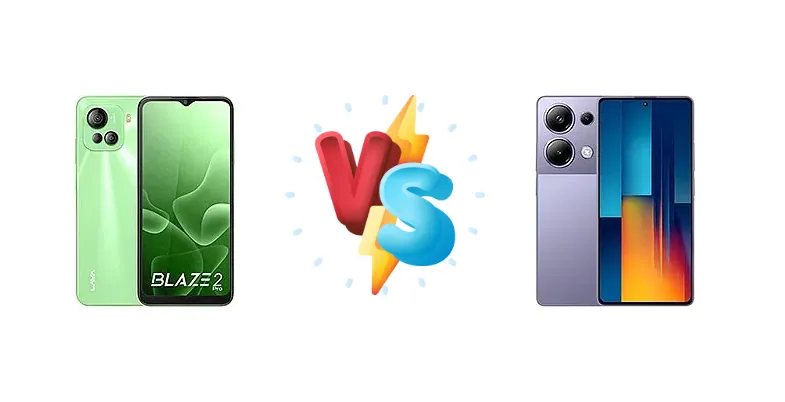
The sub-$200 smartphone market is fiercely competitive. The Lava Blaze 2 Pro aims to deliver a solid all-around experience, while the Xiaomi Poco M6 Pro 4G prioritizes performance and rapid charging. This comparison dissects their key differences to determine which device offers the best value for your money.
🏆 Quick Verdict
For most users, the Xiaomi Poco M6 Pro 4G is the superior choice. Its significantly faster MediaTek Helio G99 Ultra chipset and blazing-fast 67W charging outweigh the Lava Blaze 2 Pro’s more conservative approach. While the Lava offers a respectable experience, the Poco delivers a noticeable performance boost.
| Network |
|---|
| 2G bands | GSM 900 / 1800 | GSM 850 / 900 / 1800 / 1900 |
| 3G bands | HSDPA 900 / 2100 | HSDPA 800 / 850 / 900 / 1700(AWS) / 1900 / 2100 |
| 4G bands | 1, 3, 5, 8, 40, 41 | 1, 2, 3, 4, 5, 7, 8, 12, 13, 17, 18, 19, 20, 26, 28, 38, 40, 41, 66 |
| Speed | HSPA, LTE | HSPA, LTE |
| Technology | GSM / HSPA / LTE | GSM / HSPA / LTE |
| Launch |
|---|
| Announced | 2023, September 11 | 2024, January 11 |
| Status | Available. Released 2023, September 11 | Available. Released 2024, January 12 |
| Body |
|---|
| Build | - | Glass front (Gorilla Glass 5), plastic frame |
| Dimensions | 163 x 75.2 x 8.5 mm (6.42 x 2.96 x 0.33 in) | 161.1 x 75 x 8 mm (6.34 x 2.95 x 0.31 in) |
| SIM | Nano-SIM + Nano-SIM | Nano-SIM + Nano-SIM |
| Weight | 190 g (6.70 oz) | 179 g (6.31 oz) |
| Display |
|---|
| Protection | - | Corning Gorilla Glass 5 |
| Resolution | 720 x 1600 pixels, 20:9 ratio (~270 ppi density) | 1080 x 2400 pixels, 20:9 ratio (~395 ppi density) |
| Size | 6.5 inches, 102.0 cm2 (~83.2% screen-to-body ratio) | 6.67 inches, 107.4 cm2 (~88.9% screen-to-body ratio) |
| Type | IPS LCD, 90Hz | AMOLED, 120Hz, 1000 nits (HBM), 1300 nits (peak) |
| Platform |
|---|
| CPU | Octa-core (2x2.0 GHz Cortex-A75 & 6x1.8 GHz Cortex-A55) | Octa-core (2x2.2 GHz Cortex-A76 & 6x2.0 GHz Cortex-A55) |
| Chipset | Unisoc Tiger T616 (12 nm) | Mediatek Helio G99 Ultra |
| GPU | Mali-G57 MP1 | Mali-G57 MC2 |
| OS | Android 12 | Android 13, MIUI 14, planned upgrade to Android 14, HyperOS |
| Memory |
|---|
| Card slot | microSDXC | microSDXC (uses shared SIM slot) |
| Internal | 128GB 8GB RAM | 256GB 8GB RAM, 512GB 12GB RAM |
| Main Camera |
|---|
| Features | LED flash | LED flash, HDR, panorama |
| Triple | 50 MP, (wide), AF
2 MP
2 MP | 64 MP, f/1.8, 25mm (wide), 1/2.0", 0.7µm, PDAF, OIS
8 MP, f/2.2, (ultrawide)
2 MP (macro) |
| Video | 1080p@30fps | 1080p@30/60fps, gyro-EIS |
| Selfie camera |
|---|
| Single | 8 MP, (wide) | 16 MP, f/2.5, (wide) |
| Video | Yes | 1080p@30/60fps |
| Sound |
|---|
| 35mm jack | Yes | Yes |
| Loudspeaker | Yes | Yes, with dual speakers |
| Comms |
|---|
| Bluetooth | 5.0, A2DP, LE | 5.2, A2DP, LE |
| Infrared port | - | Yes |
| NFC | No | Yes (market/region dependent) |
| Positioning | GPS | GPS, GALILEO, GLONASS, BDS |
| Radio | FM radio | FM radio |
| USB | USB Type-C 2.0, OTG | USB Type-C 2.0, OTG |
| WLAN | Wi-Fi 802.11 b/g/n/ac | Wi-Fi 802.11 a/b/g/n/ac, dual-band |
| Features |
|---|
| Sensors | Fingerprint (side-mounted), accelerometer, proximity | Fingerprint (under display, optical), accelerometer, gyro, compass |
| Battery |
|---|
| Charging | 18W wired | 67W wired, 100% in 44 min |
| Type | Li-Po 5000 mAh | 5000 mAh |
| Misc |
|---|
| Colors | Thunder Black, Swag Blue, Cool Green | Black, Blue, Purple |
| Models | - | 2312FPCA6G |
| Price | About 110 EUR | $ 170.00 |
| SAR | - | 1.09 W/kg (head) 1.09 W/kg (body) |
| SAR EU | - | 0.99 W/kg (head) 0.99 W/kg (body) |
Lava Blaze 2 Pro
- Potentially more affordable price point
- Reliable Unisoc chipset for basic tasks
- Simple and straightforward user experience
- Significantly slower processor than the Poco
- Slow 18W charging
- Likely lower display brightness
Xiaomi Poco M6 Pro 4G
- Powerful MediaTek Helio G99 Ultra processor
- Ultra-fast 67W charging (0-100% in 44 mins)
- Bright 1053 nit display
- Excellent battery life (11:46h active use)
- May be slightly more expensive
- Xiaomi’s MIUI software can be resource-intensive
Display Comparison
The Poco M6 Pro 4G boasts a significantly brighter display, reaching a measured peak of 1053 nits. This translates to superior visibility outdoors under direct sunlight, a clear advantage over the Lava Blaze 2 Pro, whose brightness remains unspecified. While both likely utilize IPS LCD panels (given the price point), the Poco’s higher brightness is a tangible benefit. Bezels are comparable, and without color accuracy data, it’s difficult to assess color performance beyond the brightness difference.
Camera Comparison
Both phones feature a camera setup, but detailed sensor information is limited. The Poco M6 Pro 4G likely benefits from MediaTek’s image signal processor (ISP), which generally offers better image processing capabilities. Without knowing the main sensor resolution or aperture on either device, it’s difficult to make a definitive judgment. However, the Poco’s ISP and potentially larger sensor size (based on brand trends) suggest superior image quality, particularly in low-light conditions. We can assume both phones include standard features like HDR and portrait modes, but the Poco is likely to deliver more refined results.
Performance
The core difference lies in the chipsets. The Poco M6 Pro 4G’s MediaTek Helio G99 Ultra, with its 2x2.2 GHz Cortex-A76 cores, offers a substantial performance uplift compared to the Lava Blaze 2 Pro’s Unisoc Tiger T616 (2x2.0 GHz Cortex-A75). The Helio G99 Ultra’s newer architecture and higher clock speeds will result in faster app loading times, smoother multitasking, and a more responsive gaming experience. While both are octa-core CPUs, the architectural advantage of the Helio G99 Ultra is significant. The Lava's Unisoc T616 is adequate for basic tasks, but will struggle with graphically intensive games.
Battery Life
The Poco M6 Pro 4G shines in the battery and charging department. While the Lava Blaze 2 Pro offers 18W wired charging, the Poco boasts a remarkable 67W wired charging, achieving a full charge in just 44 minutes. The Poco also has a reported active use score of 11:46h, indicating excellent battery life. While the Lava’s battery capacity is unknown, the Poco’s faster charging and proven endurance make it the clear winner for users who prioritize minimizing downtime.
Buying Guide
Buy the Lava Blaze 2 Pro if you prioritize a balanced, reliable experience and aren't heavily reliant on demanding applications or gaming. It's a good fit for everyday tasks and users who value simplicity. Buy the Xiaomi Poco M6 Pro 4G if you want a phone that can handle gaming, multitasking, and quick top-ups thanks to its powerful processor and 67W fast charging – ideal for power users and those on the go.
Frequently Asked Questions
❓ Is the Helio G99 Ultra in the Poco M6 Pro 4G capable of running demanding games like Genshin Impact?
Yes, the Helio G99 Ultra is a capable gaming chipset. While it won't deliver flagship-level performance, it can run Genshin Impact at medium settings with playable frame rates. Expect some frame drops during intense scenes, but the overall experience should be enjoyable.
❓ How does the 67W charging on the Poco M6 Pro 4G compare to standard 33W charging?
67W charging is significantly faster than 33W charging. The Poco M6 Pro 4G can charge from 0-100% in just 44 minutes, while a 33W charger would typically take over an hour and a half. This difference is particularly noticeable for users who frequently need to top up their battery quickly.
❓ Does the Lava Blaze 2 Pro support VoLTE and VoWiFi for improved call quality?
While not explicitly stated, Lava phones generally support VoLTE (Voice over LTE) and VoWiFi (Voice over Wi-Fi) in regions where these technologies are available. However, compatibility depends on your carrier, so it's best to check with your provider to confirm support.
❓ What type of storage does the Poco M6 Pro 4G use – UFS 2.2 or UFS 3.1?
The Poco M6 Pro 4G utilizes UFS 2.2 storage. While not as fast as UFS 3.1, UFS 2.2 still provides respectable read and write speeds, resulting in quick app loading times and file transfers. It's a common storage standard for phones in this price range.