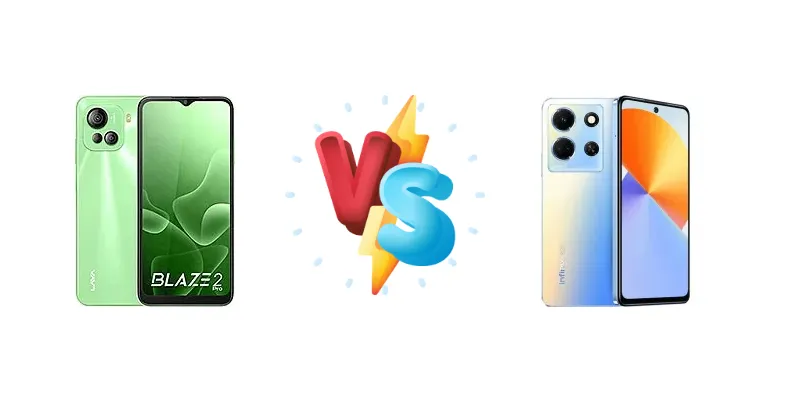
The sub-$200 5G smartphone segment is heating up. The Lava Blaze 2 Pro and Infinix Note 30 5G represent compelling options, but cater to slightly different priorities. The Blaze 2 Pro focuses on a streamlined experience, while the Note 30 5G aims for a more feature-rich package. This comparison dissects their key differences to determine which device offers the best value.
🏆 Quick Verdict
For the average user prioritizing performance and faster charging, the Infinix Note 30 5G is the clear winner. Its Mediatek Dimensity 6080 chipset, built on a 6nm process, provides a noticeable performance uplift over the Lava Blaze 2 Pro’s Unisoc Tiger T616, and the 45W charging significantly reduces downtime. However, the Blaze 2 Pro remains a viable option for those on a tighter budget.
| Network |
|---|
| 2G bands | GSM 900 / 1800 | GSM 850 / 900 / 1800 / 1900 |
| 3G bands | HSDPA 900 / 2100 | HSDPA 850 / 900 / 1700(AWS) / 1900 / 2100 |
| 4G bands | 1, 3, 5, 8, 40, 41 | 1, 2, 3, 4, 5, 7, 8, 12, 17, 20, 28, 38, 40, 41, 66 |
| 5G bands | - | 1, 3, 5, 7, 8, 12, 22, 28, 38, 40, 41, 66, 77, 78 |
| Speed | HSPA, LTE | HSPA, LTE, 5G |
| Technology | GSM / HSPA / LTE | GSM / HSPA / LTE / 5G |
| Launch |
|---|
| Announced | 2023, September 11 | 2023, May 22 |
| Status | Available. Released 2023, September 11 | Available. Released 2023, May 22 |
| Body |
|---|
| Build | - | Glass front, plastic frame, glass or leather back |
| Dimensions | 163 x 75.2 x 8.5 mm (6.42 x 2.96 x 0.33 in) | 168.5 x 76.5 x 8.5 mm (6.63 x 3.01 x 0.33 in) |
| SIM | Nano-SIM + Nano-SIM | Nano-SIM + Nano-SIM |
| Weight | 190 g (6.70 oz) | 205 g (7.23 oz) |
| Display |
|---|
| Resolution | 720 x 1600 pixels, 20:9 ratio (~270 ppi density) | 1080 x 2460 pixels (~396 ppi density) |
| Size | 6.5 inches, 102.0 cm2 (~83.2% screen-to-body ratio) | 6.78 inches, 109.2 cm2 (~84.7% screen-to-body ratio) |
| Type | IPS LCD, 90Hz | IPS LCD, 120Hz, 580 nits (peak) |
| Platform |
|---|
| CPU | Octa-core (2x2.0 GHz Cortex-A75 & 6x1.8 GHz Cortex-A55) | Octa-core (2x2.4 GHz Cortex-A76 & 6x2.0 GHz Cortex-A55) |
| Chipset | Unisoc Tiger T616 (12 nm) | Mediatek Dimensity 6080 (6 nm) |
| GPU | Mali-G57 MP1 | Mali-G57 MC2 |
| OS | Android 12 | Android 13 |
| Memory |
|---|
| Card slot | microSDXC | microSDXC (dedicated slot) |
| Internal | 128GB 8GB RAM | 128GB 4GB RAM, 256GB 8GB RAM |
| Main Camera |
|---|
| Features | LED flash | Quad-LED flash, HDR, panorama |
| Triple | 50 MP, (wide), AF
2 MP
2 MP | 108 MP, f/1.75, 26mm (wide), 1/1.67", 0.64µm, PDAF
Auxiliary lenses |
| Video | 1080p@30fps | 1440p@30fps, 1080p@30/60fps |
| Selfie camera |
|---|
| Features | - | Dual-LED flash, HDR |
| Single | 8 MP, (wide) | 16 MP, f/2.0, (wide) |
| Video | Yes | 1080p@30fps |
| Sound |
|---|
| 35mm jack | Yes | Yes |
| Loudspeaker | Yes | Yes, with dual speakers |
| Comms |
|---|
| Bluetooth | 5.0, A2DP, LE | Yes |
| NFC | No | Yes |
| Positioning | GPS | GPS |
| Radio | FM radio | FM radio |
| USB | USB Type-C 2.0, OTG | USB Type-C 2.0, OTG |
| WLAN | Wi-Fi 802.11 b/g/n/ac | Wi-Fi 802.11 a/b/g/n/ac, dual-band, Wi-Fi Direct |
| Features |
|---|
| Sensors | Fingerprint (side-mounted), accelerometer, proximity | Fingerprint (side-mounted), accelerometer, gyro, proximity, compass |
| Battery |
|---|
| Charging | 18W wired | 45W wired, bypass charging |
| Type | Li-Po 5000 mAh | 5000 mAh |
| Misc |
|---|
| Colors | Thunder Black, Swag Blue, Cool Green | Magic Black, Interstellar Blue, Sunset Gold |
| Models | - | X6711 |
| Price | About 110 EUR | - |
Lava Blaze 2 Pro
- Lower price point makes it accessible.
- Functional and reliable for basic tasks.
- Acceptable 5G connectivity.
- Slower processor and less efficient chipset.
- Significantly slower charging speed.
- Likely inferior display quality.
Infinix Note 30 5G
- Faster and more efficient Dimensity 6080 chipset.
- 45W fast charging with bypass charging.
- Brighter and higher contrast display.
- Higher price compared to the Lava Blaze 2 Pro.
- May still lack features found in higher-end devices.
- Software experience may vary.
Display Comparison
The Infinix Note 30 5G boasts a brighter display, achieving a measured peak brightness of 607 nits, compared to an unspecified brightness for the Lava Blaze 2 Pro. This translates to better visibility outdoors. While both likely utilize IPS LCD panels (given the price point), the Note 30 5G’s 1521:1 contrast ratio suggests a more vibrant image. The absence of high refresh rate support on either device is typical for this segment, but the Note 30 5G’s superior brightness is a tangible advantage for media consumption.
Camera Comparison
Without detailed camera specs for either device, a direct comparison is difficult. However, given the price bracket, it’s safe to assume both rely on primary sensors around the 50MP mark. The Infinix Note 30 5G likely benefits from Mediatek’s image signal processor (ISP) within the Dimensity 6080, potentially offering better image processing and noise reduction. The prevalence of 2MP macro lenses on both devices suggests limited utility; focusing on the quality of the main sensor and its accompanying software algorithms is more crucial.
Performance
The core difference lies in the chipsets. The Infinix Note 30 5G’s Mediatek Dimensity 6080 (6nm) is a significant step up from the Lava Blaze 2 Pro’s Unisoc Tiger T616 (12nm). The Dimensity 6080 features newer Cortex-A76 cores clocked at 2.4 GHz, versus the Blaze 2 Pro’s Cortex-A75 cores at 2.0 GHz. This architectural advantage, coupled with the more efficient 6nm fabrication process, results in faster processing speeds and improved power efficiency. While both are octa-core CPUs, the Note 30 5G will handle demanding apps and multitasking with greater ease. The 6nm process also implies better thermal management, reducing the likelihood of performance throttling during extended use.
Battery Life
The charging speeds are a major differentiator. The Infinix Note 30 5G’s 45W wired charging with bypass charging is a game-changer, allowing for significantly faster top-ups. Bypass charging enables charging the battery directly, bypassing heat generation, which is beneficial for battery health. The Lava Blaze 2 Pro’s 18W charging is comparatively slow. While battery capacity isn’t specified for either, the faster charging of the Note 30 5G mitigates the impact of a potentially smaller battery, offering more convenient power management.
Buying Guide
Buy the Lava Blaze 2 Pro if you need a functional, reliable 5G smartphone with acceptable performance for everyday tasks and prioritize a lower upfront cost. Buy the Infinix Note 30 5G if you prefer a smoother user experience, faster app loading times, and significantly quicker charging speeds, even if it means spending a bit more.
Frequently Asked Questions
❓ Does the Mediatek Dimensity 6080 in the Infinix Note 30 5G get hot during prolonged gaming sessions?
The Dimensity 6080’s 6nm fabrication process is more efficient than the 12nm process used in the Lava Blaze 2 Pro’s Unisoc Tiger T616. This generally translates to lower heat generation. While some warming is expected during intensive gaming, the Note 30 5G is less likely to experience significant thermal throttling compared to the Blaze 2 Pro.
❓ Is the 18W charging on the Lava Blaze 2 Pro sufficient for daily use, or will I be constantly tethered to a charger?
18W charging is relatively slow by today’s standards. While it will charge the device overnight, you’ll likely find yourself needing to top it up during the day with moderate to heavy usage. The Infinix Note 30 5G’s 45W charging offers a much more convenient charging experience.
❓ How does the software experience differ between the Lava Blaze 2 Pro and the Infinix Note 30 5G?
Lava typically offers a near-stock Android experience with minimal bloatware, focusing on simplicity. Infinix, on the other hand, utilizes its XOS skin, which includes various customization options and pre-installed apps. XOS can be feature-rich but may also introduce some bloatware and a slightly less fluid experience compared to stock Android.
❓ Will the Infinix Note 30 5G support 90fps gameplay in popular titles like PUBG Mobile or Call of Duty Mobile?
While the Dimensity 6080 is capable, achieving consistently high frame rates (90fps) in demanding games like PUBG Mobile or Call of Duty Mobile will depend on the game’s optimization and the graphics settings used. Expect to likely play at 60fps with balanced or high graphics settings for a smoother, more stable experience.