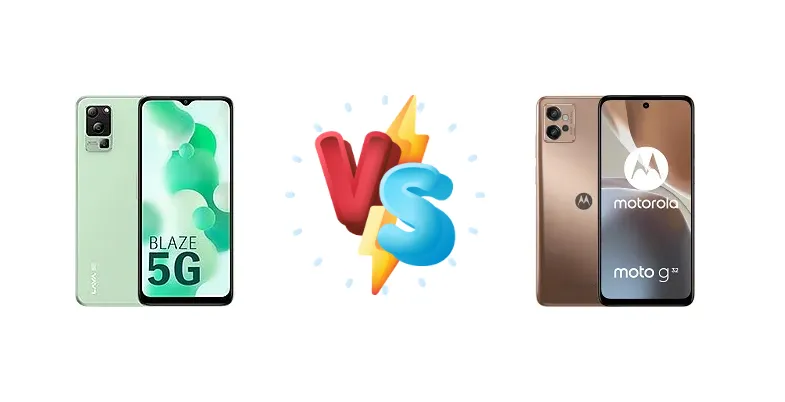
The Lava Blaze 1X and Motorola Moto G32 represent compelling options in the crowded budget 4G smartphone market. While both aim to deliver essential smartphone functionality at an accessible price point, they diverge significantly in their core hardware choices – specifically, their chipsets and charging capabilities. This comparison dissects these differences to determine which device offers the best value for your money.
🏆 Quick Verdict
For the average user prioritizing faster charging and potentially smoother multitasking, the Motorola Moto G32 emerges as the better choice. Its Snapdragon 680, built on a more efficient 6nm process, coupled with 30W charging, provides a tangible advantage over the Lava Blaze 1X’s Dimensity 700 and 15W charging.
| Network |
|---|
| 2G bands | GSM 900 / 1800 | GSM 850 / 900 / 1800 / 1900 |
| 3G bands | HSDPA 900 / 2100 | HSDPA 850 / 900 / 1900 / 2100 |
| 4G bands | 1, 3, 5, 8, 40, 41 | 1, 3, 5, 7, 8, 20, 28, 38, 40, 41 |
| 5G bands | 1, 3, 5, 8, 28, 41, 41, 77, 78 SA/NSA/Sub6 | - |
| Speed | HSPA, LTE, 5G | HSPA, LTE |
| Technology | GSM / HSPA / LTE / 5G | GSM / HSPA / LTE |
| Launch |
|---|
| Announced | 2023, April 27 | 2022, July 28 |
| Status | Available. Released 2023, June 14 | Available. Released 2022, August 16 |
| Body |
|---|
| Build | - | Glass front, plastic frame, plastic back |
| Dimensions | 165.3 x 76.4 x 8.9 mm (6.51 x 3.01 x 0.35 in) | 161.8 x 73.8 x 8.5 mm (6.37 x 2.91 x 0.33 in) |
| SIM | Nano-SIM + Nano-SIM | · Nano-SIM· Nano-SIM + Nano-SIM |
| Weight | 207 g (7.30 oz) | 184 g (6.49 oz) |
| | - | Water-repellent design |
| Display |
|---|
| Resolution | 720 x 1600 pixels, 20:9 ratio (~270 ppi density) | 1080 x 2400 pixels, 20:9 ratio (~405 ppi density) |
| Size | 6.5 inches, 102.0 cm2 (~80.8% screen-to-body ratio) | 6.5 inches, 102.0 cm2 (~85.4% screen-to-body ratio) |
| Type | IPS LCD, 90Hz | IPS LCD, 90Hz |
| Platform |
|---|
| CPU | Octa-core (2x2.2 GHz Cortex-A76 & 6x2.0 GHz Cortex-A55) | Octa-core (4x2.4 GHz Kryo 265 Gold & 4x1.9 GHz Kryo 265 Silver) |
| Chipset | Mediatek Dimensity 700 (7 nm) | Qualcomm SM6225 Snapdragon 680 4G (6 nm) |
| GPU | Mali-G57 MC2 | Adreno 610 |
| OS | Android 12 | Android 12, upgradable to Android 13 |
| Memory |
|---|
| Card slot | microSDXC (uses shared SIM slot) | microSDXC (dedicated slot) |
| Internal | 128GB 6GB RAM | 64GB 4GB RAM, 128GB 4GB RAM, 128GB 6GB RAM, 128GB 8GB RAM, 256GB 8GB RAM |
| | UFS 2.2 | - |
| Main Camera |
|---|
| Features | LED flash, HDR, panorama | LED flash, HDR, panorama |
| Triple | 50 MP, (wide), AF
2 MP
0.3 MP | 50 MP, f/1.8 (wide), 1/2.76", 0.64µm, PDAF
8 MP, f/2.2, 118˚ (ultrawide), 1/4.0", 1.12µm
2 MP, f/2.4, (macro/depth) |
| Video | 1440p@30fps, 1080p@30fps | 1080p@30fps |
| Selfie camera |
|---|
| Single | 8 MP, (wide) | 16 MP, f/2.4, (wide), 1.0µm |
| Video | Yes | 1080p@30fps |
| Sound |
|---|
| 3.5mm jack | Yes | Yes |
| 35mm jack | Yes | Yes |
| Loudspeaker | Yes | Yes, with stereo speakers |
| Comms |
|---|
| Bluetooth | 5.1, A2DP, LE | 5.2, A2DP, LE |
| NFC | No | Yes (market/region dependent) |
| Positioning | GPS | GPS, GLONASS, GALILEO |
| Radio | FM radio | FM radio |
| USB | USB Type-C 2.0, OTG | USB Type-C 2.0 |
| WLAN | Wi-Fi 802.11 b/g/n/ac | Wi-Fi 802.11 a/b/g/n/ac, dual-band, Wi-Fi Direct |
| Features |
|---|
| Sensors | Fingerprint (side-mounted), accelerometer, gyro, proximity, compass | Fingerprint (side-mounted), accelerometer, gyro, proximity, compass |
| Battery |
|---|
| Charging | 15W wired | 30W wired |
| Type | Li-Po 5000 mAh | Li-Po 5000 mAh |
| Misc |
|---|
| Colors | Glass Blue, Glass Green | Mineral Grey, Satin Silver, Rose Gold |
| Models | - | XT2235-2, XT2235-3 |
| Price | - | ₹ 8,990 |
Lava Blaze 1X
- Potentially higher peak CPU performance due to Cortex-A76 cores.
- May offer a slightly lower price point.
- Dimensity 700 is a proven chipset with good 4G connectivity.
- Less power-efficient 7nm process.
- Slower 15W charging.
- Potential for more thermal throttling under sustained load.
Motorola Moto G32
- More power-efficient 6nm Snapdragon 680.
- Faster 30W charging.
- Potentially smoother multitasking and app responsiveness.
- Slightly lower peak CPU core clock speeds.
- May be marginally more expensive.
- Snapdragon 680 is less known for gaming performance.
Display Comparison
Neither device boasts a standout display. Given the context data focuses on processing power, we can infer both likely utilize standard LCD panels common in this price bracket. The absence of information regarding refresh rates suggests both are likely capped at 60Hz. Bezels are expected to be noticeable on both, and color accuracy will likely be tuned for vibrancy rather than strict color science. The display is unlikely to be a deciding factor for most buyers.
Camera Comparison
Without detailed camera specifications, a direct comparison is difficult. However, the market segment suggests both phones will rely on primary sensors for most image capture. The absence of OIS on either device indicates reliance on software stabilization. The 6nm process of the Snapdragon 680 *could* allow for slightly more sophisticated image signal processing (ISP) capabilities, potentially resulting in better low-light performance and dynamic range. The inclusion of a 2MP macro lens on either device is largely a marketing tactic and unlikely to deliver significant photographic value.
Performance
The core difference lies in the chipsets. The Lava Blaze 1X’s MediaTek Dimensity 700 (7nm) features a CPU with two high-performance Cortex-A76 cores clocked at 2.2 GHz, paired with six efficiency cores. The Motorola Moto G32 counters with the Qualcomm Snapdragon 680 (6nm), utilizing four Kryo 265 Gold cores at 2.4 GHz and four Kryo 265 Silver cores. While the Dimensity 700’s A76 cores offer higher peak performance, the Snapdragon 680’s 6nm fabrication process provides superior power efficiency. This translates to potentially less thermal throttling during sustained loads and better battery life. The Snapdragon 680’s architecture is also optimized for everyday tasks, potentially offering a smoother experience in common apps. The lack of LPDDR5/LPDDR5x specification suggests both likely use LPDDR4x RAM, limiting memory bandwidth.
Battery Life
The battery capacity is not specified, but the charging wattage is a key differentiator. The Motorola Moto G32’s 30W wired charging is a significant advantage over the Lava Blaze 1X’s 15W charging. This means the Moto G32 will replenish its battery much faster, reducing downtime. Even if the Blaze 1X has a slightly larger battery capacity, the faster charging of the Moto G32 will likely result in a more convenient user experience. The 6nm process of the Snapdragon 680 also contributes to better power efficiency, potentially extending battery life during typical usage.
Buying Guide
Buy the Lava Blaze 1X if you prioritize a slightly more powerful CPU core configuration for occasional demanding tasks and are comfortable with slower charging speeds. Buy the Motorola Moto G32 if you value a more efficient chipset for sustained performance, faster charging to minimize downtime, and a potentially smoother overall user experience, even if peak CPU performance is marginally lower.
Frequently Asked Questions
❓ Will the Snapdragon 680 in the Moto G32 struggle with graphically intensive games like PUBG Mobile?
While the Snapdragon 680 isn't a gaming powerhouse, it's capable of running PUBG Mobile at medium settings with reasonable frame rates. The 6nm process helps maintain thermal control during gaming sessions, preventing significant performance drops. However, users seeking a consistently smooth high-frame-rate experience should consider a device with a dedicated gaming chipset.
❓ How much faster is the 30W charging on the Moto G32 compared to the 15W charging on the Lava Blaze 1X?
The 30W charging on the Moto G32 will significantly reduce charging times. While exact 0-100% times depend on battery capacity, expect the Moto G32 to charge roughly twice as fast as the Lava Blaze 1X. This means less time tethered to a charger and more time using your phone.
❓ Does the Dimensity 700 in the Lava Blaze 1X offer a noticeable advantage for multitasking compared to the Snapdragon 680?
The Dimensity 700's Cortex-A76 cores provide a higher peak performance ceiling, which *could* translate to slightly faster app switching in some scenarios. However, the Snapdragon 680's efficiency and optimized architecture often result in a smoother overall multitasking experience, especially with multiple apps open simultaneously.